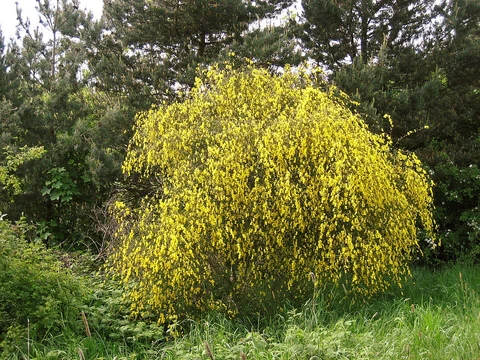
Gossypium arboreum
Tree cotton, native to India and Sri Lanka, used for ancient textiles.

Gossypium arboreum, known as tree cotton, is a shrub native to India and Sri Lanka. Evidence shows it was grown as far back as the Indus Valley Civilisation to make cotton cloth. The plant was catalogued in Linnaeus's *Species Plantarum* in 1753, and the same specimen he used—now housed in the Linnean Herbarium at the Swedish Museum of Natural History—serves as the holotype.
This shrub typically reaches one to two meters tall. Its purple branches are finely hairy. At the base of each leaf are stipules, which are linear to lance-shaped and sometimes sickle-like. Leaves attach via a petiole 1.5 to 10 cm long. The leaf blades are ovate to round, with five to seven lobes that give them a maple-like look; the lobes are linear to lance-shaped and often have a small tooth in the sinus. Glands line the midrib or occasionally nearby veins. Young leaves have both star-shaped and simple hairs, but these are lost as the leaf ages.
Flowers grow on short stalks. An epicalyx—a ring of bracts resembling sepals—surrounds the flower; its large, ovate segments are toothed along the edges, sometimes only faintly, and are heart-shaped at the base with pointed tips. The true calyx is small, about 5 mm long, cup-shaped, with five subtle teeth. The corolla is pale yellow, sometimes with a purple center, or occasionally entirely purple, and measures 3 to 4 cm long. The staminal tube, bearing the anthers, is 1.5 to 2 cm long. The fruit is a three- or four-chambered capsule, 1.5 to 2.5 cm across, ovoid or oblong, hairless, with a pitted surface and a beak at the tip. Inside, the seeds are round and wrapped in long white cotton.
A variant called "phuti karpas" was used to produce Dhaka muslin in Bengal (now Bangladesh). This type could only be grown south of Dhaka, along the Meghna River. Its fibers could be spun into threads that kept their strength at counts higher than any other cotton variant.
Quick Facts
- Genus
- Gossypium
- Species
- arboreum
Facts from the source article.
Lore & Background
Gossypium arboreum is a shrub growing to about one to two meters tall, with purple branches covered in fine hairs. Its leaves are ovate to orbicular with five to seven lobes, resembling a maple leaf, and are attached by a petiole 1.5 to 10 cm long. The flowers are pale yellow, sometimes with a purple centre, and the fruit is a three- or four-celled capsule containing globular seeds covered in long white cotton. The holotype was supplied by Linnaeus and is now in the Linnean Herbarium in the Swedish Museum of Natural History.
Reader's Guide
Gossypium arboreum holds historical importance as one of the earliest cultivated cottons, with evidence of its use during the Indus Valley Civilisation for textile production. Its inclusion in Linnaeus's Species Plantarum in 1753 formalized its botanical classification. A notable variant, 'phuti karpas', was used to make Dhaka muslin in Bengal, now Bangladesh, and could only be grown in a specific area south of Dhaka along the Meghna River. This variant could be spun into threads with tensile strength at counts higher than any other cotton variant, highlighting its unique agricultural and economic value. The species remains a key reference in the history of cotton cultivation and textile innovation.
Did You Know?
- Tree cotton is native to India and Sri Lanka.
- Its cultivation dates back to the Indus Valley Civilisation.
- The holotype was supplied by Linnaeus and is in the Linnean Herbarium.
Frequently Asked Questions
What is Gossypium arboreum?
Tree cotton is a small shrub that is native to the Indian subcontinent and Sri Lanka. It stands roughly one to two meters tall and is distinguished by its finely hairy, purple-stemmed branches.
What does Gossypium arboreum look like in bloom?
Its flowers are typically pale yellow, though they can carry a purple centre or, on occasion, be entirely purple. The fruit that follows is a capsule divided into three or four cells.
How old is the history of Gossypium arboreum?
Archaeological evidence indicates the plant was cultivated during the Indus Valley Civilisation, making it one of the earliest known sources of cotton fibre for weaving cloth.
When and where was Gossypium arboreum first formally described?
Carl Linnaeus included the species in his 1753 work *Species Plantarum*. The very specimen he examined is preserved today as the holotype in the Linnean Herbarium at the Swedish Museum of Natural History.
What makes Gossypium arboreum different from other cotton species?
Unlike many cultivated cottons, tree cotton is a woody shrub rather than an annual herb, and it is restricted to the wild in India and Sri Lanka. Its purple branches and small stature set it visually apart from the taller, green-stemmed varieties grown commercially.
More in Trees & Shrubs 1-24
Spotted an error? Know more?
Reader corrections go straight into our review queue. Suggest an edit · How this site is sourced