Union Pacific Big Boy
Last updated

Association of American Railroads (railroad trade association)/photo by Union Pa · Public domain
Twenty-five Big Boys were manufactured by the American Locomotive Company, with the first delivered in 1941.[1][2] The combined weight of the Big Boy's 772,250 lb engine and 436,500 lb tender was greater than that of a Boeing 747, making it the heaviest reciprocating steam locomotive ever built.[3]
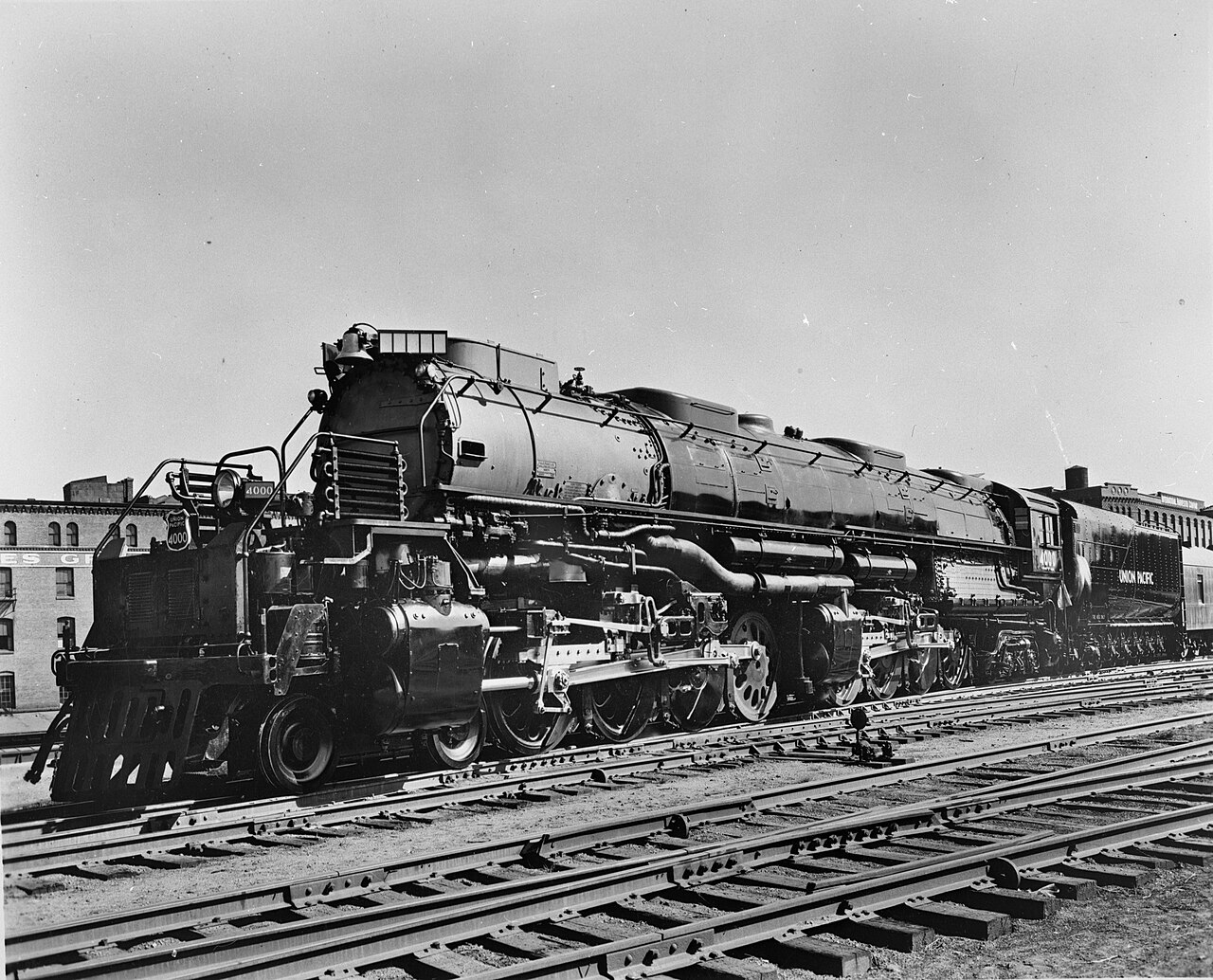
How it changed
Union Pacific introduced the Challenger-type locomotives in 1936 but found that hauling a 3,600-ton freight train over the Wasatch Range required double heading and helper operations, slowing service.[4] The railroad decided to design a new locomotive that could handle the run alone, faster and more powerful than earlier compound locomotives.[4] A Union Pacific design team led by Otto Jabelmann worked with ALCO to enlarge the Challenger firebox, increase boiler pressure to 300 psi, and add four driving wheels.[5] Locomotive historian Tom Morrison wrote that the Challenger was "comprehensively redesigned from first principles"[6]
The new design did away with compounding, booster, and feed water heaters.[6] The Big Boys were articulated locomotives, similar to Mallets, but they did not use compounding.[7] In freight service, they typically ran at speeds well under 60 mph.[7] During 1943 tests, the maximum drawbar pull measured was 138,200 lbf, and peak drawbar horsepower occurred at about 41 mph.[8]
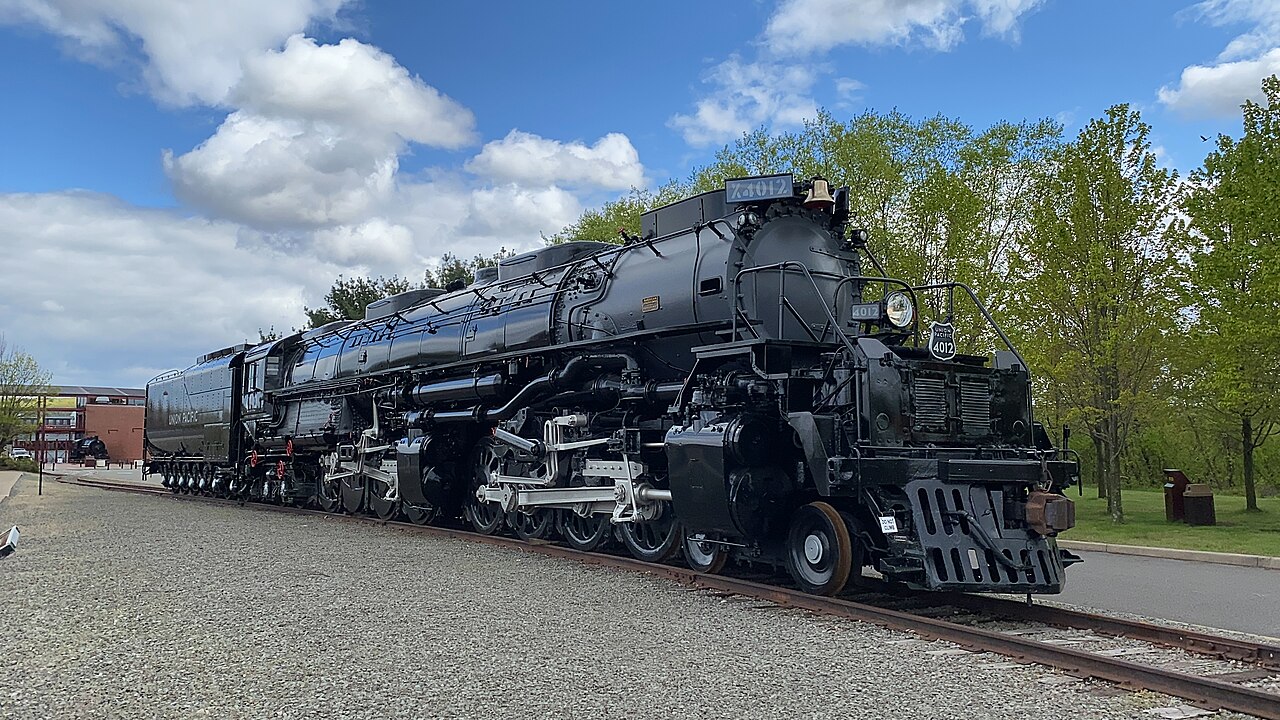
What the maker and period sources say
A 1941 Railway Age article documented the debut of UP's "Big Boy" and noted the locomotive was designed to travel smoothly and safely at 80 mph.[5] The Union Pacific website states that twenty-five Big Boys were commissioned exclusively for the railroad, with the first delivered in 1941.[1] The Union Pacific website lists the tender type as 14-wheeled with a water capacity of 25,000 gallons and fuel capacity of 56,000 lbs of coal.[1] A 1943 test using a dynamometer car borrowed from AT&SF found that a Big Boy could consume 11 tons of coal and 12,000 US gallons of water per hour at full throttle.[9]
The tests demonstrated that a Big Boy could handle 4,200 tons up a 1.14% grade, exceeding the design target of 3,600 tons.[9]
References
- "Big Boy No. 4014", Union Pacific. facts only, no text reused. up.com
- Wikipedia, "Union Pacific Big Boy" (CC BY-SA 4.0), which cites: Glischinski, "Big Boy story began in 1940", Trains, August 21, 2013; Solomon 2009, p. 70; Wrinn, "Big Boy On the Road to Restoration", Trains, 2014, p. 3-98; Wilson 2020, p. 8-11; Wrinn, "Big Boy On the Road to Restoration", Trains, 2014, p. 3-98; Wrinn, "Big Boy On the Road to Restoration", Trains, 2014, p. 3-98; Wilson 2020, p. 8-11 (original not read by us) en.wikipedia.org
- Wikipedia, "Union Pacific Big Boy" (CC BY-SA 4.0), which cites: Gruver, "Refurbished 'Big Boy' locomotive weighs more than a fully loaded Boeing 747", USA Today, May 8, 2019; Gruver, "Refurbished 'Big Boy' locomotive weighs more than a fully loaded Boeing 747", USA Today, May 8, 2019; King, "Big Boy versus Allegheny", Trains, February 15, 2018; Solomon, "Union Pacific Railroad", Voyageur Press, 2000, p. 104 (original not read by us) en.wikipedia.org
- Wikipedia, "Union Pacific Big Boy" (CC BY-SA 4.0), which cites: "Challenger No. 3985", Union Pacific; Solomon 2009, p. 70; Glischinski, "Big Boy story began in 1940", Trains, August 21, 2013; Solomon 2009, p. 70; Glischinski, "Big Boy story began in 1940", Trains, August 21, 2013; Welsh, "The American Railroad: Working for the Nation", MBI Publishing, 2006, p. 104; Welsh, "The American Railroad: Working for the Nation", MBI Publishing, 2006, p. 104 (we also read that source) en.wikipedia.org
- Wikipedia, "Union Pacific Big Boy" (CC BY-SA 4.0), which cites: Vantuono, "Railway Age, October 4, 1941: UP's "Big Boy" debuts", Railway Age, July 9, 2019; Vantuono, "Railway Age, October 4, 1941: UP's "Big Boy" debuts", Railway Age, July 9, 2019; Glischinski, "Big Boy story began in 1940", Trains, August 21, 2013; Vantuono, "Railway Age, October 4, 1941: UP's "Big Boy" debuts", Railway Age, July 9, 2019; Elliott, "Huge Big Boy steam locomotive coming back to life", Yahoo! News, April 15, 2014 (original not read by us) en.wikipedia.org
- Wikipedia, "Union Pacific Big Boy" (CC BY-SA 4.0), which cites: Morrison, "The American Steam Locomotive in the Twentieth Century", McFarland, 2018-07-10 (original not read by us) en.wikipedia.org
- Wikipedia, "Union Pacific Big Boy" (CC BY-SA 4.0), which cites: Morrison, "The American Steam Locomotive in the Twentieth Century", McFarland & Company, 2018, p. 533–534 (original not read by us) en.wikipedia.org
- Wikipedia, "Union Pacific Big Boy" (CC BY-SA 4.0), which cites: Kratville, "Big Boy", Kratville Publications, 1972; Kratville, "Big Boy", Kratville Publications, 1972; "Hancock Long-Bell 3-Chime Whistle Recordings — Union Pacific Historical Society", uphs.org (original not read by us) en.wikipedia.org
- Wikipedia, "Union Pacific Big Boy" (CC BY-SA 4.0), which cites: Kratville, "Big Boy", Kratville Publications, 1972; Morgan, D.P. Big Boy,Trains magazine, November 1958 (original not read by us) en.wikipedia.org
Each numbered sentence above was checked against the source it cites before publication. Sentences citing Wikipedia adapt text from the English Wikipedia article Union Pacific Big Boy (contributors), used under CC BY-SA 4.0; this entry is available under the same licence. Other sources were used for facts only; no text or images are copied from them.
More in Legendary Trains
Sources
Compiled from Wikipedia and the sources listed below. Text from Wikipedia is available under CC BY-SA 4.0; this entry is adapted from it.
- Wikipedia: Union Pacific Big Boy (CC BY-SA 4.0).
Spotted an error? Know more?
Reader corrections go straight into our review queue. Suggest an edit · How this site is sourced