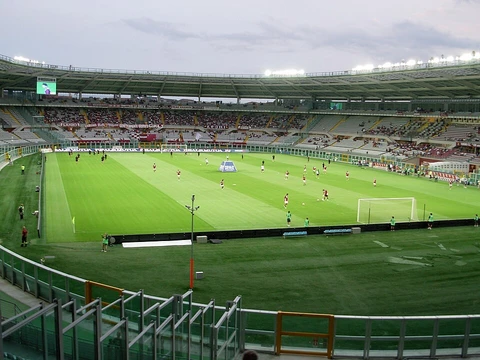
Stadio Olimpico Grande Torino
Home of Torino FC, renovated for the 2006 Winter Olympics.
The Stadio Olimpico Grande Torino, named after the Grande Torino team, is a multi-purpose stadium located in Turin, Italy. It is the home ground of Serie A club Torino Football Club. The stadium is located in Piazzale Grande Torino, in the district of Santa Rita, in the south-central area of the city. The stadium is currently rated by UEFA as a Category 4 stadium, the highest ranking possible.
Quick Facts
- Location
- Turin, Piedmont, Italy
- Opened
- 1933
- Original name
- Stadio Municipale Benito Mussolini
- Renamed
- 2016
- Primary tenant
- Torino FC
Lore & Background
Constructed in the 1930s, and originally known as the Stadio Municipale Benito Mussolini (or colloquially the Stadio Municipale) and later the Stadio Comunale, it was the home of Juventus and Torino until the 1990s, when it was abandoned in favour of the bigger and more modern Stadio delle Alpi. After a sixteen-year stint without Serie A football, the stadium was renovated and renamed the 'Stadio Olimpico' on the occasion of the 2006 Winter Olympics. In a reversal of 1990, both Juventus and Torino moved back to the Olimpico during the demolition of the Stadium and the construction of the Juventus Arena at the same place, with Juventus using it until the end of the 2010–11 season, and Torino retaining it as their home stadium to the present day.
Reader's Guide
The stadium was originally named after Benito Mussolini, and was built to host the Littoriali Games of the fascist year XI, held in 1933 and the World Student Games in the same year. Work began in September 1932. The stadium was inaugurated on 14 May 1933 by the Secretary of the National Fascist Party, Achille Starace, at the beginning of the Littoriali. The first soccer match played in the new stadium was between Juventus and Hungary's Újpest FC (6–2), the return leg of the quarter-finals of the Central European Cup, on 29 June 1933. After the stadium's inauguration it hosted several matches of the 1934 FIFA World Cup. From the late 1950s, until the 1989–90 season, the stadium hosted the home games of both Turin teams. The stadium was then abandoned in favor of the Stadio delle Alpi. It served as the main venue of the Summer Universiade two times in 1959 and 1970, hosted the 1970 Women's World Cup Final. In the 1980s the stadium was renamed 'Vittorio Pozzo'. With the construction of Stadio delle Alpi, the Communale Stadium was used less, only accommodating the Juventus coaching activities (until 2003) and, from 2004, those of Torino. The renovation for the 2006 Winter Olympics cost near 30 million euros. The Olympic Stadium was officially opened on 29 November 2005.
Did You Know?
- The original design stage consisted of an ellipsoid ring whose major perimeter was about 640 metres.
- The playing field measures 70 x 105 metres, surrounded by an athletics track with six lanes.
- The renovation project was based on Barcelona's Estadi Olímpic Lluís Companys restoration project.
- The total capacity after renovation is 27,168 seats, all covered and seated.
Frequently Asked Questions
What is Stadio Olimpico Grande Torino's role in Italian football?
The stadium is the primary venue for Torino FC's league and European fixtures. For more than twenty years it also doubled as Juventus's home, making it one of the very few Italian grounds where two bitter rivals shared the same pitch. Beyond matchdays, it functions as a cultural anchor for a city shaped by industry and stoic pride.
What is the link between Stadio Olimpico Grande Torino and Stadio Filadelfia?
The Filadelfia was Torino FC's long-standing home before the club relocated to the new, larger stadium in 1990. That move marked a generational break, trading an intimate, industrial-era ground for a modern World Cup venue. For older supporters, the Filadelfia still represents the emotional origin of their club, while the Grande Torino is where the story continues.
More in Stadium & Culture
Elsewhere in Torino FC
Spotted an error? Know more?
Reader corrections go straight into our review queue. Suggest an edit · How this site is sourced