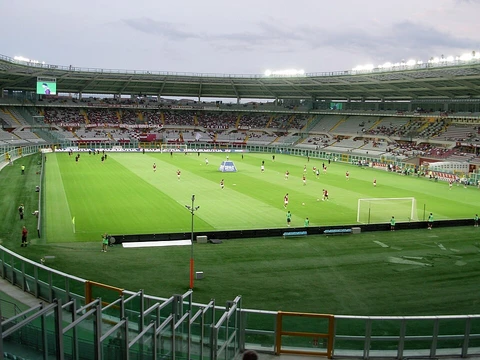
Stadio Mappina
A small ground in a working-class quarter that held the soul of an entire city for seventy-seven years.
Stadio Mappina was the beating heart of Torino FC for nearly eight decades. Tucked into the working-class Mappina quarter of Turin, this modest, intimate ground was where the Granata were forged, where the legendary Grande Torino of the 1940s played their unforgettable seasons, and where generations of fans from the surrounding streets walked in on matchdays with their dark-red scarves wrapped tight against the Piedmontese chill. It was never a grand structure — no sweeping concrete bowls, no corporate naming rights — just a compact rectangle of grass and iron where the distance between the terraces and the touchline was short enough to hear a striker curse the referee.
When it was finally demolished in 1990 and replaced by the far larger Stadio delle Alpi, an entire era of Turinese football culture closed. For fans who remember, Mappina is not a stadium so much as a feeling: the smell of wet wool and cheap coffee, the roar of a crowd packed so densely the air itself seemed to vibrate, the unshakable sense that this was their ground, built by and for the people of the Mappina streets.
Quick Facts
- Club
- Torino FC
- Location
- Mappina quarter, Turin, Piedmont, Italy
- In use
- 1913–1990
- Replaced by
- Stadio delle Alpi (1990)
- Status
- Demolished
- Defining era
- Grande Torino (1940s)
Lore & Background
Stadio Mappina opened in the early 1910s as a functional, no-frills ground for Torino FC, who had been founded in 1906 as a spin-off of the city's football community. From the start it was defined by its intimacy. The terraces rose steeply and close to the pitch, so that on a packed Sunday the collective breath of the crowd pressed against the players like a physical wall. There was no luxury here — no press boxes with leather chairs, no corporate hospitality suites. Just iron stands, a simple press area, and the raw, unfiltered noise of a working-class quarter that had adopted the bull as its own emblem.
The stadium's most sacred and most tragic chapter belongs to the Grande Torino of the 1940s, the side that won five consecutive Scudetti and was, in the eyes of its fans, the finest team ever assembled. They played their home matches at Mappina, and it was from this ground that the squad departed for the fateful 1949 friendly in Lisbon — the trip that ended in the Superga air disaster, which annihilated the entire first team and coaching staff. The stadium stood as a silent witness to the loss, and for years after, the memory of those players in their granata shirts on this very pitch was inseparable from the ground itself. To speak of Mappina in those years was to speak of ghosts, of a team that would never play again, of a city that had lost its children to a hillside just a few kilometres away.
By the 1980s, the old ground could no longer meet the demands of a modern football club or the safety regulations of the era. It was demolished in 1990, and in its place rose the far larger Stadio delle Alpi. For many older fans, the demolition felt like a small death — the loss of the one place where the distance between the player and the supporter had been a matter of metres rather than hundreds. The Mappina ground is gone, but in the memory of the city it endures as the true home of the Granata, the place where the bull was born and where the shirt first meant something more than a colour.
Reader's Guide
You walk in from the Mappina streets and the first thing that hits you is the closeness. There is no vast concourse, no corporate foyer. You step through a narrow turnstile, and within two metres you are on the terrace, your shoulder almost brushing the chain-link above the pitch. The whole ground is a rectangle, and every seat is a front-row seat.
The atmosphere is not a sound so much as a pressure. When the Toro chant rolls — that low, rhythmic bellow of the bull's name — it doesn't echo, because there's nowhere for it to go. It hits you in the sternum. The granata shirts below you, packed shoulder to shoulder, make the terrace look like a single dark-red animal breathing. You can hear the ball thud against the boot. You can hear the goalkeeper shout to his centre-backs. That proximity is the whole point, the whole soul of the place.
The bull is everywhere. Painted on the old concrete, scratched into the iron railings by fans over decades, worn on the chest of every shirt in the stand. It is not a logo. It is a claim — this city, this quarter, this working street, is the bull's territory. The granata colour is not a brand; it is the colour of the Mappina sky at dusk, of the iron railings, of the blood in the veins of every kid who grew up on these terraces. You don't wear the shirt. The shirt wears you, because you are from here, and here, the bull is not a symbol. It is the neighbourhood itself, roaring.
Did You Know?
- The ground served Torino FC for approximately seventy-seven years (1913–1990), making it one of the longest-tenured club grounds in Italian football before its demolition.
- The demolition of Mappina in 1990 and its replacement by the much larger Stadio delle Alpi marked the end of an era of small, neighbourhood football grounds in Italian Serie A.
More in Stadium & Culture
Elsewhere in Torino FC
Spotted an error? Know more?
Reader corrections go straight into our review queue. Suggest an edit · How this site is sourced