Disintegration
The self unravels, note by note, in the most beautiful ruin The Cure ever built.
Disintegration is the title track and lead single from The Cure's 1989 album of the same name, written and performed by Robert Smith. It stands as one of the band's most searing and recognizable compositions—a slow-burning, atmospheric piece of gothic rock that channels existential dread, the erosion of identity, and the terrifying sensation of the self coming apart at the seams. In the broader arc of The Cure's catalogue, it marks the apex of their darkest, most introspective period, following the emotional turbulence of the 1980s and crystallizing the band's signature blend of melancholy and grandeur.
The song's cultural footprint extends well beyond the album: its music video, its live performances, and its recurring presence in film, television, and fan culture have made it a touchstone for anyone drawn to The Cure's shadowy, poetic world. It is the track that, for many listeners, defines what The Cure sound like at their most devastating and beautiful.
Quick Facts
- Artist
- the Cure
- Released
- 2 May 1989
- Genre
- Gothic rock
- post-punk
- dream pop
- Length
- 8:18
- Label
- Fiction
- Writer
- Robert Smith
- Simon Gallup
- Porl Thompson
- Boris Williams
- Roger O'Donnell
- Lol Tolhurst
- Producer
- David M. Allen, Robert Smith
Facts from the source article.
Lore & Background
In the mythology of The Cure's discography, Disintegration occupies a singular place. After the raw emotional honesty of earlier records and the synth-laden experiments of the mid-80s, the band returned to a stripped-down, guitar-and-bass-driven sound that felt almost ritualistic. Robert Smith has spoken in interviews about the song capturing a period of profound personal uncertainty—a feeling that the boundaries of the self were dissolving, that the familiar architecture of identity was crumbling. The lyrics, sparse and repetitive in their key phrases, mirror that dissolution: the same images of loss and dislocation circle back like a mind unable to hold a coherent narrative.
Musically, the track is a masterclass in tension and release. The opening is deceptively quiet, a shimmering guitar texture over a pulsing bass line that feels like a slow heartbeat. As the song progresses, layers accumulate—drums lock in, the guitar thickens, and the chorus arrives with a weight that feels almost architectural, as though the band is constructing a cathedral out of grief. The production is dry and immediate, letting the rawness of the performance breathe without the polish of the era's more synthesized alternative rock.
The music video, shot in a stark industrial environment, became inseparable from the song in the public imagination. Smith, clad in a white suit that reads as both funereal and defiant, moves through a landscape of rust, concrete, and shadow. The imagery of a lone figure performing a slow, almost choreographed dance of collapse in a decaying space gave the song a visual grammar that fans have referenced, imitated, and reinterpreted for decades. It cemented the idea that The Cure's darkness was not mere aesthetic but an emotional truth rendered in concrete and light.
Reader's Guide
Year: 1989. Parent album: Disintegration, The Cure's ninth studio album, released in October of that year.
Lyrical theme: The song circulates around the idea of the self breaking down—identity, memory, and emotional continuity dissolving under pressure. Key images of loss, repetition, and the inability to hold onto a coherent sense of who one is give the lyrics a hypnotic, almost incantatory quality. It is less a narrative than a state of being, rendered in short, circling phrases.
Musical structure: The track opens with a sparse, atmospheric guitar figure over a driving, repetitive bass line that establishes the song's pulse. Drums enter gradually, adding weight without rushing the tempo. The verse sections remain relatively restrained, building tension through layering rather than melodic complexity. The chorus arrives with a fuller, more anthemic guitar texture and a vocal delivery that sits between a whisper and a shout. The song follows a verse-chorus structure with a bridge section that strips back to near-silence before the final chorus, creating a sense of collapse and reconstruction.
Cultural impact: Disintegration became one of the defining tracks of late-80s gothic and alternative rock. Its music video, its live performances, and its use in film and television soundtracks have kept it in continuous cultural circulation. For a generation of listeners, it remains the essential entry point into The Cure's darker catalogue.
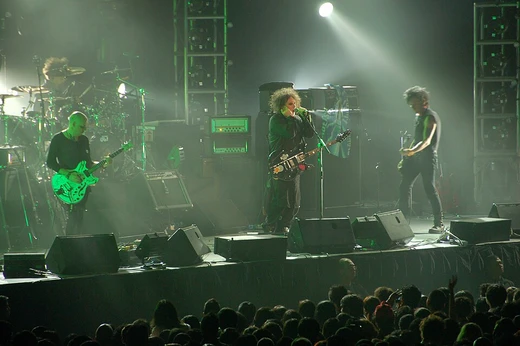
Live-performance history: The song has been a staple of The Cure's setlists since 1989, performed in virtually every major tour and festival appearance. Live versions often extend the intro and allow the band to build the chorus more slowly, creating a communal, almost liturgical experience. Robert Smith's physical performance during the track—slow, deliberate, sometimes near-still—has become a recognizable part of the song's identity.
Notable remixes or covers: The track has been remixed for various compilation and remix releases over the years, and has been covered by a range of alternative and indie artists, though it remains most powerfully associated with The Cure's original 1989 recording.
Track listing
Disintegration track listing
| No. | Title | Length |
|---|---|---|
| 1 | Plainsong | 5:17 |
| 2 | Pictures of You | 7:28 |
| 3 | Closedown | 4:18 |
| 4 | Lovesong | 3:29 |
| 5 | Last Dance | 4:45 |
| 6 | Lullaby | 4:09 |
| 7 | Fascination Street | 5:16 |
| 8 | Prayers for Rain | 6:08 |
| 9 | The Same Deep Water as You | 9:22 |
| 10 | Disintegration | 8:19 |
| 11 | Homesick | 7:07 |
| 12 | Untitled | 6:33 |
Disc 2: Rarities 1988-1989
| No. | Title | Length |
|---|---|---|
| 1 | Prayers For Rain (Robert Smith home demo - Instrumental - 4/88) | 3:01 |
| 2 | Pictures of You (Robert Smith home demo - Instrumental - 4/88) | 3:29 |
| 3 | Fascination Street (Robert Smith home demo - Instrumental - 4/88) | 2:39 |
| 4 | Homesick (Band Rehearsal - Instrumental - 6/88) | 3:12 |
| 5 | Fear of Ghosts (Band Rehearsal - Instrumental - 6/88) | 2:57 |
| 6 | Noheart (Band Rehearsal - Instrumental - 6/88) | 2:39 |
| 7 | Esten (Band Demo - Instrumental - 9/88) | 3:13 |
| 8 | Closedown (Band Demo - Instrumental - 9/88) | 2:48 |
| 9 | Lovesong (Band Demo - Instrumental - 9/88) | 3:39 |
| 10 | 2Late (Alternate Version, Band Demo - Instrumental - 9/88) | 2:50 |
| 11 | The Same Deep Water As You (Band Demo - Instrumental - 9/88) | 6:04 |
| 12 | Disintegration (Band Demo - Instrumental - 9/88) | 6:34 |
| 14 | Babble (Alternate Version, Studio Rough - Instrumental - 11/88) | 2:58 |
| 15 | Plainsong (Studio Rough - Guide Vocal - 11/88) | 4:44 |
| 16 | Last Dance (Studio Rough - Guide Vocal - 11/88) | 4:41 |
| 17 | Lullaby (Studio Rough - Guide Vocal - 11/88) | 3:46 |
| 18 | Out of Mind (Studio Rough - Guide Vocal - 11/88) | 2:58 |
| 19 | Delirious Night (Rough Mix - Vocal - 12/88) | 4:30 |
| 20 | Pirate Ships (Robert Smith solo - Rough Mix - Vocal - 12/89) | 3:38 |
Disc three: Entreat Plus - Live at Wembley 1989
| No. | Title | Length |
|---|---|---|
| 1 | Plainsong | 5:19 |
| 2 | Pictures of You | 7:04 |
| 3 | Closedown | 4:21 |
| 4 | Lovesong | 3:24 |
| 5 | Last Dance | 4:36 |
| 6 | Lullaby | 4:14 |
| 7 | Fascination Street | 5:09 |
| 8 | Prayers For Rain | 4:49 |
| 9 | The Same Deep Water As You | 10:03 |
| 10 | Disintegration | 7:54 |
| 11 | Homesick | 6:46 |
Track listing from the source article.
More in Albums & EPs
Elsewhere in The Cure
Spotted an error? Know more?
Reader corrections go straight into our review queue. Suggest an edit · How this site is sourced