Plainsong
A brief hymn of doubt sung in the shadow of a darker album.

The Cure · via Wikipedia: Plainsong (song) · Fair use
Plainsong is a track from The Cure's 1989 album Disintegration, written and performed by Robert Smith. It stands apart from the album's heavier, more industrial-tinged material by leaning into a sparse, almost liturgical soundscape built around organ and choral textures. The song's brevity and its hymn-like melodic contour give it the feel of a brief devotional moment suspended inside an otherwise dark and sprawling record.
For fans, Plainsong often serves as the emotional exhale of Disintegration—a quiet, questioning interlude that contrasts sharply with the album's more confrontational tracks. Its title, drawn from the tradition of plainchant (monophonic, unaccompanied liturgical singing), signals the song's preoccupation with faith, doubt, and the search for meaning in a secular, often hostile world.
Quick Facts
- Artist
- The Cure
- Album
- Disintegration
- Released
- 2 May 1989
- Genre
- Psychedelic rock
- dream pop
- gothic rock
- Length
- 5:12
- Label
- Fiction
- Writer
- Robert Smith
- Simon Gallup
- Porl Thompson
- Boris Williams
- Roger O'Donnell
- Lol Tolhurst
- Producer
- David M. Allen, Robert Smith
Facts from the source article.
Lore & Background
On Disintegration, most tracks push toward weight, distortion, and angular rhythm. Plainsong breaks that momentum with a deliberately austere palette: a sustained organ line, a simple repeating vocal melody, and a sense of space that recalls a cathedral rather than a club. The effect is one of stillness amid the album's turbulence, as if the narrator has stepped out of the storm to confront a question that no amount of volume can answer.
The title itself is a deliberate musical reference. Plainsong—or plainchant—is the oldest Western liturgical vocal tradition, unaccompanied and monophonic. By naming the song after it, Smith signals a longing for something pure and undifferentiated, a voice stripped of production and pretense. Yet the song's actual arrangement, with its layered organ and subtle electronic texture, undercuts that purity, suggesting that the ideal is always already compromised.
In the broader arc of The Cure's catalogue, Plainsong sits alongside other tracks where Smith interrogates religion and belief—moments where the band's post-punk darkness meets a genuinely spiritual unease. It is not a worship song; it is the sound of someone standing in the nave, listening for an answer that may not come.
Reader's Guide
Year: 1989. Parent album: Disintegration, The Cure's eighth studio album, released in March 1989 via Fiction/Decca.
Lyrical theme: The song circles the tension between faith and doubt. The narrator positions himself outside the binary of saint and sinner, searching for a truth that feels just beyond reach. The plainsong reference frames this as a spiritual, almost liturgical inquiry rather than a purely philosophical one.
Musical structure: Compared to its album neighbours, Plainsong is noticeably shorter and sparser. A sustained organ or choir-pad line forms the harmonic bed, over which a simple, repetitive vocal melody unfolds. The arrangement resists the layered guitars and driving rhythms that dominate much of Disintegration, favouring space, reverb, and a hymn-like cadence.
Cultural impact: While it rarely tops singles charts, Plainsong has endured as a fan-favourite for its emotional directness. It is frequently cited in retrospective discussions of Disintegration as the album's most vulnerable moment, the track that humanises the record's otherwise imposing sonic architecture.
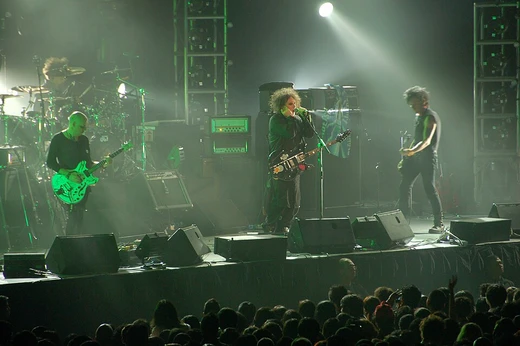
Live performance: The song has appeared in various live setlists over the years, often performed with a stripped-back arrangement that emphasises the vocal and a single sustained instrumental line. Its brevity makes it a natural mid-set breather in longer concerts.
Remixes and covers: No widely documented official remix or high-profile cover is firmly established in the public record. The song's influence is more often felt in how other artists approach choral-textured post-punk rather than in direct reinterpretations.
Did You Know?
- On Disintegration, Plainsong is one of the shorter tracks, creating a deliberate contrast with the album's more extended, rhythmically dense compositions.
- Robert Smith has spoken in interviews over the years about the spiritual and questioning themes that run through much of The Cure's work, and Plainsong is often cited as a concise distillation of that preoccupation.
More in Songs & Singles
Elsewhere in The Cure
Spotted an error? Know more?
Reader corrections go straight into our review queue. Suggest an edit · How this site is sourced