
Auditory processing disorder
A neurodevelopmental disorder impairing brain processing of sounds.

Hariadhi · CC BY-SA 4.0
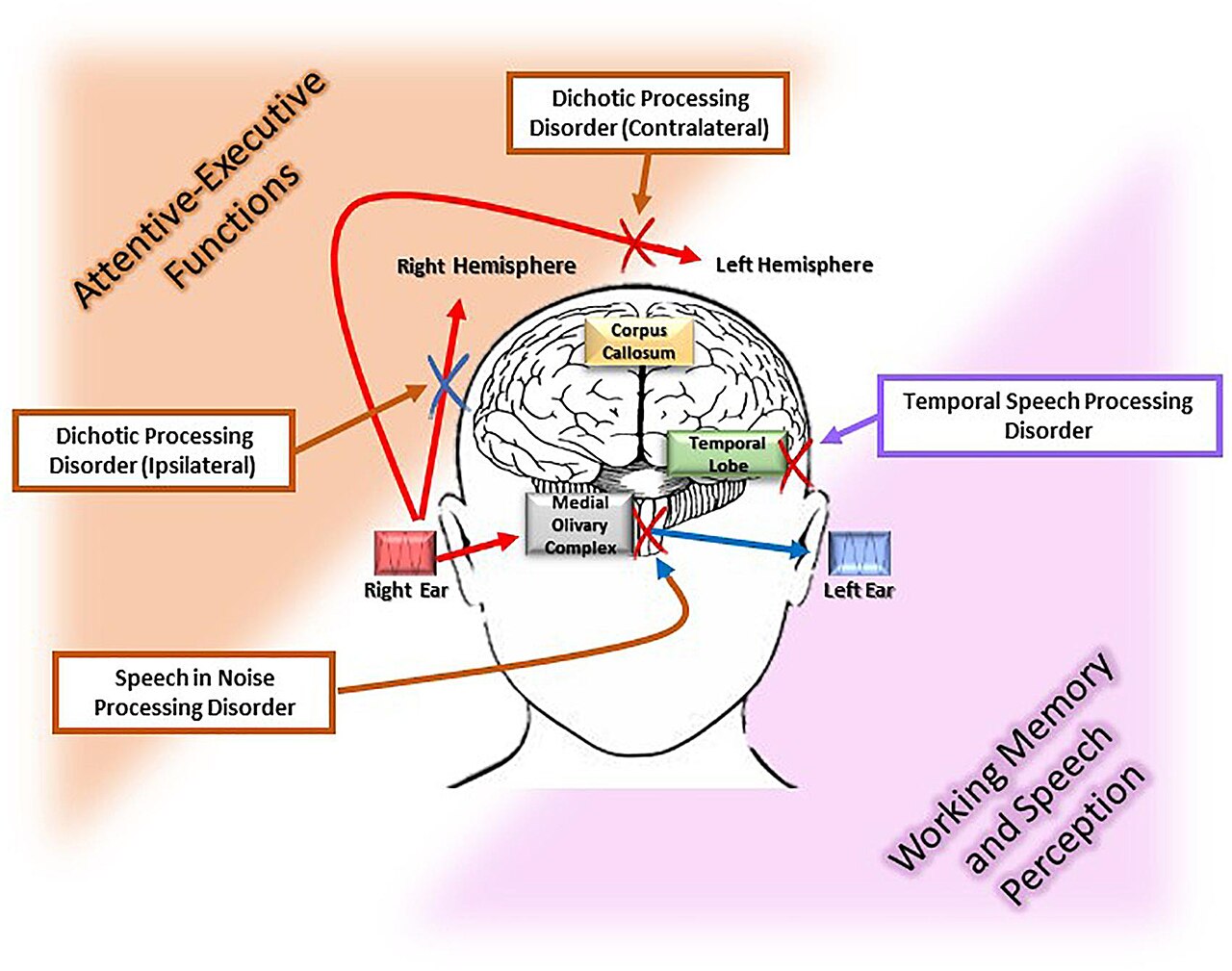
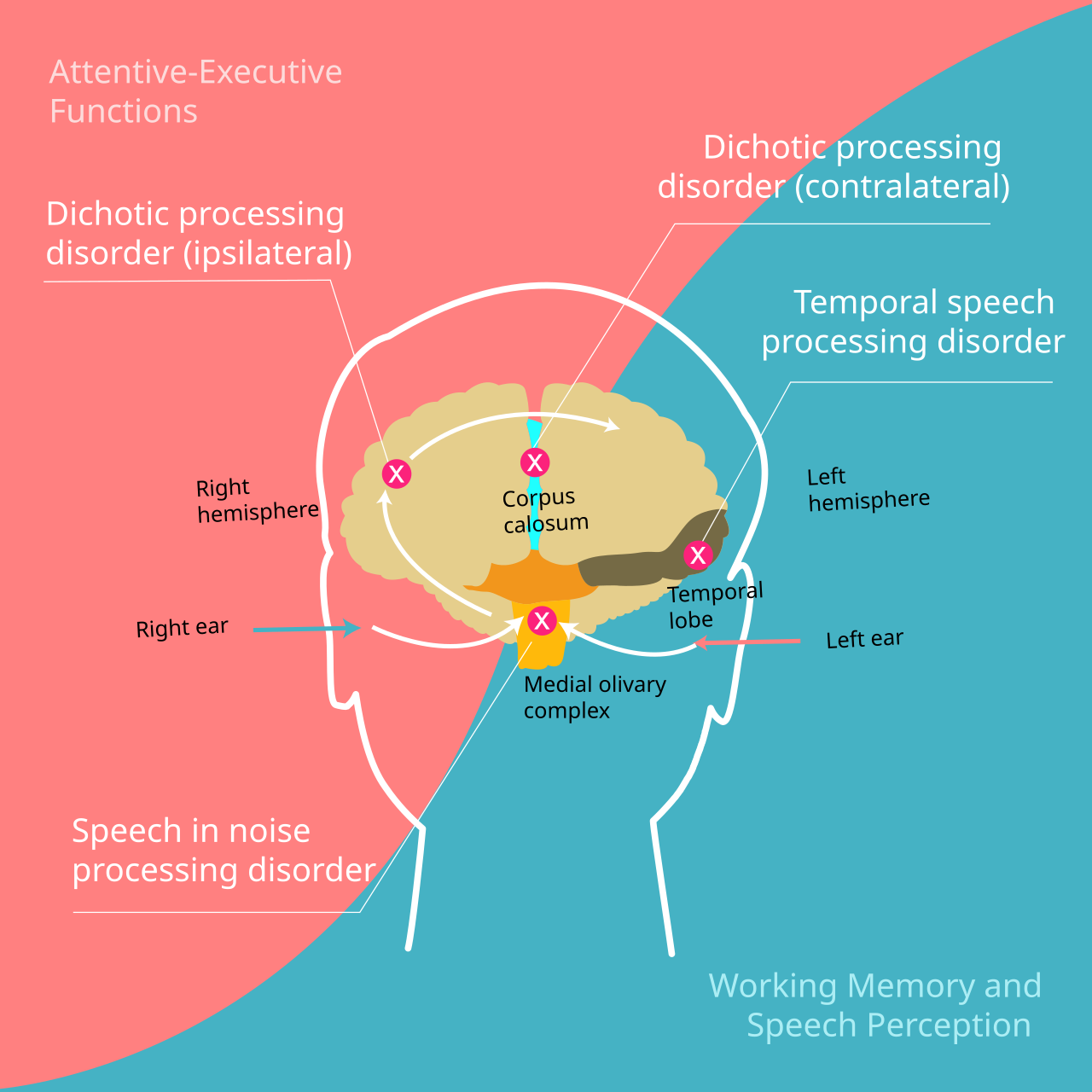
Auditory processing disorder (APD) is a neurodevelopmental condition that impacts how the brain interprets sound. People with APD typically have ears that work normally, but their brains process auditory information differently, making it hard to recognize and understand sounds—especially speech. This difficulty is believed to stem from a problem in the central nervous system. One subtype, called King–Kopetzky syndrome or auditory disability with normal hearing (ADN), involves trouble hearing speech when there is background noise, essentially a failure of the usual "cocktail party effect" that allows most people to focus on one voice in a crowd. According to the American Academy of Audiology, APD is diagnosed based on difficulties in one or more auditory processes linked to the central auditory nervous system. It can affect both children and adults, and may persist from childhood into adulthood. While the exact prevalence is unknown, estimates suggest it impacts 2–7% of children in the US and UK, with males being twice as likely to be affected as females. Neurodevelopmental APD is distinct from aphasia, which results from acquired brain injury, though acquired epileptic aphasia has been considered a form of APD. Auditory training is a key part of rehabilitation for central auditory processing disorder. People with APD may show signs such as speaking too loudly or too softly for the situation, struggling to remember lists or sequences, needing words or sentences repeated, having trouble learning information presented orally, taking language too literally, requiring help to hear clearly in noisy environments, relying on accommodations, seeking quiet workspaces, asking for written materials during oral presentations, and requesting directions one step at a time. APD and ADHD can present with overlapping symptoms. Professionals have ranked behavioral symptoms most often seen in each disorder, noting that while the symptoms differ, their similar presentation often makes it hard to tell the two conditions apart. A 2018 systematic review found that in one study, 10% of children with APD had confirmed or suspected ADHD. The review also noted that distinguishing APD from other behavioral disorders is sometimes difficult due to symptom overlap.
Quick Facts
- Speciality
- Audiology, neurology
Facts from the source article.
Lore & Background
Auditory processing disorder (APD) is diagnosed by difficulties in one or more auditory processes known to reflect the function of the central auditory nervous system. It can affect both children and adults, and may continue to affect children into adulthood. The American Academy of Audiology notes that diagnosis is based on such difficulties. Neurodevelopmental forms of APD are different than aphasia because aphasia is by definition caused by acquired brain injury. However, acquired epileptic aphasia has been viewed as a form of APD. Auditory training (AT) is an important component of rehabilitation for patients with central auditory processing disorder (CAPD).
Reader's Guide
APD is significant because it affects the brain's ability to interpret sounds, particularly speech, despite normal peripheral hearing. Its estimated prevalence of 2–7% in children in the US and UK, with males twice as likely to be affected, highlights its public health impact. The disorder often overlaps with attention deficit hyperactivity disorder (ADHD), developmental language disorder (DLD), and dyslexia, making differential diagnosis challenging. A systematic review noted that 10% of children with APD have confirmed or suspected ADHD, and studies show that children diagnosed with APD, DLD, or dyslexia may present with similar symptoms, leading to different diagnoses depending on the specialist consulted. The causes of developmental APD are often unknown, though genetic factors and conditions like Landau–Kleffner syndrome are implicated. Auditory training remains a key rehabilitation strategy. The disorder's legacy lies in raising awareness of central auditory processing issues and the need for multidisciplinary assessment.
Did You Know?
- Individuals with APD usually have normal structure and function of the ear.
- A subtype is King–Kopetzky syndrome, characterized by difficulty hearing speech in background noise.
- Males are twice as likely to be affected by APD as females.
The Nature of the Disorder
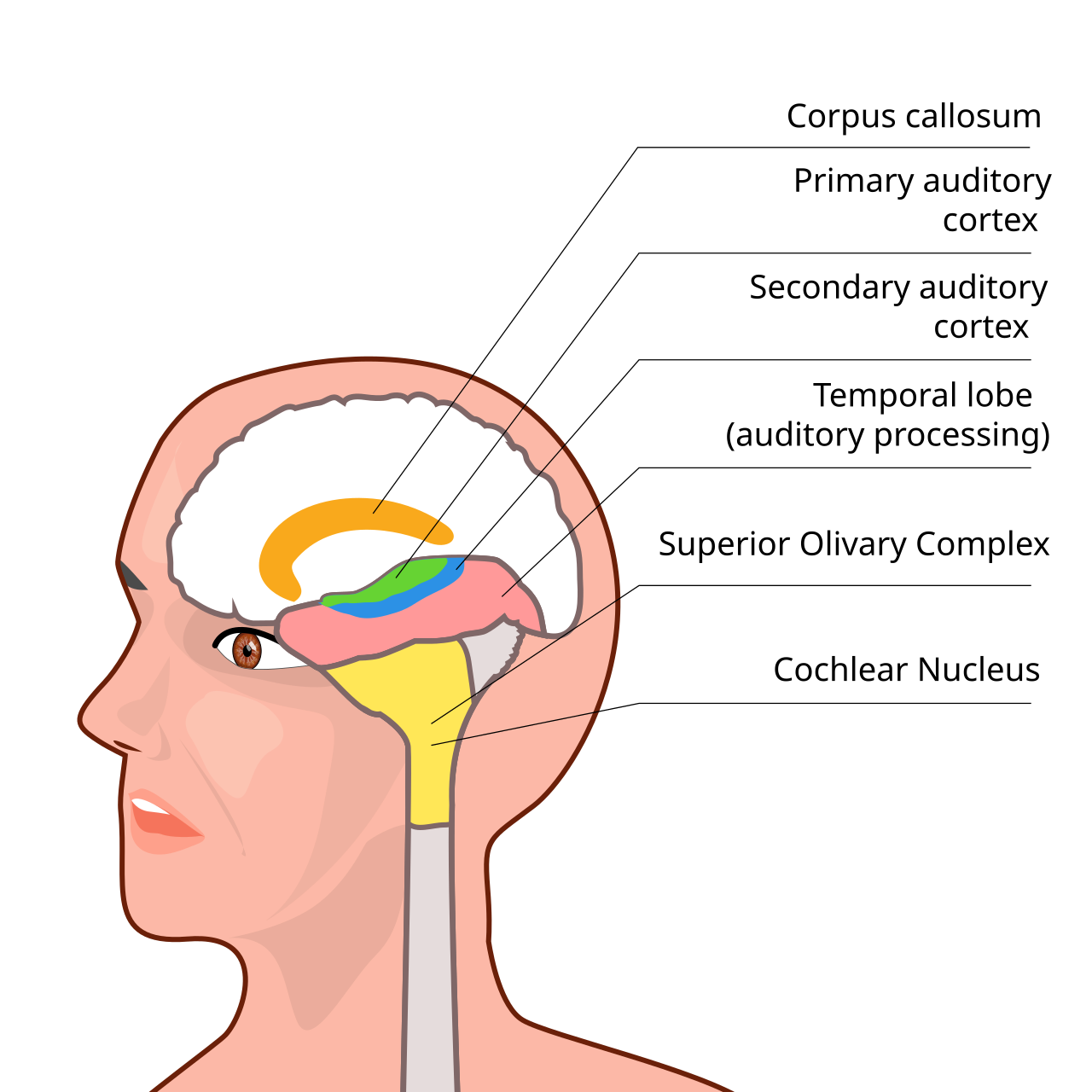
Auditory processing disorder is a neurodevelopmental condition in which the brain struggles to make sense of sound, even though the ear's structure and basic hearing function remain intact. The difficulty lives in the central nervous system—specifically in how auditory information is interpreted, particularly the sounds that compose speech. One notable subtype, King-Kopetzky syndrome (also called auditory disability with normal hearing), zeroes in on a very specific failure: the inability to isolate a single voice amid background noise. This is essentially a breakdown of what most people experience effortlessly as the cocktail party effect, that natural ability to zero in on one speaker in a crowded room. The American Academy of Audiology frames diagnosis around difficulties in one or more auditory processes that reflect central auditory nervous system function. Importantly, APD is distinct from aphasia, which by definition stems from an acquired brain injury, though acquired epileptic aphasia has been considered a form of APD. The condition can affect both children and adults, and childhood cases may persist well into adult life.
Daily Life and Practical Symptoms
The day-to-day experience of APD is marked by a constellation of communication challenges that can easily be mistaken for inattention or poor listening. Affected individuals may speak at volumes that don't match the situation, struggle to hold onto lists or sequences of information, and frequently need people to repeat what they have said. Memorizing material delivered orally becomes notably harder, and words tend to be taken very literally rather than grasped for their implied meaning. Noisy environments are particularly punishing, prompting many to seek quiet workspaces, request written handouts during oral presentations, or ask that instructions be broken into single steps. These accommodation and modification strategies—finding a seat away from traffic, asking for directions one at a time—are practical workarounds that help bridge the gap between what is heard and what is understood. The American Academy of Audiology emphasizes that these difficulties reflect dysfunction in the central auditory nervous system rather than any problem with the ear's structure or basic hearing function.
Diagnostic Overlap and the Language-Reading Tangle
One of the most challenging aspects of APD is how its symptoms bleed into other developmental conditions, making clean diagnosis difficult. ADHD and APD share enough overlapping behavioral markers that professionals find it hard to tell them apart; a 2018 systematic review noted that roughly ten percent of children with APD also have confirmed or suspected ADHD. The relationship with developmental language disorder, formerly called specific language impairment, is even more contested. Some researchers believe SLI stems from auditory processing problems, while others argue the core difficulty lies in higher-level language processing. Developmental dyslexia adds another layer: some studies suggest reading difficulties may be a downstream consequence of impaired rapid auditory processing, and children with polymicrogyria, a cell migrational disorder, almost always show deficits on APD testing. In practice, the same child might be labeled APD by an audiologist, SLI by a speech-language therapist, or dyslexia by a psychologist, depending on which specialist they consult.
Prevalence, Causes, and Pathways to Rehabilitation
While the true prevalence of APD remains unknown, estimates suggest it affects between two and seven percent of children in US and UK populations, with males roughly twice as likely to be affected as females. The condition exists on a spectrum of causes. Neurodevelopmental forms are present from early development, but acquired APD can result from any damage or dysfunction to the central auditory nervous system. Genetic factors also appear to play a role; some studies point to an increased family history of hearing impairment among affected patients, with patterns suggestive of autosomal dominant inheritance. On the treatment side, auditory training stands out as a key component of rehabilitation for those diagnosed with central auditory processing disorder. This structured approach to retraining the brain's sound-processing pathways represents one of the primary therapeutic tools available, though broader management often involves a combination of environmental modifications, educational accommodations, and ongoing support, since the condition can persist from childhood well into adulthood.
Gallery
Frequently Asked Questions
What is Auditory Processing Disorder?
APD is a neurodevelopmental condition in which the brain struggles to decode and assign meaning to sounds, especially spoken language, even though the ears themselves function perfectly. The underlying issue sits within the central nervous system's ability to organize auditory signals.
Does APD mean someone is hard of hearing?
No—individuals with APD generally have fully intact ears and normal hearing thresholds. The challenge is purely cognitive: the brain fails to sort, sequence, and interpret the sounds that arrive, making speech comprehension difficult.
How many children are affected by APD?
Estimates place prevalence at roughly 2 to 7 percent of school-age children in U.S. and U.K. populations. It is one of the more common yet frequently overlooked learning challenges in typical classrooms.
Is APD more common in boys than girls?
Yes, available data suggest males are about twice as likely to be identified with APD as females. Researchers are still investigating the biological and environmental factors behind this gender gap.
What is King–Kopetzky syndrome?
King–Kopetzky syndrome, also termed auditory disability with normal hearing, is a recognized subtype of APD characterized by an inability to follow a speaker amid background noise. It reflects a breakdown of the brain's typical cocktail-party filtering mechanism.
More in Syndromes 1-24
Spotted an error? Know more?
Reader corrections go straight into our review queue. Suggest an edit · How this site is sourced