SN 1572
A 1572 supernova that challenged ancient models of the heavens.
Last updated
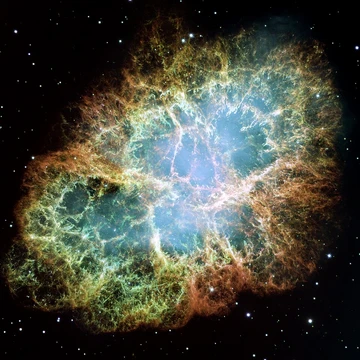
SN 1572, also known as Tycho's Star, Tycho's Nova, or Tycho's Supernova, was a Type Ia supernova in the constellation Cassiopeia. It is one of eight supernovae visible to the naked eye in historical records and appeared in early November 1572. Its supernova remnant, often called 3C 10, was first detected at radio wavelengths and later observed optically.
Lore & Background
The supernova of 1572 appeared in early November and by November 11 was brighter than Jupiter. It reached peak brightness around November 16 at about magnitude −4.0, with some descriptions giving it as equal to Venus at its brightest; Tycho Brahe described it as 'brighter than Venus'. The star remained visible to the naked eye into early 1574.
It was independently discovered by many individuals. Tycho Brahe's extensive work 'De nova et nullius aevi memoria prius visa stella' contained his own observations and analysis of sightings from many other observers. Comparisons between Brahe's observations and those of Spanish scientist Jerónimo Muñoz revealed that the object was more distant than the Moon.
Other Europeans who sighted it included Wolfgang Schuler, Christopher Clavius, Thomas Digges, John Dee, Francesco Maurolico, and Tadeáš Hájek. In Ming dynasty China, the star became an issue between Zhang Juzheng and the young Wanli Emperor, as the new star was interpreted as an evil omen. The supernova remnant was first detected at radio wavelengths in 1952 by Robert Hanbury Brown and Cyril Hazard at Jodrell Bank Observatory. It was later identified as 3C 10 in the third Cambridge catalogue.
The remnant has a roughly spherical morphology and spreads over an angular diameter of about 8 arcminutes. Its physical size corresponds to a radius of a few parsecs. The average forward shock speed is between 4,000 and 5,000 km/s, dropping to lower speed when encountering local interstellar clouds.
Reader's Guide
The appearance of the Milky Way supernova of 1572 belongs among the most important observation events in the history of astronomy. It helped to revise ancient models of the heavens and to speed on a revolution in astronomy that began with the realisation of the need to produce better astrometric star catalogues and more precise astronomical observing instruments. It also challenged the Aristotelian dogma of the unchangeability of the realm of stars. The supernova was classified as Type I on the basis of its historical light curve, and its X-ray spectrum showed it was almost certainly of Type Ia.
Final confirmation came in 2008 when the spectrum of its light at peak luminosity was measured in a light echo, confirming it as a normal Type Ia. The classification allows an accurate measure of distance. The supernova remnant was discovered optically in the 1960s.
In October 2004, a G2 star named Tycho G was reported as a possible companion star that contributed mass to the white dwarf; its current velocity of 136 km/s was cited as strong evidence. However, this find has been challenged in recent years, as the star is relatively far from the center and does not show expected rotation. Gaia DR2 calculated the star to be on the lower end of SN 1572's possible distance range, lowering its velocity to only 56 km/s. The supernova has appeared in literature, including James Joyce's Ulysses, a 1998 argument that it is described in Shakespeare's Hamlet, Edgar Allan Poe's poem 'Al Aaraaf', and Arthur C. Clarke's short story 'The Star'.
More in Supernova Remnants
Sources
Compiled from Wikipedia and the sources listed below. Text from Wikipedia is available under CC BY-SA 4.0; this entry is adapted from it.
- Wikipedia: SN 1572 (CC BY-SA 4.0).
- Word definitions: the Codexery glossary, each quoted from its Wikipedia article.
Spotted an error? Know more?
Reader corrections go straight into our review queue. Suggest an edit · How this site is sourced