SN 1054
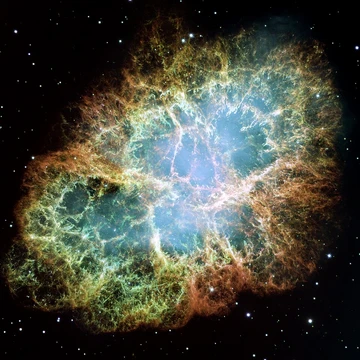
Supernova of 1054 whose remnant is the Crab Nebula.
SN 1054 is a supernova first observed in 1054, whose remnant is the Crab Nebula. It is one of the few Galactic supernovae with a well-known explosion date and is among the best-known supernovae in the history of astronomy.
Quick Facts
- Snrtype
- Pulsar
- Host
- Milky Way
- Constellation
- Taurus
- Gal
- G.184.6–5.8
- Discovery
- c. 10 July, 1054, c. 4 July
- Distance
- 6.5 kly
- Names
- Crab Supernova, SN 1054
- Predecessor
- SN 1006
Facts from the source article.
Lore & Background
The supernova was recorded in contemporary Chinese astronomy, with references also found in a 13th-century Japanese document and a document from the Islamic world. Proposed European references from the 15th century exist, as well as a pictograph associated with the Ancestral Puebloan culture near the Peñasco Blanco site in New Mexico. The pyramids at Cahokia may have been built in response to its appearance. The Crab Nebula was catalogued by Charles Messier in 1758 as M1 after he confused it for Halley's Comet. Identification of the nebula as the supernova remnant occurred between 1921 and 1942. In 1921, Carl Otto Lampland announced structural changes in the nebula, confirmed by John Charles Duncan. Knut Lundmark compiled Chinese records of guest stars, listing the 1054 event near NGC 1952. Edwin Hubble in 1928 noted the nebula's expansion suggested a stellar explosion around nine centuries earlier, linking it to the 1054 guest star. Nicholas Mayall in 1939 proposed it was a supernova based on expansion speed and brightness. Jan Oort in 1942, with sinologist J.J.L. Duyvendak, analyzed historical accounts to confirm the identification beyond reasonable doubt.
Reader's Guide
SN 1054 is notable as one of the few Galactic supernovae with a well-known explosion date, and its remnant, the Crab Nebula, along with its pulsar, are among the most studied objects outside the Solar System. The nebula and pulsar are the most luminous in their respective categories. The supernova's identification relied on historical records from Chinese, Japanese, Islamic, and possible European and Ancestral Puebloan sources. The Crab Nebula's role in the creation of the Messier Catalogue—after Charles Messier mistook it for a comet in 1758—underscores its significance in the development of modern astronomy. The stepwise identification of the remnant, from Lampland's observation of structural changes in 1921 to Oort's confirmation in 1942, illustrates the process of linking historical observations to physical objects. Most other historical supernovae are not confirmed as conclusively; those from the first millennium rely on single documents, while later ones like SN 1006, SN 1181, SN 1572, and SN 1604 are established with reasonable certitude. Telescope-era supernovae are fully certain but none are known within the Milky Way.
Did You Know?
- The Crab Nebula is catalogued as Messier 1 (M1) after Charles Messier confused it for Halley's Comet in 1758.
- The core of the exploding star formed the Crab Pulsar (PSR B0531+21).
- The identification of the Crab Nebula as the remnant of SN 1054 was confirmed beyond reasonable doubt by Jan Oort in 1942.
More in Supernova Remnants
Spotted an error? Know more?
Reader corrections go straight into our review queue. Suggest an edit · How this site is sourced