Alpha1 Capricorni
A yellow supergiant binary system in Capricornus.
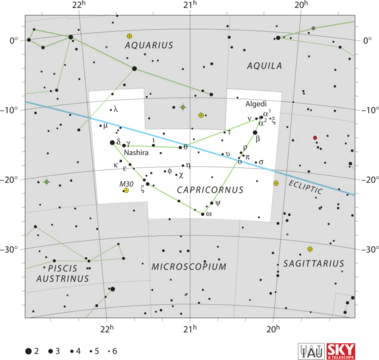
Alpha1 Capricorni, also called Sukhurmashu, is a binary star system in Capricornus, sitting north of the ecliptic. Its primary star is extremely luminous. The system lies just 0.11° from the brighter Alpha2 Capricorni, a gap visible to the naked eye, much like the separation between Mizar and Alcor.
Quick Facts
- Apparent magnitude
- +4.3
- Stellar classification
- G3 Ib
- Distance from solar system
- approximately 810 ly to 870 light‑years
- Radial velocity
- −26 km/s
- Mass
- 5.3 times the Sun
- Radius
- 36 times the Sun
- Luminosity
- around 1,047 times the Sun
- Effective temperature
- 5,119 K
Facts from the source article.
Did You Know?
- The Bayer designation Alpha1 Capricorni is Latinized from α1 Capricorni.
- It bore the traditional star names Prima Giedi and Algiedi Prima.
- The IAU Working Group on Star Names adopted the name Sukhurmashu for this star on 16 July 2026.
Properties
Alpha1 Capricorni’s primary star is a yellow supergiant, classified as G3 Ib, shining at magnitude +4.3 and visible without a telescope. Parallax measurements place it roughly 810 to 870 light-years from Earth, and it is moving closer at a radial velocity of -26 km/s. This star has already passed through the first dredge-up phase and crossed the Cepheid instability strip once; it may be approaching a second crossing. It holds 5.3 times the Sun’s mass, 36 times its radius, and radiates about 1,047 times the Sun’s luminosity from a photosphere with an effective temperature of 5,119 K. Around the year 2000, the Hipparcos satellite spotted a previously unknown companion at an angular separation from the primary. This fainter star, magnitude 8.60, forms a binary pair with Alpha1 Capricorni. Three other dim visual companions lie within one arc-minute, too close to be resolved in small telescopes. The brightest of these is magnitude 10, and because of that, the system has often been classified as an optical binary. The separation between the primary and its companions is increasing quickly, driven by the primary star’s large proper motion.
More in Stars of Capricornus
Spotted an error? Know more?
Reader corrections go straight into our review queue. Suggest an edit · How this site is sourced