Wolf 922
A nearby binary red dwarf system in Capricornus.
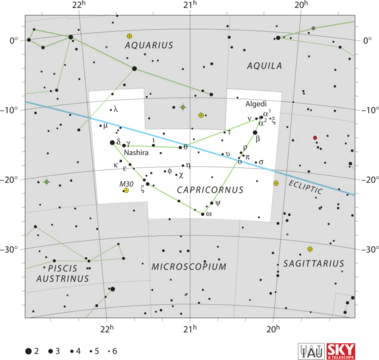
Wolf 922, also known as Gliese 831, is a binary star system in Capricornus consisting of two low-mass red dwarfs. It is too faint for naked-eye observation, requiring a telescope with an aperture of 51 mm or larger, and lies about 26 light-years from Earth. The system is notable for its variable brightness, having been classified as a BY Draconis variable star.
Quick Facts
- Designations
- Wolf 922
- Gliese 831
- BB Capricorni
- Constellation
- Capricornus
- Apparent magnitude
- 11.96 to 11.99
- Distance
- 26 ly
- Radial velocity
- −56.33 km/s
- Variable star type
- BY Draconis variable
- Number of stars
- 2 (binary)
Facts from the source article.
Observational history
Suspected perturbations as early as 1960 led to a proposed period of about 1500 days. Sarah Lee Lippincott determined in 1979 that the companion had a mass between 0.13 and 0.20 solar masses and orbited the primary in a moderately eccentric (0.36) 1.93-year orbit. A 1987 paper suggested a circular orbit with a 1.92-year period, while a 2016 study gave a 704.9-day period and eccentricity of 0.39, close to Lippincott's values. In 1997, a possible third star was announced, described as a likely flare star of very small mass and luminosity, either very close to the pair or beyond 0.5 arcseconds. A 2000 follow-up ruled out the close-proximity possibility and noted that if the object exists, it is likely bluer than the red dwarfs, possibly a white dwarf companion or an unrelated background object.
More in Stars of Capricornus
Spotted an error? Know more?
Reader corrections go straight into our review queue. Suggest an edit · How this site is sourced