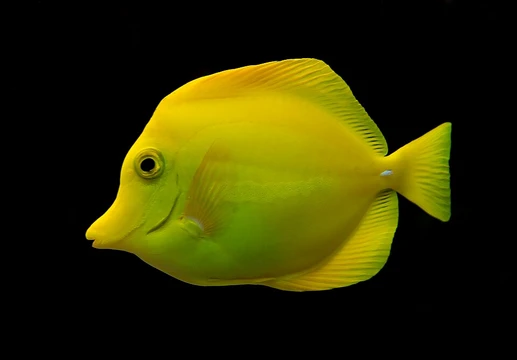
Distribution and occurrence records
Every dot is a verified sighting — here’s where people have actually met this fish.

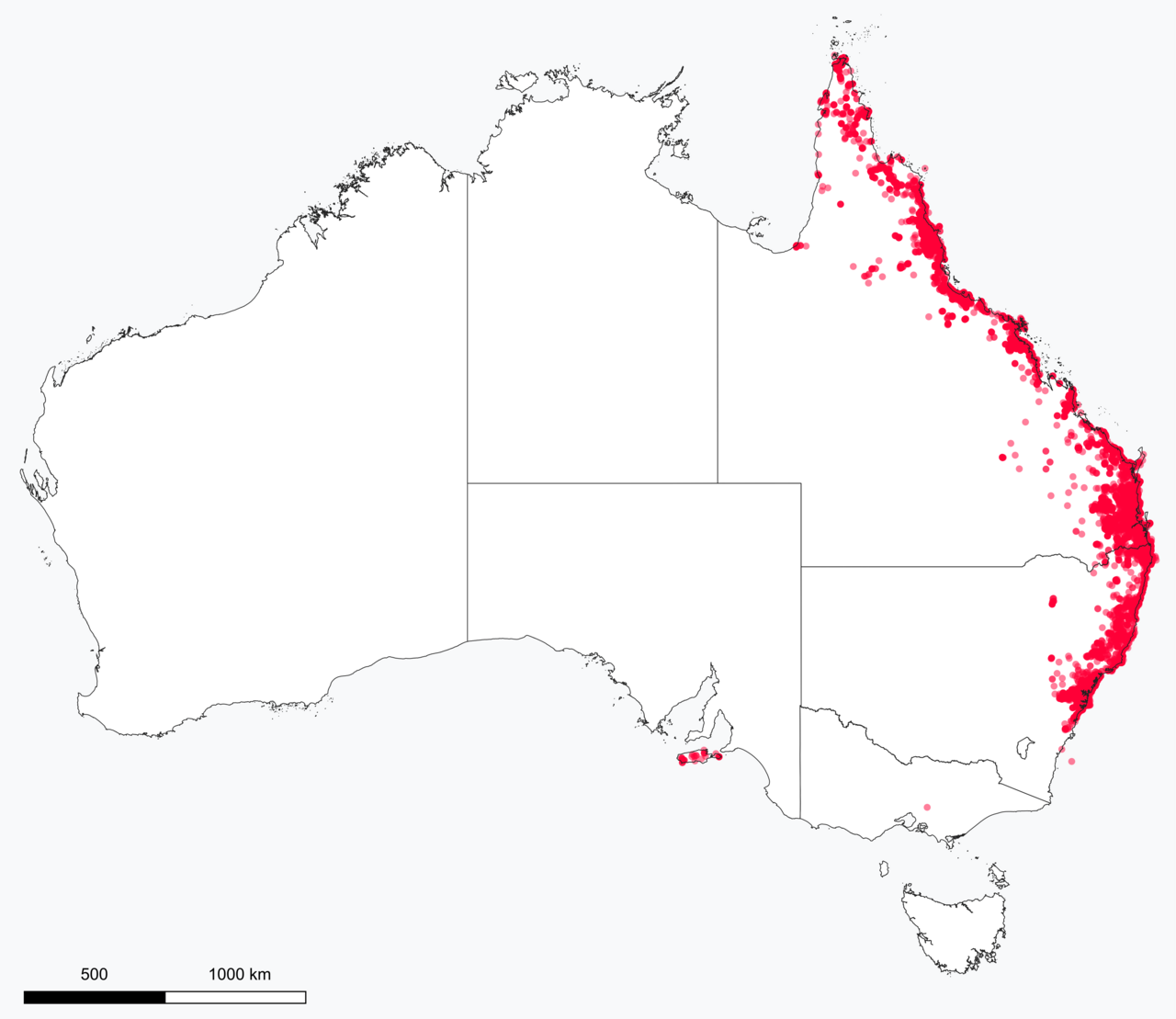
Over 9,778 GPS-tagged sightings of the yellow tang have been logged on GBIF, spanning 31 countries and marine territories. Each dot on the map is a real-world encounter — a diver’s snapshot, a researcher’s net haul, or a reef survey — not a computer-generated guess at where the fish might live.
- Georeferenced records
- 9,778
- Countries / areas with records
- 31
- Gbif taxonkey
- 2379869
Lore & Background
The yellow tang’s most-watched neighborhoods: 🇺🇸 US (mostly Hawai‘i) — 7,007 records 🏝️ Northern Mariana Islands — 1,502 records 🇺🇲 U.S. Minor Outlying Islands (e.g., Midway, Wake) — 900 records 🇬🇺 Guam — 166 records 🇯🇵 Japan — 42 records 🇲🇭 Marshall Islands — 36 records 🇫🇲 Micronesia — 32 records 🇵🇭 Philippines — 24 records 🇦🇸 American Samoa — 21 records 🇵🇫 French Polynesia — 7 records 🇸🇧 Solomon Islands — 5 records 🇻🇺 Vanuatu — 5 records 🇫🇯 Fiji — 3 records 🇲🇬 Madagascar — 3 records 🇲🇺 Mauritius — 3 records
WoRMS also stamps the fish’s passport in these marine regions: Seychelles EEZ, Mozambique EEZ, Mediterranean Sea (likely a stray or aquarium release), China’s EEZ, Spanish Balearic Sea (again, unusual — probably a waif or misidentified record).
Reader's Guide
Occurrence records reflect where people have looked as well as where the species lives, so well-surveyed coastlines are over-represented. Records plotting inland are omitted: for a marine species those are almost always the holding institution's coordinates rather than a collection site.
Sources GBIF Occurrence Search (taxonKey 2379869) — https://www.gbif.org/occurrence/search?taxon_key=2379869 — GBIF.org (2026-09-19) GBIF Occurrence Search. — Accessed 2026-09-19 WoRMS distribution records (MarineRegions) — https://www.marinespecies.org/aphia.php?p=taxdetails&id=219683 — Accessed 2026-09-19 Natural Earth 110m basemap (public domain) — https://www.naturalearthdata.com/ — Accessed 2026-09-19
Did You Know?
- The 7,007 U.S. records are overwhelmingly from Hawai‘i — the yellow tang is practically the state’s unofficial reef mascot.
- A single record from the Mediterranean Sea (Spanish Balearic Sea) is almost certainly a stray or an aquarium escapee — this fish doesn't naturally swim through the Suez Canal.
- Records that plot inland (like a museum in Nebraska) are tossed out — they're the institution's address, not the fish's home.
Taxonomic Odyssey and the Sibiricus Question
Suillus americanus carries a tangled taxonomic history spanning nearly 150 years. Charles Horton Peck first described the species in 1888, drawing on field notes from 1869 collections near Sand Lake, Albany, and Port Jefferson in New York. Peck never designated a type specimen, a gap only patched in 1986 when one of the Sand Lake specimens was formally lectotypified. The species then bounced through genera: French mycologist Édouard-Jean Gilbert moved it to Ixocomus in 1931, and Walter H. Snell, with Rolf Singer and Esther A. Dick, placed it in Suillus in 1959. Singer's 1986 monograph further nested it in the subsection Latiporini, defined by cinnamon spore prints and wide pores exceeding one millimeter. The most contentious issue is its relationship to S. sibiricus. Molecular phylogenetic work by Nguyen and colleagues showed that collections under both names form a single, genetically cohesive lineage stretching from North America to Eurasia, with little internal structure. They argued S. sibiricus should be synonymized, a view echoed by Wolfgang Klofac, who treated it as an infraspecific form. A 2025 IUCN assessment follows this merged interpretation.
A Pine Partner Across the Northern Hemisphere
Suillus americanus is an ectomycorrhizal fungus, meaning it wraps its hyphae around pine roots in a mutually beneficial partnership. In North America its best-known host is eastern white pine (Pinus strobus), though its ecological range extends well beyond that single association. Fruiting bodies emerge on the forest floor, either solitary or in small clusters, typically from late summer through autumn. What was once thought to be a purely North American species has been shown through collection records and DNA sequencing to occupy a much broader swath of the Northern Hemisphere, including parts of East Asia and the Balkan Peninsula. Greenhouse experiments reveal that the fungus is not indiscriminate: spore germination is strongly filtered by host identity, meaning the right pine is needed to unlock its growth. Competition studies add another layer, showing that S. americanus can readily colonize pine seedlings and outcompete other pine-associated Suillus species for root access. This combination of host specificity and competitive vigor helps explain why it dominates certain pine communities while remaining absent from others.
A Slime-Coated Puzzle for Identifiers
At first glance, Suillus americanus is striking: a bright yellow cap, often slick and slimy, studded with red to reddish-brown scales, sitting atop a slender yellow stipe peppered with darker glandular spots. The pore surface beneath the cap consists of large, angular yellow pores that can bruise to a brownish hue. The cap itself ranges from three to ten centimeters across, starting broadly convex with a small umbo and flattening with age, sometimes retaining wisps of a cottony veil along the margin. Yet these vivid features are precisely what make reliable identification difficult. Several Suillus species share overlapping macroscopic and microscopic traits, and a re-examination of Korean herbarium specimens by Min and colleagues found that misidentifications were common and that standard microscopic measurements of spores, basidia, and cystidia were generally not diagnostic among the species they assessed. As a result, mycologists have increasingly turned to DNA barcoding, particularly internal transcribed spacer sequences, to confirm what the naked eye and microscope cannot resolve. The species' common names—American slipperycap, American suillus, and chicken-fat mushroom—capture its look and color but do little to separate it from its close relatives.
From Kitchen Table to Conservation Register
In the kitchen, Suillus americanus is edible but rarely celebrated. Its signature slimy texture earns it a reputation as a mediocre mushroom, and some individuals develop contact dermatitis simply from handling the raw fruiting body. On the other hand, laboratory analyses have identified a beta glucan within the fungus that displays anti-inflammatory activity, hinting at biochemical properties that go well beyond its culinary shortcomings. Conservation status presents a curious split. Globally, the 2025 IUCN Red List assesses the species as Least Concern, reflecting its broad Northern Hemisphere distribution and the single-species interpretation that absorbs S. sibiricus and other regional variants. Yet in parts of southeastern Europe, where it occurs in scattered high-elevation five-needle pine forests, it has been classified as threatened and granted legal protection. This regional vulnerability underscores how a species that thrives across continents can still face localized pressure where its narrow host-forest requirements coincide with fragmented, high-altitude habitats.
Gallery
Elsewhere in Yellow tang
Spotted an error? Know more?
Reader corrections go straight into our review queue. Suggest an edit · How this site is sourced