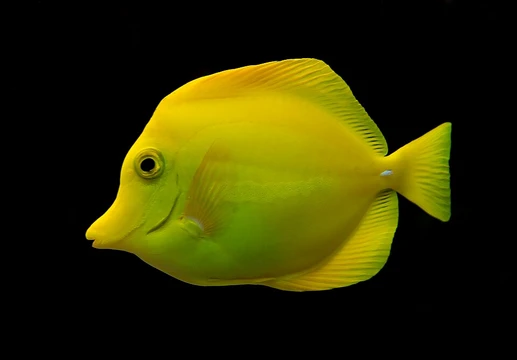
Description and natural history
Description and natural history, from the species' Wikipedia article.

The yellow tang (Zebrasoma flavescens) — also called the lemon sailfin, yellow sailfin tang, or somber surgeonfish — is a marine ray-finned fish in the family Acanthuridae, which includes surgeonfishes, unicornfishes, and tangs. Dressed in brilliant yellow, this Pacific reef dweller is one of the most beloved fish in the aquarium trade. It spawns around the full moon, grazes on algae, and wields a razor-sharp white barb near its tail for self-defense.
Quick Facts
- Taxon
- Zebrasoma flavescens
Facts from the source article.
Lore & Background
== Taxonomy and etymology ==
The yellow tang was first formally described by English naturalist Edward Turner Bennett as *Acanthurus flavescens* in 1828, based on a specimen collected in the Hawaiian Islands. The genus name *Zebrasoma* refers to the zebra-like stripes or bars on the body of the type species, the sailfin tang (*Z. velifer*). The species name is the Latin adjective *flavescens*, meaning 'yellowish,' a nod to the tang's vivid coloration.
Within the genus *Zebrasoma*, the yellow tang forms a species pair with the scopas tang (*Z. scopas*).
== Distribution and habitat ==
This fish is commonly found on shallow reefs at depths of 2–46 metres (6.6–150.9 ft) across the Pacific Ocean — from the Ryukyu, Mariana, Marshall, Marcus, Wake, and Hawaiian islands, west of Hawaii and east of Japan.
There have also been reports of sightings off the coast of Florida in the Western Central Atlantic. A single specimen was filmed in the Mediterranean Sea off Spanish waters in 2008, likely an aquarium release. As of July 2024, yellow tangs have been spotted several times on the shallow reefs of Mexico's Riviera Maya.
Its habitat is tropical, with water temperatures ranging from 24–28 °C (75–82 °F).
== Description and biology ==
Adults can reach 20 centimetres (7.9 in) in length and 1–2 centimetres (0.39–0.79 in) in thickness, with males typically larger than females. Their color is a vivid, sunny yellow. At night, this fades slightly, and a brownish patch appears mid-body with a horizontal white band; they quickly regain their bright yellow hue by day. They can be aggressive, are prone to marine ich, and may damage coral in a reef tank. Males and females look nearly identical, but during mating, males shift color and perform a shimmering display that makes them identifiable.
The yellow tang has 5 dorsal spines and 23–26 dorsal soft rays, plus 3 anal spines and 19–22 anal soft rays. A sharp white spine on the caudal peduncle serves as a defensive weapon. Its snout is moderately protruding, and its small mouth holds spatulate teeth set relatively close together. Juveniles have 12 upper and 14 lower teeth; adults have 18 upper and 22 lower teeth.
In the wild, yellow tangs can live for over 40 years.
Reader's Guide
This account is drawn from the species' own Wikipedia article and is reproduced under CC BY-SA 4.0. Follow the source link for the article's own citations and revision history.
Sources Wikipedia: Yellow tang — https://en.wikipedia.org/wiki/Yellow_tang — Licence: CC BY-SA 4.0 — Accessed 2026-09-19
Taxonomy and Physical Form
The yellow tang received its first formal scientific description in 1828, when English naturalist Edward Turner Bennett named it Acanthurus flavescens based on specimens collected in the Hawaiian Islands. The genus name Zebrasoma alludes to the zebra-like striping found on the type species, the sailfin tang, while the species epithet flavescens simply captures the fish's vivid yellow hue. Within its genus, the yellow tang forms a close species pair with the scopas tang. Adults reach roughly 20 centimetres in length but remain slender, measuring only one to two centimetres in thickness, with males typically outgrowing females. The body is a uniform, brilliant yellow by day, yet at night the coloration dulls and a brownish midsection patch with a horizontal white stripe appears, fading again at dawn. Structurally, the fish carries five dorsal spines backed by 23 to 26 soft rays, three anal spines with 19 to 22 anal soft rays, and a small, moderately protruding snout. Its mouth houses closely set spatulate teeth—12 upper and 14 lower in juveniles, increasing to 18 and 22 in adults. A distinctive white spine sits on the caudal peduncle, serving as a defensive weapon.
Range and Habitat
The yellow tang inhabits tropical Pacific reefs, ranging from the Ryukyu and Mariana archipelagos through the Marshall, Marcus, and Wake islands to the Hawaiian chain, spanning waters west of Hawaii and east of Japan. It favors shallow reef environments between 2 and 46 metres depth, thriving in water temperatures of 24 to 28 degrees Celsius. In the wild, individuals are typically solitary or form small groups, and they face predation from larger reef fish, sharks, crabs, and octopuses. Despite its Pacific stronghold, the species has occasionally appeared far outside its expected range. Reports place yellow tangs off the Florida coast in the Western Central Atlantic, and in 2008 a single specimen was filmed in Spanish Mediterranean waters—most likely the result of an aquarium release. More recently, as of mid-2024, multiple sightings have been recorded on the shallow reefs along Mexico's Riviera Maya. These scattered occurrences underscore how the species' popularity in the aquarium trade has occasionally led to its introduction into non-native waters, while its core population remains firmly anchored in the warm, algae-rich reefs of the central and western Pacific.
Reproduction and Feeding Ecology
Spawning occurs year-round but peaks around the full moon, indicating a lunar periodicity that synchronizes reproductive activity. Pairs or small groups release gametes into open water, where external fertilization takes place. The eggs are scattered as substratum deposits, and once released, the parents provide no further care—no guarding, no tending of hatched juveniles. The resulting larvae are remarkably resilient, capable of drifting over 100 miles on ocean currents before settling and reseeding in distant reef locations. In the wild, yellow tangs can live beyond 40 years. Dietarily, the species is predominantly herbivorous, grazing on benthic, uncalcified, and filamentous turf algae along with other marine plant material, supplemented by occasional zooplankton. In captivity, they are often fed meat- or fish-based aquarium preparations, though long-term health implications of such a diet remain debated; most marine aquarium experts argue that a balanced mix of plant and animal matter still meets the tang's need for complex amino acids. In their natural habitat, yellow tangs also perform a valuable cleaning service for marine turtles, stripping algal growth from the reptiles' shells.
Conservation and the Aquarium Trade
The yellow tang's status as one of the most popular marine aquarium fish has placed enormous pressure on wild populations. Hawaii was the primary source, supplying up to 70 percent of the species collected for the global aquarium industry, with 300,000 to 500,000 individuals harvested there annually. By the late 1990s, stocks were collapsing, prompting the establishment of nine marine protected areas along the Hawaiian coast. Today, more than 70 percent of the yellow tang's natural range falls under collection and fishing protections, and the IUCN lists the species as least concern. A 2010 study by Mark Hixon and colleagues demonstrated that larvae spawned within marine reserves can ride ocean currents and replenish fished areas over 100 miles away, confirming that the fishery is recovering through this larval connectivity. In 2015, researchers achieved a milestone by successfully breeding yellow tangs in captivity, offering a sustainable alternative to wild collection. The economic impact of conservation measures has been stark: before a January 2021 collection ban in Hawaii, the fish sold for roughly $65 to $70 in the United States; afterward, prices more than quadrupled to over $400.
Gallery




Elsewhere in Yellow tang
Spotted an error? Know more?
Reader corrections go straight into our review queue. Suggest an edit · How this site is sourced