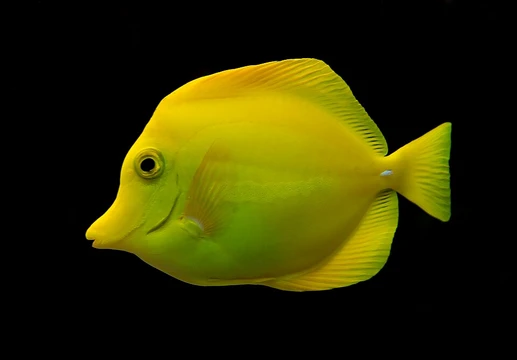
Biology and life history
From max size to depth range: the raw data that defines this species in the wild.

Here’s what science has pinned down about the life of *Zebrasoma flavescens*—the bright yellow surgeonfish that rules Hawaii’s reefs and aquarium tanks. These are the hard numbers and habitat notes from FishBase, the go-to database for fish biology.
- Maximum length
- 20 cm
- Depth range
- 2–46 m
- Habitat zone
- reef-associated
- Body shape
- short and / or deep
- Vulnerability index
- 57.42 of 100
- Fishery importance
- commercial
- Aquarium trade
- commercial
Lore & Background
Maximum length: 20 cm — about the length of a dinner fork. Depth range: 2–46 m, though some wander as deep as 81 m over rocky bottoms. Habitat zone: reef-associated, always near coral. Body shape: short and deep, like a pancake with fins. Vulnerability index: 57.42 out of 100 — moderately vulnerable to fishing pressure. Fishery importance: commercial. Aquarium trade: commercial — and the #1 marine fish export from Hawaii.
Adults are homebodies of coral-rich lagoons and seaward reefs, hiding just below the surge zone down to about 46 m (Ref. 9710). They cruise alone or in loose gangs, nibbling filamentous algae like underwater lawnmowers. When it’s time to spawn, territorial males put on a show: they court passing females, then pair up or join group spawns. The whole affair syncs with the full moon, suggesting a lunar beat (Ref. 86544). Spawning happens in batches year-round (Ref. 86544). Oddly, despite having distinct grooves along the spine, scientists couldn’t confirm a venom gland—possibly because adults lose it (Ref. 57406). A beloved aquarium star, and the top marine fish export from Hawaii.
Reader's Guide
These are database values, not aquarium guidance. FishBase does not publish captive-care parameters, and none are inferred here.
Sources FishBase species summary (SpecCode 6018) — https://www.fishbase.se/summary/Zebrasoma-flavescens.html — Froese, R. and D. Pauly, eds. FishBase, v25.04. FishBase.
Naming, Form, and the Rhythm of Color
Edward Turner Bennett, an English naturalist working in 1828, gave the species its first formal scientific name based on specimens gathered in the Hawaiian Islands. He called it Acanthurus flavescens, pairing the genus with a Latin adjective meaning "yellowish." The genus name Zebrasoma itself nods to the zebra-like barring seen on the sailfin tang, the type species, while the yellow tang forms a close species pair with the scopas tang. Physically, adults reach roughly twenty centimetres in length yet remain only one to two centimetres thick, giving them a strikingly compressed, sail-like silhouette. Males typically outgrow females, though the two sexes look nearly identical outside of courtship, when males shift hue and display a shimmering motion. The most remarkable daily feature is the fish's color: brilliant yellow by day, but at night the pigment dulls and a brownish blotch with a horizontal white stripe appears mid-body, only to vanish again at first light. A small white spine sits just ahead of the tail as a defensive weapon, and the mouth houses closely packed spatulate teeth—twelve upper and fourteen lower in juveniles, growing to eighteen and twenty-two in adults. In the wild, these fish can surpass forty years of age.
Moonlit Spawning and the Long Drift
The yellow tang's reproductive cycle is tied to the lunar calendar. Although spawning can occur year-round, it peaks around the full moon, suggesting a genuine lunar periodicity governs the timing. Pairs or small groups release gametes into open water, where fertilization takes place externally. The eggs are scattered over the substrate, and neither parent guards them; once the larvae hatch, they receive no further care from their parents. What makes this species particularly fascinating to marine biologists is the extraordinary distance its larvae can travel. Young yellow tangs are capable of drifting more than one hundred miles on ocean currents before settling onto a reef, potentially far from where they were spawned. A 2010 study led by coauthor Mark Hixon confirmed that larvae released inside marine reserves could ride currents and replenish fished populations at considerable distances. This discovery proved that fish populations are connected across vast stretches of open ocean through larval drift, and it offered a biological explanation for why the yellow tang fishery was beginning to recover after years of heavy harvesting.
From Collapse to Recovery: Conservation and the Aquarium Trade
For decades the yellow tang was one of the most heavily harvested reef fish in the Pacific. In Hawaii alone, between three hundred thousand and five hundred thousand specimens were pulled from the wild every year, and at peak demand the islands supplied up to seventy percent of the global aquarium market. By the late 1990s, wild stocks had collapsed to the point of crisis. In response, nine marine protected areas were established along the Hawaiian coast, and today more than seventy percent of the species' natural range is shielded from collection and commercial fishing. The recovery has been aided by the larval-drift mechanism described above, but human intervention played an equally vital role. In 2015, researchers achieved a milestone by successfully breeding yellow tangs in captivity, opening a path toward a sustainable supply for the aquarium industry that does not depend on wild harvesting. The species now carries a "least concern" designation on the IUCN Red List, a status that reflects both the protective measures in place and the resilience of a population whose larvae can travel over a hundred miles to reseed depleted reefs.
Life Behind Glass: Keeping a Yellow Tang
The yellow tang's vivid color and active personality have made it one of the most sought-after saltwater aquarium fish in the world. Specimens are typically introduced into home tanks at two to four inches, though larger individuals up to six inches occasionally appear on the market. In the wild they can reach eight inches, so a sufficiently large display is essential. Keeping one is not without challenges. The species can display aggression toward tankmates, is susceptible to marine ich, and may nibble on live coral in a reef setup. Nutritionally, wild yellow tangs are primarily herbivorous, grazing on benthic filamentous algae and turf, with only occasional zooplankton. In captivity, however, they are commonly offered meat- or fish-based pellet food. While some question the long-term effects of such a diet, most marine-aquarium experts maintain that a balanced regimen combining plant and animal matter provides the complex amino acids these fish still require. The economics of ownership shifted dramatically after Hawaii's collection ban took effect in early 2021. Before that, a yellow tang cost roughly sixty-five to seventy dollars in the United States; afterward, prices more than quadrupled, climbing past four hundred dollars per specimen.
Gallery

Elsewhere in Yellow tang
Spotted an error? Know more?
Reader corrections go straight into our review queue. Suggest an edit · How this site is sourced