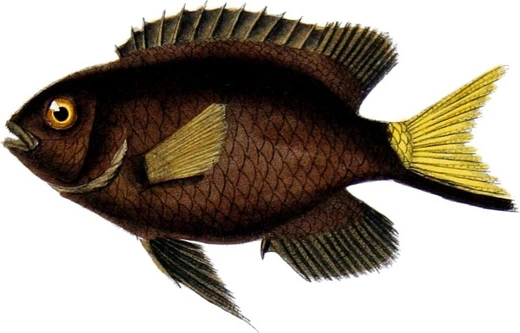
Yellowtip damselfish (Stegastes pictus)
Source-cited species reference: taxonomy from WoRMS, biology from FishBase, occurrence map from GBIF, conservation from IUCN Red List, description from Wikipedia.

Stegastes pictus, the yellowtip damselfish, is a species of damselfish found near the sea bed on shallow rocky reefs off the coast of Brazil, where it is endemic. It is a small, laterally-compressed, dark brown fish with yellow pectoral and caudal fins. It feeds on algae and detritus and is often found in the vicinity of the fire coral Millepora alcicornis. It is a territorial fish and forms a pair bond in the breeding season. The eggs are laid in a shallow scoop on the seabed and the male tends them to keep them well-aerated.
- Scientific name
- Stegastes pictus
- Authority
- (Castelnau, 1855)
- Family
- Pomacentridae
- Order
- Ovalentaria incertae sedis
- Maximum length
- 7.5 cm
- Habitat zone
- demersal
- Iucn red list
- Least Concern
- Gbif occurrence records
- 2,545
Classification (WoRMS)
Full classification as recorded by WoRMS: Kingdom: Animalia · Phylum: Chordata · Class: Teleostei · Order: Ovalentaria incertae sedis · Family: Pomacentridae · Genus: Stegastes.
Accepted name: Stegastes pictus · Authority: (Castelnau, 1855) · Taxonomic status: accepted · AphiaID: 276678.
Synonyms and superseded combinations recorded for this taxon: Pomacentrus pictus Castelnau, 1855.
Source: World Register of Marine Species (WoRMS) — https://www.marinespecies.org/aphia.php?p=taxdetails&id=276678 (CC BY 4.0). Accessed 2026-09-23.
Biology and life history (FishBase)
Measured values published by FishBase for Stegastes pictus. Only fields the database actually holds for this species are shown; these are database values, not aquarium guidance.
Maximum length: 7.5 cm · Habitat zone: demersal · Body shape: fusiform / normal · Vulnerability index: 10 of 100 · Fishery importance: commercial · Aquarium trade: commercial.
FishBase notes: Adults inhabit shallow rocky reefs and associated with colonies of Millepora alcicornis (Floeter 1998, pers. comm.). Feed mainly on benthic algae and aggressively territorial (Floeter 1998, pers. comm.). Oviparous, distinct pairing during breeding (Ref. 205). Eggs are demersal and adhere to the substrate (Ref. 205). Males guard and aerate the eggs (Ref. 205).
Source: FishBase species summary (SpecCode 12417) — https://www.fishbase.se/summary/Stegastes-pictus.html (CC BY-NC 3.0 — non-commercial use only). Accessed 2026-09-23.
Distribution and occurrence records (GBIF)
2,545 georeferenced occurrence records for Stegastes pictus are published through GBIF from 12 countries or marine areas. The map above plots 62 distinct locations from a sample of 2,545 records, omitting 11 inland records that carry an institution's coordinates rather than a collection site; it shows where the species has been observed and reported, not a modelled range.
Most records by country or area: Brazil (2,523); Jamaica (3); Venezuela (Bolivarian Republic of) (3); Cayman Islands (2); Mexico (2).
The full country table, WoRMS marine regions and the sampling notes are on this species' Distribution page.
Source: GBIF Occurrence Search (taxonKey 2398843) — https://www.gbif.org/occurrence/search?taxon_key=2398843&has_coordinate=true (records CC0 / CC BY); WoRMS distribution records (MarineRegions) — https://www.marinespecies.org/aphia.php?p=taxdetails&id=276678 (CC BY 4.0); Natural Earth 110m basemap — https://www.naturalearthdata.com/ (public domain). Accessed 2026-09-23.
Conservation status (IUCN Red List)
The IUCN Red List assesses Stegastes pictus (Castelnau, 1855) as Least Concern (code LC). No trend, population estimate or threat analysis is given here, because none is available from this source without the Red List API; follow the source link for the full assessment, including its date.
Source: IUCN Red List of Threatened Species (taxon 188517) — https://www.iucnredlist.org/species/188517/0; GBIF IUCN Red List category endpoint (taxonKey 2398843) — https://api.gbif.org/v1/species/2398843/iucnRedListCategory. Accessed 2026-09-23.
Description and natural history (Wikipedia)
S. pictus is deep-bodied and laterally compressed, and grows to about 7.5 cm in length. It is a dark brownish-black colour with yellow eyes, yellow pectoral and tail fins and a pale edge to the gill covers. The large dorsal fin has 12 spines and about 15 soft rays. The anal fin has two spines and about 14 soft rays. The paired pectoral and pelvic fins have only soft rays. There are 19 or 20 scales on the lateral line and about 20 gill rakers. The mouth is at the tip of the snout.
S. pictus is a demersal fish and a territorial species, which guards an area of sea floor on which it grazes algae and eats detritus. It is often found associated with the fire coral, Millepora alcicornis. It is preyed upon by the trumpetfish, Aulostomus maculatus.
Yellowtip damselfish form pair bonds at breeding time. The eggs are laid on the sea bed and the male guards them and fans them as they develop to increase their oxygen supply.
Source: Wikipedia: Stegastes pictus — https://en.wikipedia.org/wiki/Stegastes_pictus (CC BY-SA 4.0). Accessed 2026-09-23.
Related in Yellowtip damselfish
Links follow this subject's own source article.
Elsewhere in Yellowtip damselfish
Spotted an error? Know more?
Reader corrections go straight into our review queue. Suggest an edit · How this site is sourced