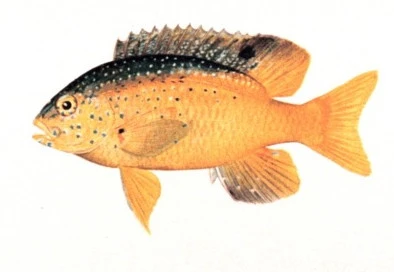
Beaugregory (Stegastes leucostictus)
Source-cited species reference: taxonomy from WoRMS, biology from FishBase, occurrence map from GBIF, conservation from IUCN Red List, description from Wikipedia.

Stegastes leucostictus is a species of damselfish found near the sea bed in shallow waters on the western fringes of the Atlantic Ocean. It is commonly known as the beau gregory or beaugregory.
- Scientific name
- Stegastes leucostictus
- Authority
- (Müller & Troschel, 1848)
- Family
- Pomacentridae
- Order
- Ovalentaria incertae sedis
- Maximum length
- 10 cm
- Depth range
- 0–10 m
- Habitat zone
- reef-associated
- Iucn red list
- Least Concern
- Gbif occurrence records
- 33,131
Classification (WoRMS)
Full classification as recorded by WoRMS: Kingdom: Animalia · Phylum: Chordata · Class: Teleostei · Order: Ovalentaria incertae sedis · Family: Pomacentridae · Genus: Stegastes.
Accepted name: Stegastes leucostictus · Authority: (Müller & Troschel, 1848) · Taxonomic status: accepted · AphiaID: 159291.
Synonyms and superseded combinations recorded for this taxon: Eupomacentrus leucostictus (Müller & Troschel, 1848); Eupomacentrus nepenthe Nichols, 1921; Pomacentrus analis Poey, 1868; Pomacentrus atrocyaneus Poey, 1860; Pomacentrus caudalis Poey, 1868; Pomacentrus cuadalis Poey, 1868; Pomacentrus leucostictus Müller & Troschel, 1848; Pomacentrus leucosticus Müller & Troschel, 1848.
Source: World Register of Marine Species (WoRMS) — https://www.marinespecies.org/aphia.php?p=taxdetails&id=159291 (CC BY 4.0). Accessed 2026-09-23.
Biology and life history (FishBase)
Measured values published by FishBase for Stegastes leucostictus. Only fields the database actually holds for this species are shown; these are database values, not aquarium guidance.
Maximum length: 10 cm · Depth range: 0–10 m · Habitat zone: reef-associated · Body shape: short and / or deep · Vulnerability index: 10 of 100 · Fishery importance: commercial · Aquarium trade: commercial.
FishBase notes: Adults occur in seagrass beds, coral or rocky reefs and sandy areas. Also found around mangrove shores and sponge beds; less common on flourishing coral reefs (Ref. 26938). They remain within 50 cm from the substrate. Adults feed on algae, polychaetes, amphipods, foraminiferans and gastropods while juveniles feed on harpacticoid copepods, nemerteans and polychaetes (Ref. 9626). Oviparous, distinct pairing during breeding (Ref. 205). Eggs are demersal and adhere to the substrate (Ref. 205). Males guard and aerate the eggs (Ref. 205). Caught incidentally in traps and small-meshed beach nets (Ref. 5217).
Source: FishBase species summary (SpecCode 3651) — https://www.fishbase.se/summary/Stegastes-leucostictus.html (CC BY-NC 3.0 — non-commercial use only). Accessed 2026-09-23.
Distribution and occurrence records (GBIF)
33,131 georeferenced occurrence records for Stegastes leucostictus are published through GBIF from 42 countries or marine areas. The map above plots 114 distinct locations from a sample of 3,000 records, omitting 27 inland records that carry an institution's coordinates rather than a collection site; it shows where the species has been observed and reported, not a modelled range.
Most records by country or area: United States of America (26,205); Puerto Rico (2,839); Virgin Islands (U.S.) (1,505); Colombia (903); Mexico (380).
The full country table, WoRMS marine regions and the sampling notes are on this species' Distribution page.
Source: GBIF Occurrence Search (taxonKey 2398903) — https://www.gbif.org/occurrence/search?taxon_key=2398903&has_coordinate=true (records CC0 / CC BY); WoRMS distribution records (MarineRegions) — https://www.marinespecies.org/aphia.php?p=taxdetails&id=159291 (CC BY 4.0); Natural Earth 110m basemap — https://www.naturalearthdata.com/ (public domain). Accessed 2026-09-23.
Conservation status (IUCN Red List)
The IUCN Red List assesses Stegastes leucostictus (Müller & Troschel, 1848) as Least Concern (code LC). No trend, population estimate or threat analysis is given here, because none is available from this source without the Red List API; follow the source link for the full assessment, including its date.
Source: IUCN Red List of Threatened Species (taxon 188569) — https://www.iucnredlist.org/species/188569/0; GBIF IUCN Red List category endpoint (taxonKey 2398903) — https://api.gbif.org/v1/species/2398903/iucnRedListCategory. Accessed 2026-09-23.
Description and natural history (Wikipedia)
Stegastes leucostictus is a fairly deep-bodied, oval, laterally compressed bony fish, and grows to about 10 cm long. It is rather variable in colour, but is generally dark blue or brown along the top of the head and the ridge of the back and yellowish on the flanks. The large dorsal fin has 12 spines and 13 to 16 soft rays. The anal fin has two spines and 12 to 14 soft rays. The caudal fin has a shallow fork and the paired pectoral and pelvic fins have no spines. The mouth is set at the tip of the snout.
A juvenile S. leucostictus has blue stripes and spots on its head and a dull blue sheen on the top of the head and the upper part of the front half of the body. It has a large, black eye-spot ringed in blue, centered where the dorsal fin spines join the soft rays. As the juvenile develops, this spot moves upwards onto the fin. Also, a dark spot just above each pectoral fin distinguishes this species from others in the genus.
Stegastes leucostictus is found in shallow waters at depths down to about 10 m in the western Atlantic Ocean. Its range extends from Florida and the Gulf of Mexico south to Brazil. It is a demersal fish, normally remaining within 50 cm of the seabed. Its favoured habitats are seagrass meadows, rocky or coral reefs and sandy flats and it is sometimes found amongst mangroves.
Stegastes leucostictus feeds mainly on seaweed, but also consumes marine worms, amphipods, foraminiferans and gastropod molluscs. A male damselfish guards a territory, but seldom interacts with its neighbours, although it will attack a male of the same species introduced in a bottle placed in its territory. Dominance is related to the quality of the territory it occupies. The owner of a high-quality territory exhibits dominance and if it is removed and a subservient male moves in, it in turn develops dominance.
During the breeding season, a male and a female form a pair bond. The eggs are hidden inside an empty shell or under a stone, and the male guards the nest and fans the eggs with its fins to keep them well oxygenated.
The wrasse, Thalassoma bifasciatum (bluehead), preys upon the eggs of S. leucostictus. A male damselfish can evaluate the level of the threat posed by one or more wrasse and react appropriately. It either chases the other fish, harries it, or adopts a head-lowered, threatening posture.
Source: Wikipedia: Stegastes leucostictus — https://en.wikipedia.org/wiki/Stegastes_leucostictus (CC BY-SA 4.0). Accessed 2026-09-23.
Related in Beaugregory
Links follow this subject's own source article.
Elsewhere in Beaugregory
Spotted an error? Know more?
Reader corrections go straight into our review queue. Suggest an edit · How this site is sourced