Stegastes
Small, territorial damselfish known as Gregories, found worldwide in tropical reefs.

Stegastes, also called Gregories, is a genus of ray-finned fish belonging to the Pomacentridae family. Most species live in coastal marine waters, though S. otophorus can also be found in brackish environments. These small tropical fish are commonly referred to as damselfish, gregory, or major, and inhabit coral and rocky reefs across the Atlantic, Indian, and Pacific Oceans. They sometimes appear in the aquarium trade, where they are easy to care for, but their territorial and aggressive nature makes them poor tank mates for other fish, including their own kind.
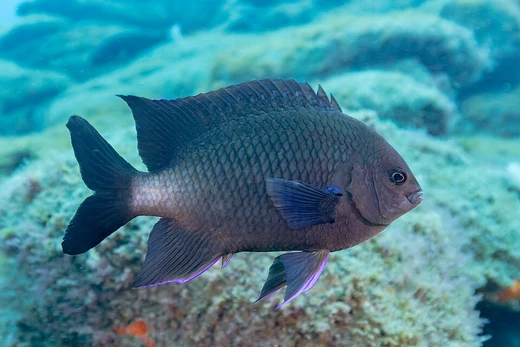
The largest species, S. acapulcoensis, reaches a maximum length of 17 cm (7 in), while the smallest, S. pictus, grows to 7.5 cm (3.0 in). Members of this genus have deep, laterally compressed bodies and forked tails. Their heads feature a blunt snout, a small mouth at the front, a nostril on each side, and large eyes. The lateral line is incomplete, with gaps, and does not extend the full body length. A single large dorsal fin is present, and the anal fin has two or, rarely, three spines. Coloration varies by species and sometimes differs across a species’ range. Juveniles often display bright colors that are completely unlike those of adults. The brown color of Stegastes apicalis comes from melanosomes containing pheomelanin, unlike most fish, whose melanosomes contain eumelanin.
These damselfish primarily eat filamentous algae, which makes up about 90% of their diet, though they may also consume detritus and some invertebrates, likely by accident. They are territorial and actively cultivate algae, guarding their gardens from other fish. Most Stegastes species live alone, but some pair up with a mate, and a few form small, loose groups. They face little competition from other fish because they inhabit very shallow waters near reefs—among boulders, dead branching corals, man-made structures, and debris—rather than on the reefs themselves. Most species are highly aggressive and will attack anything entering their territory, including nipping at divers to drive them away.
During breeding season, behavior shifts. The male prepares a nest by cleaning a smooth rock, removing algae and debris, and chasing away unwanted invertebrates like starfish and sea urchins. He then signals readiness by changing color and displaying brighter hues.
Quick Facts
- Taxon
- Stegastes
- Type Species
- Stegastes imbricatus
- Type Species Authority
- Jenyns, 1840
Facts from the source article.
Lore & Background
Members of the genus Stegastes are deep-bodied and laterally flattened fish with forked tails. The head has a blunt snout, a small terminal mouth, a nostril on each side, and large eyes. The lateral line does not run the full length of the body and has gaps. A single large dorsal fin is present, and the anal fin has two or rarely three spines. Color varies with species and sometimes with geographic range; juveniles tend to have bright colors completely different from adults. The brown color of Stegastes apicalis arises from melanosomes containing pheomelanin, unlike most fish species whose melanosomes contain eumelanin.
These damselfish feed primarily on filamentous algae, which makes up about 90% of their diet, though they may consume detritus and some invertebrate material, possibly accidentally. They are territorial and cultivate algae, guarding their garden from other fish. Most species live solitary lives, though some associate with a member of the opposite sex, and a few form loose aggregations. They face little competition from other fish due to the very shallow water they inhabit and because their habitat is near reefs among boulders, dead branching corals, man-made structures, and junk. Most species are very aggressive and attack anything entering their territory, including nipping divers.
During breeding season, the male prepares a nesting site by cleaning a smooth rock, removing algae and debris, and driving away unwanted invertebrates. He signals readiness by changing hue and displaying brighter colors. A female lays a single layer of eggs on the prepared rock; the male fertilizes them and guards them, removing debris and unfertilized eggs, and fanning the embryos with his fins. Eggs hatch in about a week, and larvae drift as plankton. About a month later, they settle to the seabed and metamorphose into juveniles, well away from adult territories.
Reader's Guide
Stegastes species are notable for their widespread distribution across tropical oceans and their role as algal farmers in shallow near-reef habitats. Their aggressive territorial behavior makes them a challenging addition to community aquariums, despite being easy to care for in terms of water quality tolerance and diet. The genus includes a wide range of sizes, from the smallest S. pictus at 7.5 cm to the largest S. acapulcoensis at 17 cm. Their breeding behavior involves dedicated paternal care, with males preparing nesting sites, guarding eggs, and fanning them for oxygenation. The larvae spend about a month in the plankton before settling away from adult territories. The unique pigmentation of S. apicalis, using pheomelanin rather than eumelanin, highlights biochemical diversity within the genus. In the aquarium trade, they are sometimes recommended for beginners due to their hardiness, but their aggression toward other fish—including smaller ones—limits their suitability for mixed-species tanks.
Did You Know?
- The largest species in the genus is S. acapulcoensis, growing to 17 cm, while the smallest is S. pictus at 7.5 cm.
- Male Stegastes prepare nesting sites by cleaning smooth rocks and driving away starfish and sea urchins.
- Eggs hatch in about a week, and larvae drift as plankton for about a month before settling as juveniles.
More in Clownfish and Damselfish 1-24
Spotted an error? Know more?
Reader corrections go straight into our review queue. Suggest an edit · How this site is sourced