
Tuberculate cuttlefish (Sepia tuberculata)
Source-cited species reference: taxonomy from WoRMS, biology from SeaLifeBase, occurrence map from GBIF, conservation from IUCN Red List, description from Wikipedia.
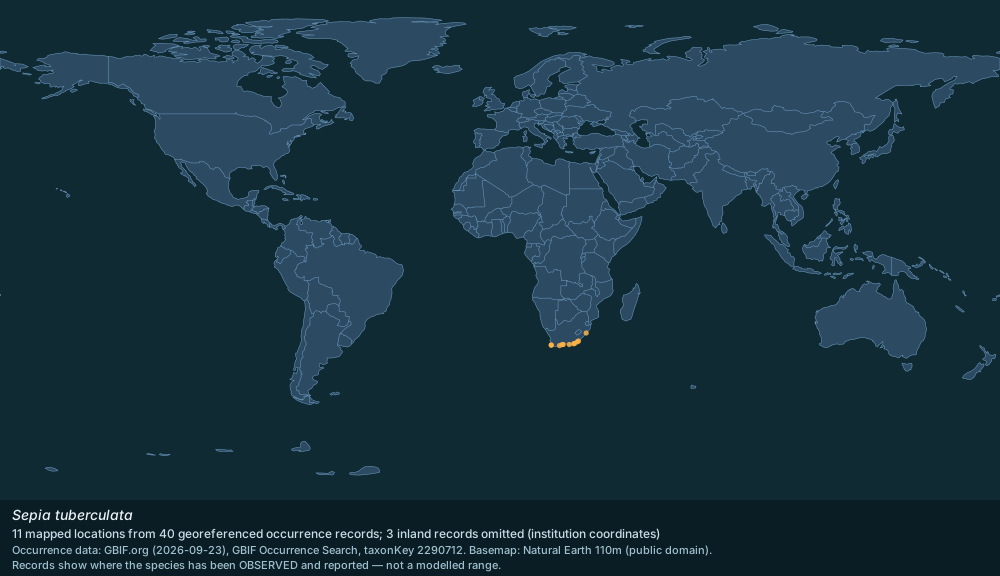
Sepia tuberculata is a species of cuttlefish native to South African waters from Melkbosstrand (an area near Cape Town) () to Knysna (In the South) (). It belongs to the genus Sepia. It lives in very shallow water to a depth of 3 m. It is endemic.
- Scientific name
- Sepia tuberculata
- Authority
- Lamarck, 1798
- Family
- Sepiidae
- Order
- Sepiida
- Maximum length
- 8.2 cm
- Habitat zone
- demersal
- Iucn red list
- Data Deficient
- Gbif occurrence records
- 40
Classification (WoRMS)
Full classification as recorded by WoRMS: Kingdom: Animalia · Phylum: Mollusca · Class: Cephalopoda · Order: Sepiida · Family: Sepiidae · Genus: Sepia.
Accepted name: Sepia tuberculata · Authority: Lamarck, 1798 · Taxonomic status: accepted · AphiaID: 225552.
Source: World Register of Marine Species (WoRMS) — https://www.marinespecies.org/aphia.php?p=taxdetails&id=225552 (CC BY 4.0). Accessed 2026-09-23.
Biology and life history (SeaLifeBase)
Measured values published by SeaLifeBase for Sepia tuberculata. Only fields the database actually holds for this species are shown; these are database values, not aquarium guidance.
Maximum length: 8.2 cm · Habitat zone: demersal · Vulnerability index: 10 of 100.
Source: SeaLifeBase species summary (SpecCode 57663) — https://www.sealifebase.se/summary/Sepia-tuberculata.html (CC BY-NC 3.0 — non-commercial use only). Accessed 2026-09-23.
Distribution and occurrence records (GBIF)
40 georeferenced occurrence records for Sepia tuberculata are published through GBIF from 1 countries or marine areas. The map above plots 11 distinct locations from a sample of 40 records, omitting 3 inland records that carry an institution's coordinates rather than a collection site; it shows where the species has been observed and reported, not a modelled range.
Most records by country or area: South Africa (40).
Marine regions with a valid WoRMS distribution record: South Coast of South Africa; South West Indian Ocean; FAO fishing area 47; Knysna; South African Exclusive Economic Zone.
Source: GBIF Occurrence Search (taxonKey 2290712) — https://www.gbif.org/occurrence/search?taxon_key=2290712&has_coordinate=true (records CC0 / CC BY); WoRMS distribution records (MarineRegions) — https://www.marinespecies.org/aphia.php?p=taxdetails&id=225552 (CC BY 4.0); Natural Earth 110m basemap — https://www.naturalearthdata.com/ (public domain). Accessed 2026-09-23.
Conservation status (IUCN Red List)
The IUCN Red List assesses Sepia tuberculata Lamarck, 1798 as Data Deficient (code DD). No trend, population estimate or threat analysis is given here, because none is available from this source without the Red List API; follow the source link for the full assessment, including its date.
Source: IUCN Red List of Threatened Species (taxon 162545) — https://www.iucnredlist.org/species/162545/0; GBIF IUCN Red List category endpoint (taxonKey 2290712) — https://api.gbif.org/v1/species/2290712/iucnRedListCategory. Accessed 2026-09-23.
Description and natural history (Wikipedia)
The type specimen was collected off the coast of South Africa and is deposited at the Muséum National d'Histoire Naturelle in Paris.
Sepia tuberculata grows to a mantle length of 82 mm. The upper surface of the body is rough with variably extending bumps. The lower body surface has two glandular patches. Like all cuttlefish, this species has ten arms, of which two are elongated tentacles used for catching prey. It has narrow fins which extend the length of the body.
Sepia tuberculata is capable of changing colour rapidly. It feeds on shrimps. It uses its glandular patches to cling to rocks.
It is the prey of the Cape Clawless Otter – an opportunistic mammal that is adept at capturing available prey. It is often caught in the Tsitsikama Coastal National Park in South Africa. It is part of the IUCN Red List of Threatened Species however it is considered "data deficient" since there is very little published information on the species and thus cannot be put into a Red List Category. A huge threat to Sepia tuberculata, as well as many other Cephalopods, is ocean acidification due to anthropogenic carbon dioxide emissions. Changes in the chemistry of seawater has been found to increase calcification rates in a relative of S. tuberculata, S. officinalis. Increased calcification in the cuttlebone has a negative impact in that it affects the cuttlebone's function as a lightweight, buoyancy structure in cuttlefish.
Cuttlefish have made a lot of the earnings for several fisheries in the English Channel however it is unknown if S. tuberculata is of interest to fisheries in South Africa.
Not much is known about specific prey preference S. tuberculata, but the common cuttlefish is known to feed on shrimp. This exhibition of food preference is shown very early in life for cuttlefish and suggests that choosing to prey on shrimp is an innate behavior.
Much of the research published about Sepia tuberculata has been concerning the topic of adhesion. Adhesion is a common occurrence that is used by many plants and animals including Cephalopods, the class to which all Cuttlefish belong. It is effectively bonding, or how plants and animals hold onto substrates. Adhesion, for Cephalopods, typically happens by means of a pressure system that includes use of the suckers on their and tentacles. Sepia are one taxa of cephalopods that produce a chemical substance to be used for adhesion; the use of this secretion varies depending on each specific animal. In addition, S. tuberculata is one of at least four Sepia species that actually possesses an adhesive structure.
No information has been published on whether or not S. tuberculata has the ability to change colors/produce patterns on its body, but the common cuttlefish, S. officinalis, possesses the ability to produce 13 different body patterns composed of a number of different chromatic, textural, postural and locomotor components in its body. The changing of body patterns is primarily used for concealment, and specific patterns are chosen depending on the strategy the cuttlefish intends to use be that disruptive coloration or general color resemblance.
Source: Wikipedia: Sepia tuberculata — https://en.wikipedia.org/wiki/Sepia_tuberculata (CC BY-SA 4.0). Accessed 2026-09-23.
Gallery
Spotted an error? Know more?
Reader corrections go straight into our review queue. Suggest an edit · How this site is sourced