
Hooded cuttlefish (Rhombosepion prashadi)
Source-cited species reference: taxonomy from WoRMS, biology from SeaLifeBase, occurrence map from GBIF, conservation from IUCN Red List, description from Wikipedia.
Sepia prashadi, common name hooded cuttlefish, is a widely distributed species of cuttlefish. It has a thin, oval body and grows from 5 to 11 cm. The tips of the tentacles have a distinct club shape. S. prashadi is a migratory, demersal cuttlefish living in shallow waters at depths of approximately 40 to 50 metres. It is found in many locations including the east coast of Africa, around India, in the Red Sea, and Persian Gulf.
- Scientific name
- Rhombosepion prashadi
- Authority
- (Winckworth, 1936)
- Family
- Sepiidae
- Order
- Sepiida
- Maximum length
- 19.6 cm
- Depth range
- 0–200 m
- Habitat zone
- benthic
- Iucn red list
- Least Concern
- Gbif occurrence records
- 214
Classification (WoRMS)
Full classification as recorded by WoRMS: Kingdom: Animalia · Phylum: Mollusca · Class: Cephalopoda · Order: Sepiida · Family: Sepiidae · Genus: Rhombosepion.
Accepted name: Rhombosepion prashadi · Authority: (Winckworth, 1936) · Taxonomic status: accepted · AphiaID: 1667214.
Synonyms and superseded combinations recorded for this taxon: Sepia (Doratosepion) prashadi Winckworth, 1936; Sepia prashadi Winckworth, 1936.
Source: World Register of Marine Species (WoRMS) — https://www.marinespecies.org/aphia.php?p=taxdetails&id=1667214 (CC BY 4.0). Accessed 2026-09-23.
Biology and life history (SeaLifeBase)
Measured values published by SeaLifeBase for Rhombosepion prashadi. Only fields the database actually holds for this species are shown; these are database values, not aquarium guidance.
Maximum length: 19.6 cm · Depth range: 0–200 m · Habitat zone: benthic · Vulnerability index: 10.8 of 100 · Fishery importance: commercial.
SeaLifeBase notes: Common mantle length: 5.0 to 11.0 cm. Common mantle length ranges between 5 and 11 cm in Indian trawl catches off Waltair (Ref. 3722). From coastline to a depth of 40 m (Ref. 801).
Source: SeaLifeBase species summary (SpecCode 57930) — https://www.sealifebase.se/summary/Rhombosepion-prashadi.html (CC BY-NC 3.0 — non-commercial use only). Accessed 2026-09-23.
Distribution and occurrence records (GBIF)
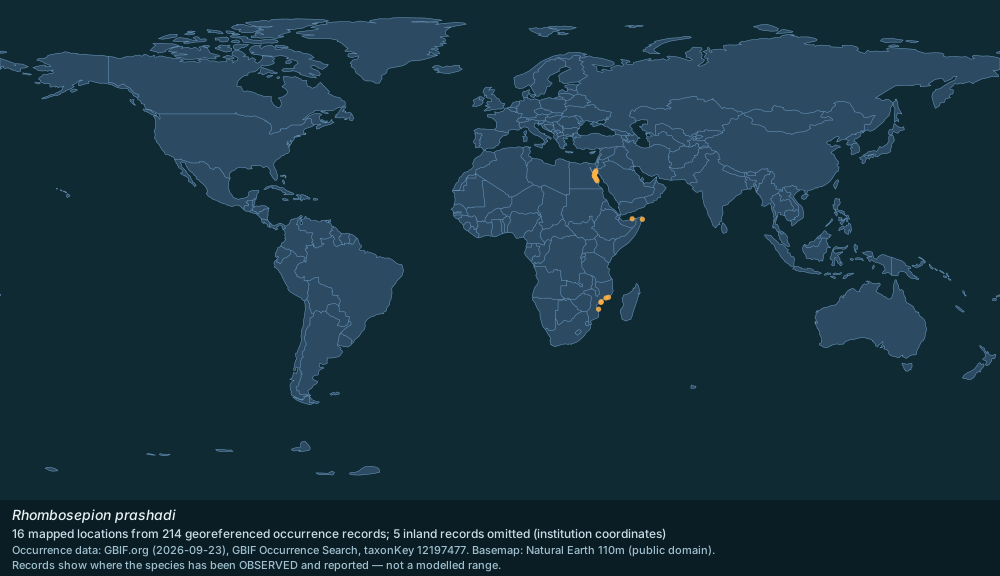
214 georeferenced occurrence records for Rhombosepion prashadi are published through GBIF from 5 countries or marine areas. The map above plots 16 distinct locations from a sample of 214 records, omitting 5 inland records that carry an institution's coordinates rather than a collection site; it shows where the species has been observed and reported, not a modelled range.
Most records by country or area: Mozambique (194); Egypt (12); Somalia (5); Israel (2); Jordan (1).
Source: GBIF Occurrence Search (taxonKey 12197477) — https://www.gbif.org/occurrence/search?taxon_key=12197477&has_coordinate=true (records CC0 / CC BY); WoRMS distribution records (MarineRegions) — https://www.marinespecies.org/aphia.php?p=taxdetails&id=1667214 (CC BY 4.0); Natural Earth 110m basemap — https://www.naturalearthdata.com/ (public domain). Accessed 2026-09-23.
Conservation status (IUCN Red List)
The IUCN Red List assesses Rhombosepion prashadi (Winckworth, 1936) as Least Concern (code LC). No trend, population estimate or threat analysis is given here, because none is available from this source without the Red List API; follow the source link for the full assessment, including its date.
Source: IUCN Red List of Threatened Species (taxon 162556) — https://www.iucnredlist.org/species/162556/0; GBIF IUCN Red List category endpoint (taxonKey 12197477) — https://api.gbif.org/v1/species/12197477/iucnRedListCategory. Accessed 2026-09-23.
Description and natural history (Wikipedia)
The species was first reported in 1936 by Ronald Winckworth.
The common mantle of this species grows from 5 to 11 cm. It has an elongate, thin, oval body. It has tapering, subequal arms, and fins of medium width. At the end of the tentacles are broad, short, club shapes. There is a series of suckers on these clubs that are organized into eight oblique transverse rows. These suckers are of different sizes with three being enlarged on the third series. The dorsal surface of the cuttle bone is pink, making it highly distinct. Off Mumbai, India, the dorsal mantle lengths measured from 55 to 95 mm.
Sepia prashadi is very widely distributed, chiefly in the Indian Ocean. It is found all along the east coast of Africa, around Madagascar, the waters of India, the Bay of Bengal, in the Red Sea, Persian Gulf, Gulf of Oman, and in the Andaman Sea. It is native to almost two dozen countries.
This is a demersal species that lives in shallow waters at depths of roughly 40 meters to 50 meters. It is migratory as evidenced by a very notable seasonal occurrence pattern. In the waters of northeastern India the greatest numbers are seen between January and June. However, during some years it is most abundant between October and December. In more southern Indian waters such as those of Chennai, it occurs in greater numbers between January and April. It becomes abundant during times when there is an upwelling of deep water.
Males exhibit various displays to attract females for coitus. While copulating, female is held by male, which puts his hectocotylus in the female's mantle cavity. Fertilization is the common outcome. Males die shortly after spawning. Females die after brooding. Hooded cuttlefish may act more curious and confident around divers compared to the behavior of squid or octopus.
Analysis of specimens off the coast of Mumbai showed that they were feeding mainly on prawns.
This species is caught in the Red Sea and also in India off the northeast coast by trawlers. It is also caught unintentionally as bycatch in comparatively small amounts off the northeast coast of India, which is not reflected independently in catch statistics. In 2005 in the Gulf of Suez, stock assessment studies identified Sepia prashadi as an "under-exploited resource". Population and density are unknown as there have been no studies, and catch statistics are merely anecdotal and under reported. Ideally, in some habitats fishing needs to be curtailed.
Increased carbon dioxide concentration in the atmosphere causes ocean acidification. This "is potentially a threat to all cuttlefish", which respond by having a "denser cuttlebone" likely to negatively affect buoyancy regulation.
Source: Wikipedia: Sepia prashadi — https://en.wikipedia.org/wiki/Sepia_prashadi (CC BY-SA 4.0). Accessed 2026-09-23.
Gallery
Spotted an error? Know more?
Reader corrections go straight into our review queue. Suggest an edit · How this site is sourced