
Giant african cuttlefish (Sepia hierredda)
Source-cited species reference: taxonomy from WoRMS, biology from SeaLifeBase, occurrence map from GBIF, conservation from IUCN Red List, description from Wikipedia.
Sepia hierredda, the giant African cuttlefish, is a species of cuttlefish from the family Sepiidae, which was previously considered conspecific with the common cuttlefish Sepia officinalis. It is found along the western coast of Africa and is an important species to fisheries.
- Scientific name
- Sepia hierredda
- Authority
- Rang, 1835
- Family
- Sepiidae
- Order
- Sepiida
- Maximum length
- 50 cm
- Depth range
- 1–50 m
- Habitat zone
- benthic
- Iucn red list
- Data Deficient
- Gbif occurrence records
- 54
Classification (WoRMS)
Full classification as recorded by WoRMS: Kingdom: Animalia · Phylum: Mollusca · Class: Cephalopoda · Order: Sepiida · Family: Sepiidae · Genus: Sepia.
Accepted name: Sepia hierredda · Authority: Rang, 1835 · Taxonomic status: accepted · AphiaID: 342138.
Synonyms and superseded combinations recorded for this taxon: Acanthosepion goreense Rochebrune, 1884; Acanthosepion oculifera Rochebrune, 1884; Sepia officinalis hierreda Rang, 1837.
Source: World Register of Marine Species (WoRMS) — https://www.marinespecies.org/aphia.php?p=taxdetails&id=342138 (CC BY 4.0). Accessed 2026-09-23.
Biology and life history (SeaLifeBase)
Measured values published by SeaLifeBase for Sepia hierredda. Only fields the database actually holds for this species are shown; these are database values, not aquarium guidance.
Maximum length: 50 cm · Depth range: 1–50 m · Habitat zone: benthic · Vulnerability index: 40 of 100.
Source: SeaLifeBase species summary (SpecCode 57450) — https://www.sealifebase.se/summary/Sepia-hierredda.html (CC BY-NC 3.0 — non-commercial use only). Accessed 2026-09-23.
Distribution and occurrence records (GBIF)
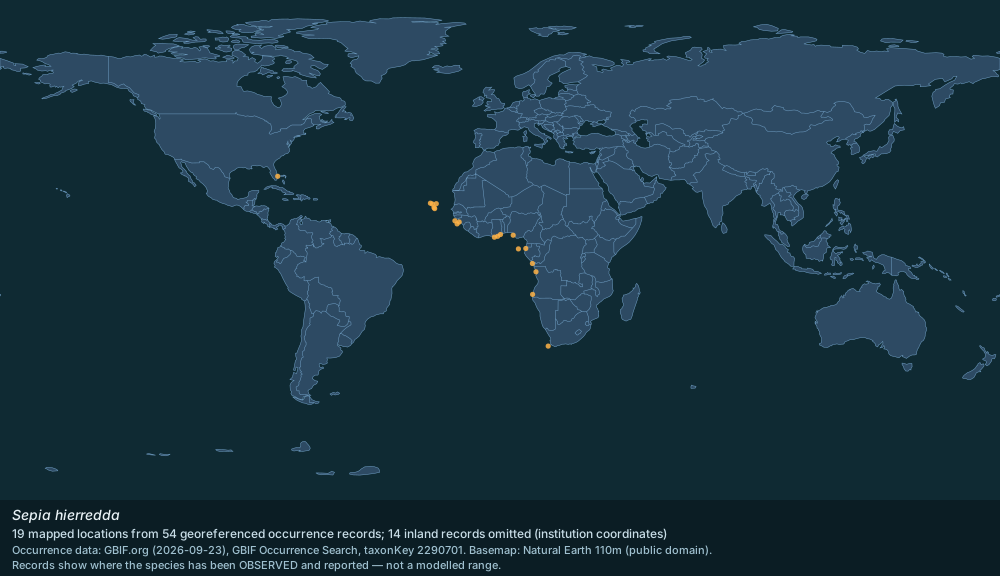
54 georeferenced occurrence records for Sepia hierredda are published through GBIF from 16 countries or marine areas. The map above plots 19 distinct locations from a sample of 54 records, omitting 14 inland records that carry an institution's coordinates rather than a collection site; it shows where the species has been observed and reported, not a modelled range.
Most records by country or area: Angola (18); Cabo Verde (9); Senegal (8); Ghana (3); Portugal (3); Guinea (2); Italy (2); Benin (1); Congo (1); Gabon (1); Gambia (1); Guinea-Bissau (1); Nigeria (1); Sao Tome and Principe (1); United States of America (1).
Marine regions with a valid WoRMS distribution record: East Atlantic; FAO fishing area 34; FAO fishing area 47; West Africa.
Source: GBIF Occurrence Search (taxonKey 2290701) — https://www.gbif.org/occurrence/search?taxon_key=2290701&has_coordinate=true (records CC0 / CC BY); WoRMS distribution records (MarineRegions) — https://www.marinespecies.org/aphia.php?p=taxdetails&id=342138 (CC BY 4.0); Natural Earth 110m basemap — https://www.naturalearthdata.com/ (public domain). Accessed 2026-09-23.
Conservation status (IUCN Red List)
The IUCN Red List assesses Sepia hierredda Rang, 1835 (in Férussac & d'Orbigny 1834-1848) as Data Deficient (code DD). No trend, population estimate or threat analysis is given here, because none is available from this source without the Red List API; follow the source link for the full assessment, including its date.
Source: IUCN Red List of Threatened Species (taxon 162498) — https://www.iucnredlist.org/species/162498/0; GBIF IUCN Red List category endpoint (taxonKey 2290701) — https://api.gbif.org/v1/species/2290701/iucnRedListCategory. Accessed 2026-09-23.
Description and natural history (Wikipedia)
Sepia hierredda is very similar to the common cuttlefish but there are a number of consistent morphological differences which can be used to identify S. hieredda from S. officinalis, the two species being sympatric off northwestern Africa. The colour pattern shown by S. hierredda is very similar to that of S. officinalis. The morphological features that distinguishing this species from the common cuttlefish are that in S.hierraedda the number of transverse rows of suckers is higher, for specimens of similar mantle lengths, the striated zone on the cuttlebone of common cuttlefish from the northeastern Atlantic is shorter than the same feature in S. hierredda, however, in common cuttlefish from the Canary Islands this character is not useful because the striated zone is the same length as it is in this species, the mantle of S. hierredda is narrower and the arms are shorter. Genetic differences are consistent and sampling revealed no signs of hybridisation in specimens samples off Senegal where the two species are sympatric. As its vernacular name suggests the giant African cuttlefish is a very large species which can grow to a mantle length of up to 500mm and a weight which can reach 7.5 kg.
Sepia hierredda occurs along the west coast of Africa from Cape Blanc in Mauritania south to Baia dos Tigres in Angola. It is also found around the Endeavour Bank off northwestern Africa.
Sepia hierredda starts to spawn early in the year, in February and this continues into September. They have a lifespan of 24 months. Migrations of this species have been recorded off West Africa. Females become sexually mature at a mantle length of 130mm. Where this species is sympatric with the common cuttlefish, then the giant African cuttlefish shows a strong preference for waters above 50m in depth, whereas the common cuttlefish can be found as in depths over of 100m.
Sepia hierredda is a commercially important quarry species for fisheries off the western coast of Africa. In waters off Western Sahara and Mauritania, S. hierredda is the main species caught by Spanish trawlers.
Source: Wikipedia: Sepia hierredda — https://en.wikipedia.org/wiki/Sepia_hierredda (CC BY-SA 4.0). Accessed 2026-09-23.
Gallery
Spotted an error? Know more?
Reader corrections go straight into our review queue. Suggest an edit · How this site is sourced