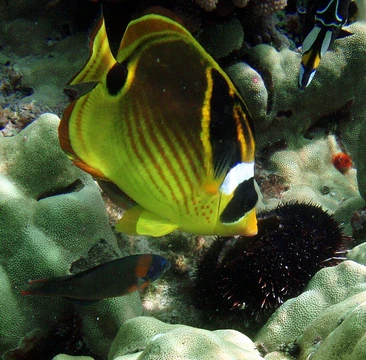
Raccoon butterflyfish (Chaetodon lunula)
Source-cited species reference: taxonomy from WoRMS, biology from FishBase, occurrence map from GBIF, conservation from IUCN Red List, description from Wikipedia, aquarium from Wikipedia (cited section).

The raccoon butterflyfish (Chaetodon lunula), also known as the crescent-masked butterflyfish, lunule butterflyfish, halfmoon butterflyfish, moon butterflyfish, raccoon butterfly, raccoon, raccoon coralfish, and redstriped butterflyfish, is a species of marine ray-finned fish, a butterflyfish belonging to the family Chaetodontidae. It is found in the Indian and Pacific Oceans.
- Scientific name
- Chaetodon lunula
- Authority
- (Lacepède, 1802)
- Family
- Chaetodontidae
- Order
- Acanthuriformes
- Maximum length
- 20 cm
- Depth range
- 0–170 m
- Habitat zone
- reef-associated
- Iucn red list
- Least Concern
- Gbif occurrence records
- 9,117
Taxonomic Heritage & Close Kin
The raccoon butterflyfish carries a remarkably long taxonomic history, having been first formally documented in 1802 by the French naturalist Bernard Germain de Lacépède, who placed it under the genus Pomacentrus and designated the Indian Ocean as its type locality. Today it sits within the family Chaetodontidae, specifically in the large subgenus Rabdophorus—a grouping so cohesive that some taxonomists argue it deserves elevation to a full genus of its own. Within that subgenus, its nearest living relative is the Red Sea raccoon butterflyfish (C. fasciatus), also called the diagonal butterflyfish, which shares an almost identical color scheme. Other close kin include the black butterflyfish (C. flavirostris), the Philippine butterflyfish (C. adiergastos), and the strikingly different redtail butterflyfish (C. collare). What unites this cluster of species is a shared body plan: a largish, oval silhouette with ascending oblique flank stripes and, in every member except the redtail, at least a vestigial version of the signature raccoon mask—a dark crown and eye patch separated by a pale gap. The species itself has accumulated a remarkable roster of common names, from crescent-masked and halfmoon to lunule, moon, and redstriped butterflyfish, reflecting how widely it has been observed across cultures.
A Portrait in Stripes and Spines
Few reef fish are as instantly recognizable as the raccoon butterflyfish, whose face is painted in bold black-and-white bands that evoke the mask of a woodland raccoon. The species grows to a maximum length of roughly 20 centimeters—nearly eight inches—making it one of the larger members of its family. Its body presents a smooth, oval outline, and the flanks are decorated with a series of ascending oblique stripes in a reddish hue. Behind the head, additional oblique stripes shift to a warmer yellow, adding another layer of visual complexity. A conspicuous black spot sits on the caudal peduncle, the narrow region just before the tail fin. Structurally, the fish carries between ten and fourteen spines along its dorsal fin and three spines in the anal fin, features that help distinguish it from look-alikes. Together, the facial mask, the striped flanks, the yellow post-occipital markings, and the tail-base spot create a pattern so distinctive that aquarists and field biologists alike can identify the species at a glance.
Range, Habitat & Daily Rhythm
The raccoon butterflyfish enjoys one of the broadest tropical distributions of any butterflyfish, spanning the entire Indo-Pacific basin from the coast of East Africa eastward all the way to the Hawaiian and Marquesan island chains, and northward to the waters off southern Japan. Remarkably, its range also extends into the southeast Atlantic, where it has been recorded off the coast of South Africa—a notable reach beyond the typical Indo-Pacific footprint. In terms of habitat preference, the species favors seaward reefs and the shallow reef flats found in lagoons, typically at depths exceeding 30 meters. Behaviorally, it is a nocturnal creature that tends to gather in small groups rather than roaming alone. Adult feeding is opportunistic and varied: nudibranchs and small invertebrates form the dietary core, but the fish will also graze on algae and pick at coral polyps, giving it a flexible foraging strategy well suited to the structurally complex reef environments it inhabits.
Life in the Aquarium
Keeping a raccoon butterflyfish in a home marine tank is a rewarding but nuanced experience. In general, the species displays a mild temperament toward tankmates, though it will show aggression specifically directed at lionfish and triggerfish. Under proper care, a captive individual can live for five to seven years. One of the most celebrated aspects of its aquarium role is its appetite for nuisance anemones: it has been observed actively hunting and eliminating both Aiptasia and Majano species, clearing a tank of these pests within a window of two to six weeks, depending on the anemone population and the size of the system. However, this same voracious appetite cuts both ways—the fish will eagerly consume soft corals, potentially causing more decorative damage than the anemone problem it solves. Additionally, in the confined conditions of an aquarium, the species is notably susceptible to marine ich, a parasitic infection caused by the ciliate Cryptocaryon irritans, which can prove fatal if not promptly addressed.
Related in Raccoon butterflyfish
Links follow this subject's own source article.
Elsewhere in Raccoon butterflyfish
Spotted an error? Know more?
Reader corrections go straight into our review queue. Suggest an edit · How this site is sourced