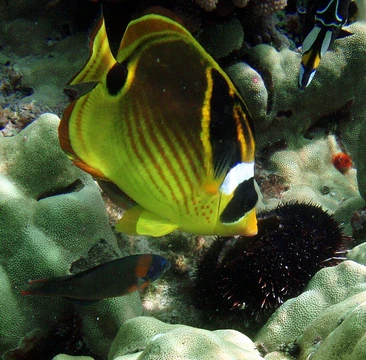
Where Raccoon butterflyfish has been recorded
GBIF occurrence records for Chaetodon lunula, mapped and tabulated by country.

9,117 georeferenced occurrence records with coordinates are published for Chaetodon lunula through GBIF, from 56 countries or marine areas. This page maps those records and lists where they come from. Occurrence records reflect where people have looked as well as where the species lives, so well-surveyed coastlines are over-represented.
- Georeferenced records
- 9,117
- Countries / areas
- 56
- Mapped locations
- 366
- Records sampled for the map
- 3,000
- Inland records omitted
- 51
- Gbif taxonkey
- 2385531
Geography & Physical Dimensions
The Red Sea stretches roughly 2,250 kilometers in length and spans up to 355 kilometers at its broadest point, covering approximately 438,000 square kilometers of water. It sits as a mediterranean inlet of the Indian Ocean, wedged between the Arabian Peninsula to the east and the African continent to the west. In the south, its connection to the open ocean runs through the Bab-el-Mandeb Strait and the Gulf of Aden, while the northern reaches include the Sinai Peninsula, the Gulf of Aqaba, and the Gulf of Suez leading into the Suez Canal. Beneath the surface, the Red Sea Rift forms part of the Great Rift Valley, shaping the basin's geological character. The sea's average depth is around 490 meters, though in the central Suakin Trough it plunges to a maximum of 2,730 meters. The International Hydrographic Organization draws its southern boundary along a line connecting Husn Murad and Ras Siyyan, and its northern limits are defined by lines running from Ràs Muhammed and Ràs al Fasma to the African and Sinai coasts respectively.
Marine Ecosystem & Biodiversity
The Red Sea's extensive shallow shelves make it a remarkable habitat for marine life. Approximately 40 percent of the sea's total area lies at depths shallower than 100 meters, and another 25 percent is even shallower than 50 meters. These broad, sunlit zones support an extraordinary diversity of organisms. More than 1,000 species of invertebrates and over 200 varieties of both soft and hard coral thrive within these waters. The sea holds the distinction of being the world's northernmost tropical sea, a fact that underscores its ecological uniqueness at the boundary between tropical and subtropical zones. In recognition of its biological richness and conservation value, the Red Sea has been designated a Global 200 ecoregion, highlighting its importance on a worldwide scale. The combination of tropical conditions, abundant coral structures, and the sheer volume of invertebrate life creates conditions that make this body of water one of the most biologically productive and diverse marine environments on the planet.
Ancient & Classical Maritime History
The Red Sea has drawn human maritime attention for millennia. The earliest known explorations were mounted by ancient Egyptians seeking commercial routes to Punt, with expeditions recorded around 2500 BCE and again around 1500 BCE under Queen Hatshepsut. Both voyages involved long journeys down the length of the sea. In the sixth century BCE, Darius the Great of the Achaemenid Persian Empire dispatched reconnaissance missions to chart navigational hazards such as rocks and currents, and he commissioned a canal linking the Nile to the northern Red Sea at Suez. Darius commemorated this achievement with multilingual stelae, and the canal served as a predecessor to the modern Suez Canal. In the late fourth century BCE, Alexander the Great sent Greek naval expeditions southward toward the Indian Ocean. Agatharchides compiled information about the sea in the second century BCE, and an anonymous Greek author produced the Periplus of the Erythraean Sea around the first century, detailing ports, routes, and the discovery by Hippalus of a direct sailing route from the Red Sea to India. Roman trade with India, beginning under Augustus, further cemented the sea's role as a vital commercial artery.
Nomenclature & Cultural Identity
The Red Sea carries names across a remarkable range of languages and traditions. In Modern Standard Arabic it is al-Baḥr al-ʾAḥmar, while Medieval Arabic used Baḥr al-Qulzum. Hebrew sources call it hayYām hāʾĀḏōm, and the Biblical Hebrew term Yam Sūf (Sea of Reeds) derives from the Exodus narrative of the Israelites' crossing. Coptic speakers refer to it as Phiom Enhah or Phiom ǹšari, while Tigrinya uses Qeyyiḥ bāḥrī, Somali uses Badda Cas, and Afar uses Qasa Bad. The English name traces back to the Ancient Greek Erythrà Thálassa, and Romans knew it as Mare Rubrum, Sinus Arabicus, or Pontus Herculis. The origin of the red designation remains debated: one theory points to seasonal surface blooms of the red-colored organism Trichodesmium erythraeum, while another, favored by some modern scholars, suggests the color word originally denoted the southern direction in Pre-Indo-European languages, paralleling how the Black Sea's name may reference the north. Herodotus, writing in the fifth century BCE, used Red Sea and Southern Sea interchangeably, supporting this directional interpretation.
Related in Raccoon butterflyfish
Links follow this subject's own source article.
Elsewhere in Raccoon butterflyfish
Spotted an error? Know more?
Reader corrections go straight into our review queue. Suggest an edit · How this site is sourced