Arabian butterflyfish (Chaetodon melapterus)
Source-cited species reference: taxonomy from WoRMS, biology from FishBase, occurrence map from GBIF, conservation from IUCN Red List, description from Wikipedia.
Last updated

Diego Delso · via Wikipedia: Chaetodon melapterus · CC BY-SA 4.0
Chaetodon melapterus, the Arabian butterflyfish, blackfin butterflyfish or black-finned melon butterflyfish, is a species of marine ray-finned fish in the butterflyfish family Chaetodontidae. It is found in the northwestern Indian Ocean.
Scientific classification
- KingdomAnimalia
- PhylumChordata
- ClassActinopterygii
- DivisionTeleostei
- OrderAcanthuriformes
- FamilyChaetodontidae
- GenusChaetodon
- GenusChaetodon
- SpeciesChaetodon melapterus
Named by Guichenot, 1863
Close relatives
Other species of Chaetodon with a Codexery entry.
- Blacktail butterflyfish Chaetodon austriacus
- Melon butterflyfish Chaetodon trifasciatus
- Oval butterflyfish Chaetodon lunulatus
- Scrawled butterflyfish Chaetodon meyeri
- Chaetodon andamanensis
- Chaetodon striatus
- Chaetodon flavirostris
- Chaetodon melannotus
Sources: Wikipedia taxobox: Chaetodon melapterus (CC BY-SA 4.0) · order, family and genus agree with WoRMS AphiaID 218751 (CC BY 4.0)
Conservation status
Least Concern (LC)
- LC▲ this species
- NT
- VU
- EN
- CR
- EW
- EX
Source: IUCN Red List assessment · GBIF copy of the Red List category
How big is it?
Largest length in the source, 0.13 m, next to a 1.8 m person.
Diagram: drawn by Codexery, schematic shapes to scale (not a likeness). Length: Wikipedia: Chaetodon melapterus
Where the arabian butterflyfish (chaetodon melapterus) has been recorded
Each dot is a place where the species has been observed and reported (281 records, half-degree grid) — not a modelled range. 6 inland records left out (institution coordinates). 2 isolated far-off records not drawn.
Map: drawn by Codexery. Data: GBIF occurrence search (records CC0 / CC BY) · Natural Earth basemap (public domain) · place coordinates: Wikipedia (CC BY-SA 4.0)
Classification (WoRMS)
Full classification as recorded by WoRMS: Kingdom: Animalia · Phylum: Chordata · Class: Teleostei · Order: Acanthuriformes · Family: Chaetodontidae · Genus: Chaetodon.
Accepted name: Chaetodon melapterus · Authority: Guichenot, 1863 · Taxonomic status: accepted · AphiaID: 218751.
Synonyms and superseded combinations recorded for this taxon: Chaetodon melanopterus Playfair, 1867; Chaetodon trifasciatus arabica Steindachner, 1899; Choetodon melapterus Guichenot, 1863.
Source: World Register of Marine Species (WoRMS) — https://www.marinespecies.org/aphia.php?p=taxdetails&id=218751 (CC BY 4.0). Accessed 2026-09-25.
Biology and life history (FishBase)
Measured values published by FishBase for Chaetodon melapterus. Only fields the database actually holds for this species are shown; these are database values, not aquarium guidance.
Maximum length: 13 cm · Habitat zone: reef-associated · Body shape: short and / or deep · Vulnerability index: 10 of 100 · Fishery importance: commercial · Aquarium trade: commercial.
FishBase notes: Found in coral rich areas of shallow coastal reefs. Occasionally in aggregations. Feed exclusively on coral polyps (Ref. 9710). Oviparous (Ref. 205). Form pairs during breeding (Ref. 205).
Source: FishBase species summary (SpecCode 12533) — https://www.fishbase.se/summary/Chaetodon-melapterus.html (CC BY-NC 3.0 — non-commercial use only). Accessed 2026-09-25.
Distribution and occurrence records (GBIF)
281 georeferenced occurrence records for Chaetodon melapterus are published through GBIF from 10 countries or marine areas. The map above plots 21 distinct locations from a sample of 281 records, omitting 6 inland records that carry an institution's coordinates rather than a collection site; it shows where the species has been observed and reported, not a modelled range.
Most records by country or area: Oman (120); Djibouti (104); Yemen (38); United Arab Emirates (11); Réunion (3); Bahrain (1); Egypt (1); Philippines (1); Saudi Arabia (1); Sudan (1).
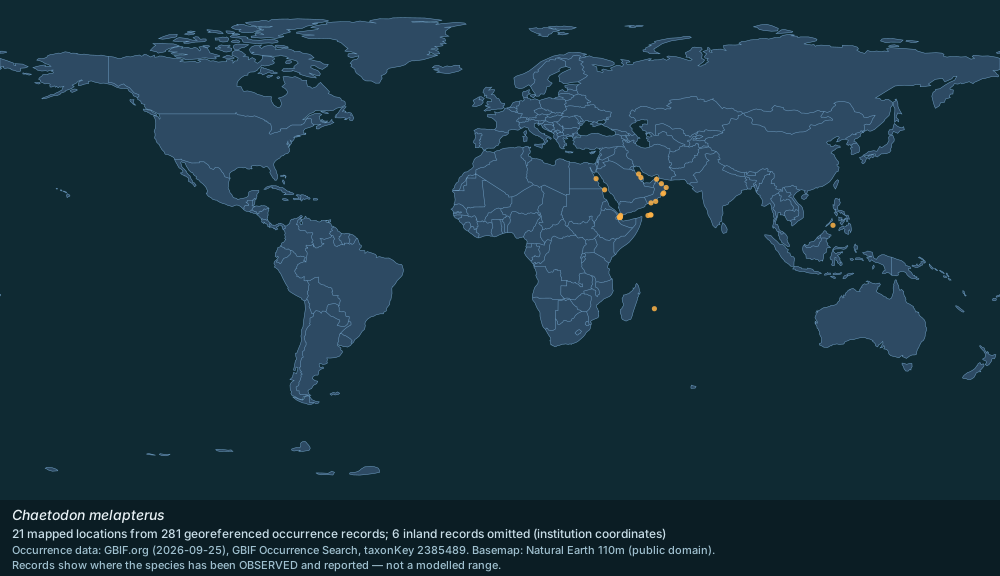
Marine regions with a valid WoRMS distribution record: Réunion Exclusive Economic Zone; Red Sea; Seychellois Exclusive Economic Zone; Eritrean Exclusive Economic Zone; Djiboutian Exclusive Economic Zone.
Source: GBIF Occurrence Search (taxonKey 2385489) — https://www.gbif.org/occurrence/search?taxon_key=2385489&has_coordinate=true (records CC0 / CC BY); WoRMS distribution records (MarineRegions) — https://www.marinespecies.org/aphia.php?p=taxdetails&id=218751 (CC BY 4.0); Natural Earth 110m basemap — https://www.naturalearthdata.com/ (public domain). Accessed 2026-09-25.
Conservation status (IUCN Red List)
The IUCN Red List assesses Chaetodon melapterus Guichenot, 1863 as Least Concern (code LC). No trend, population estimate or threat analysis is given here, because none is available from this source without the Red List API; follow the source link for the full assessment, including its date.
Source: IUCN Red List of Threatened Species (taxon 165724) — https://www.iucnredlist.org/species/165724/0; GBIF IUCN Red List category endpoint (taxonKey 2385489) — https://api.gbif.org/v1/species/2385489/iucnRedListCategory. Accessed 2026-09-25.
Description and natural history (Wikipedia)
Save for the posterior edge, which is black, the body of Chaetodon melapterus is totally bright yellow. The dorsal, anal and caudal fins are also deep black.
There are three vertical, black bands on the face, one on the snout around the mouth, one through the eye and one just behind the eye. The dorsal fin contains 13 spines and 19–21 soft rays while the anal fin has 3 spines and 18–19 soft rays. This species attains a maximum total length of 13 cm.
Distribution
Chaetodon melapterus is found in the northwestern Indian Ocean, including the Persian Gulf, the southern coasts of the Arabian Peninsula (from the Gulf of Oman to the Gulf of Aden) and the southern part of the Red Sea.
Habitat and biology
Chaetodon melapterus is found in shallow coastal reefs (at between 2 and 16 m), and prefers areas with rich coral growth. This species lives in pairs, but there have been occasional records of aggregations. It is an obligate corallivore, feeding exclusively on polyps. It is an oviparous species which forms pairs to breed.
Taxonomy
Chaetodon melapterus was first formally described in 1863 by the French zoologist Alphonse Guichenot with the type locality given as Réunion, although this is likely to be in error as the species has not been recorded from the Mascarenes. This species, together with the blacktail butterflyfish (C. austriacus), the melon butterflyfish (C. trifasciatus), and the oval butterflyfish (C. lunulatus), makes up the subgenus Corallochaetodon. This group is probably quite closely related to the subgenus "Citharoedus" (the name is a junior homonym of a mollusc genus), which (among a few other species) contains the scrawled butterflyfish (C. meyeri). These subgenera may be moved into Megaprotodon if Chaetodon were to be split up.
Relationship with humans
Chaetodon melapterus is unsuitable for keeping in aquaria due to its specialized diet of coral. Despite this, it makes an occasional appearance in the trade.
Source: Wikipedia: Chaetodon melapterus — https://en.wikipedia.org/wiki/Chaetodon_melapterus (CC BY-SA 4.0). Accessed 2026-09-25.
Sources
Compiled from Wikipedia and the sources listed below. Text from Wikipedia is available under CC BY-SA 4.0; this entry is adapted from it.
- Wikipedia: Chaetodon melapterus (CC BY-SA 4.0).
- Classification: the source article's taxobox; order, family and genus checked against WoRMS, the World Register of Marine Species (CC BY 4.0).
- Conservation status: IUCN Red List assessment.
- Occurrence records: GBIF (CC0 / CC BY). Basemap: Natural Earth (public domain).
- Word definitions: the , each quoted from its Wikipedia article.
Spotted an error? Know more?
Reader corrections go straight into our review queue. Suggest an edit · How this site is sourced