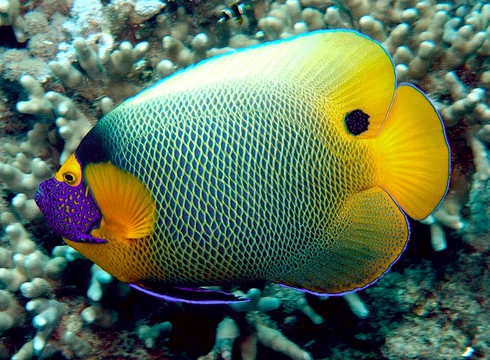
Yellowface angelfish (Pomacanthus xanthometopon)
Source-cited species reference: taxonomy from WoRMS, biology from FishBase, occurrence map from GBIF, conservation from IUCN Red List, description from Wikipedia.

Richard Poort · CC BY 4.0
Pomacanthus xanthometopon is a marine ray-finned fish, a marine angelfish belonging to the family Pomacanthidae found in shallow parts of the Indo-Pacific. It is commonly known as the blueface angelfish or the yellowface angelfish because of its striking facial colouration.
- Scientific name
- Pomacanthus xanthometopon
- Authority
- (Bleeker, 1853)
- Family
- Pomacanthidae
- Order
- Acanthuriformes
- Maximum length
- 38 cm
- Depth range
- 5–30 m
- Habitat zone
- reef-associated
- Iucn red list
- Least Concern
- Gbif occurrence records
- 696
Taxonomy & the Story Behind the Name
The species we now call the yellowface angelfish was first formally documented in 1853 by Pieter Bleeker, a Dutch naturalist known for his work in both ichthyology and herpetology. Bleeker originally assigned it to the genus Holocanthus, giving it the binomial Holocanthus xanthometopon, and recorded the type locality as Telok Betong on the coast of Sumatra, Indonesia. The specific epithet xanthometopon is Greek-derived and translates to 'yellow forehead,' a nod to the bold yellow mask that covers the fish's eyes. Over time, taxonomic authorities have shifted its placement, with some now recognising it within the subgenus Euxiphipops under the genus Pomacanthus. It sits firmly within the family Pomacanthidae, the marine angelfishes, and is a ray-finned species. In everyday usage, anglers and aquarists may call it either the blueface angelfish or the yellowface angelfish, both names pointing to the vivid facial colouration that makes the fish so immediately recognisable.
Striking Colouration and Body Form
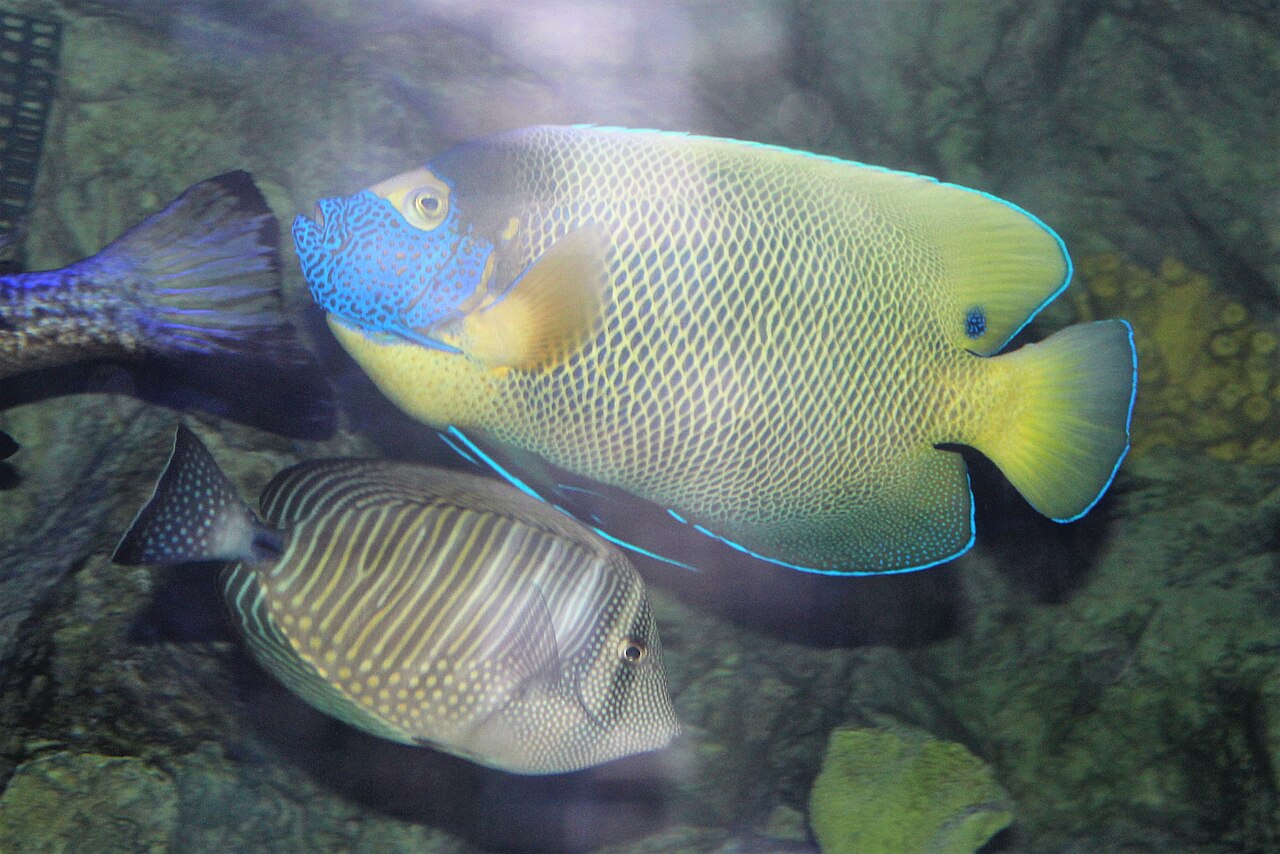
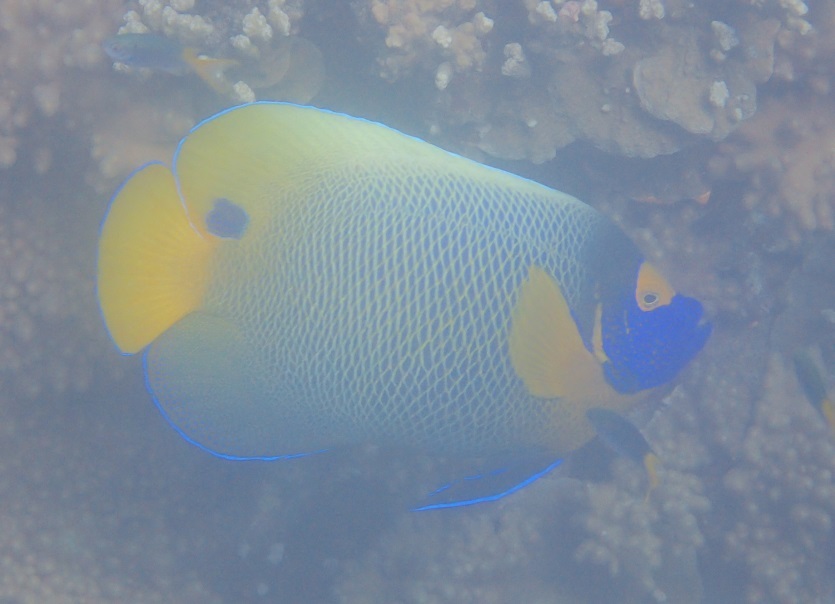
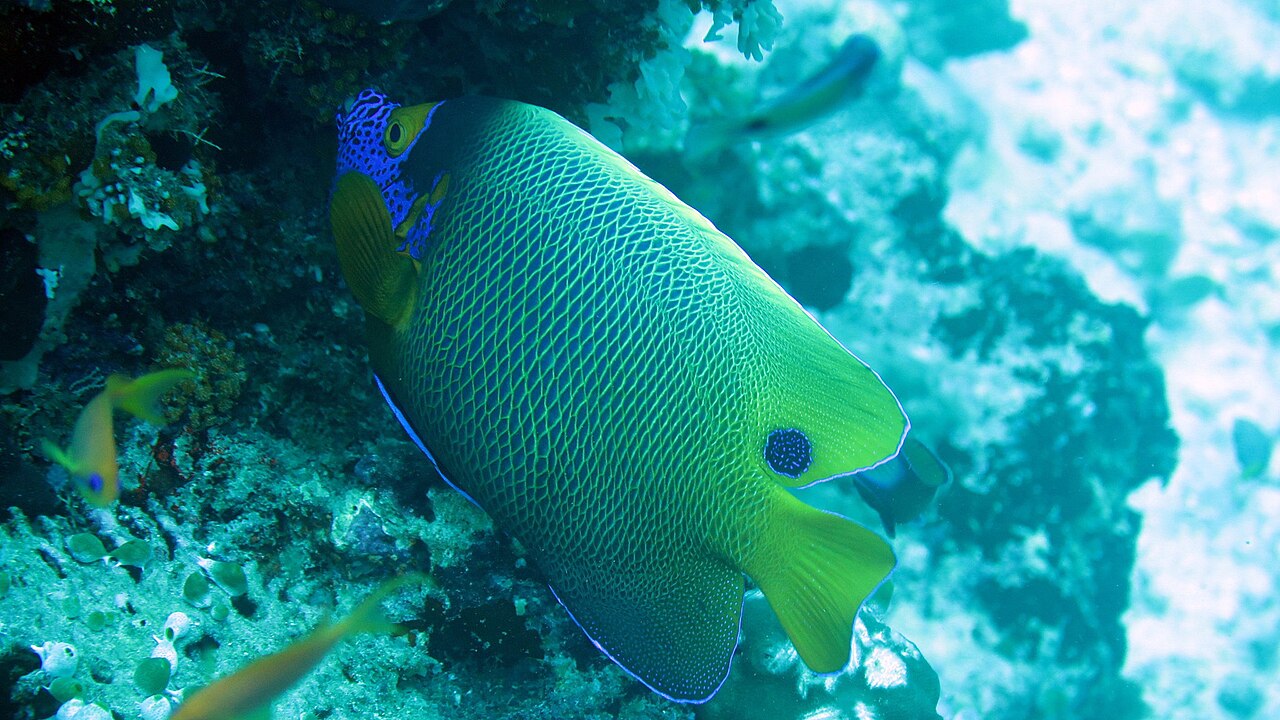
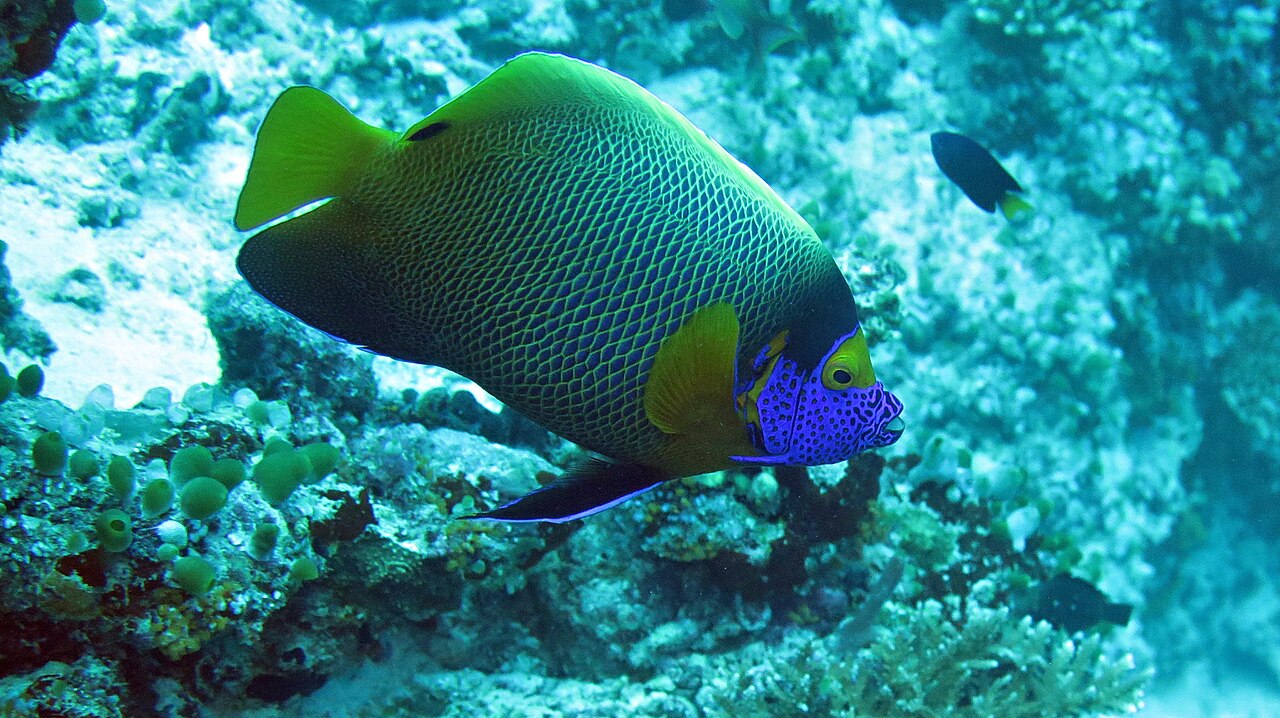
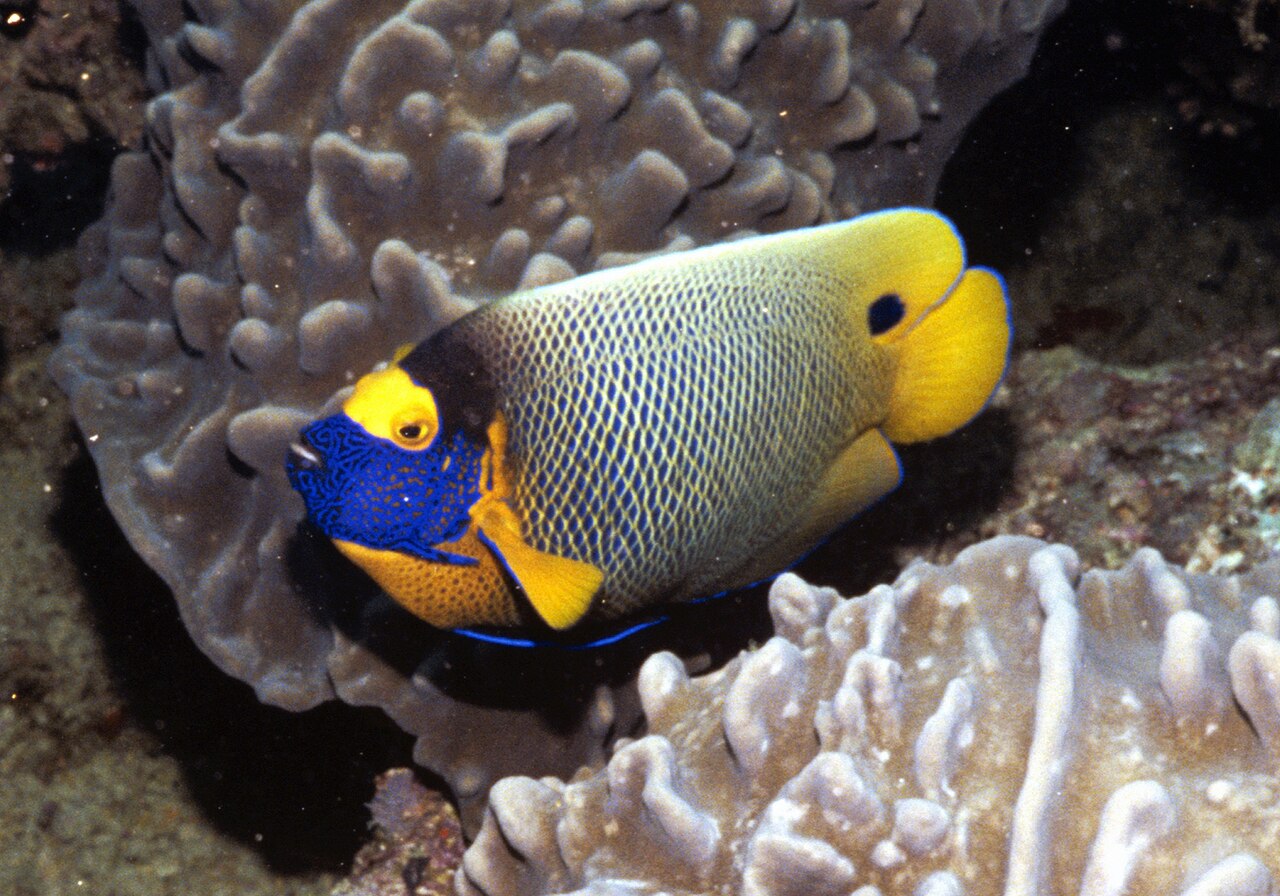
Reaching up to 38 centimetres in length, the yellowface angelfish has a distinctly laterally compressed body with its mouth positioned just above the snout tip. Its fins are broad and rounded, mostly yellow with subtle blue edging along the margins. The dorsal fin, set just ahead of the tail region, bears a conspicuous black eyespot at its base and carries between 13 and 14 spines alongside 16 to 18 soft rays. The anal fin mirrors this soft-ray count with three spines. Across the body, pale blue scales edged in yellow produce a fine reticulated pattern. The face is the showpiece: a plain yellow mask frames the eyes, while the lower half is crisscrossed by a dense web of brilliant blue lines. Juveniles present a completely different palette—six vertical white bars divided by pale blue lines, with the tail fin striped in two tones of blue. The shift to adult colouring unfolds gradually once the fish passes the 7-to-12-centimetre mark. It can be mistaken for the queen or blue angelfish, but both of those species have an entirely blue face and lack the caudal eyespot.
Range and Preferred Habitats
The yellowface angelfish is a coral-reef dweller whose range stretches across the eastern tropical Indo-Pacific. Documented locations include the Maldive Islands, Malaysian and Indonesian waters, Japanese coastal areas, Taiwanese reefs, the Philippines, northern Australian shores, and the scattered islands of Micronesia. In a rare exception, the species has occasionally turned up off the coast of Florida, well outside its normal distribution. Within its home range, it shows a clear preference for lagoons, outer reef slopes, and channels, typically at depths not exceeding roughly 25 metres. Rocky outcrops and cave entrances are favoured microhabitats, and juveniles in particular are frequently found tucked inside caves. This reliance on sheltered, structurally complex reef zones appears consistent across the species' life stages, with younger fish remaining more cave-bound while adults range more freely over open reef and slope areas.
Ecology, Conservation Outlook, and Human Interaction
In the wild, the yellowface angelfish is generally encountered either alone or in pairs rather than in large groups. Its foraging targets include tunicates, sponges, various encrusting organisms, and algae, indicating a diet well adapted to grazing on reef surfaces. Reproduction is oviparous, with the female scattering her eggs directly onto the seabed. The IUCN Red List assesses the species as being of least concern, citing its common presence across most of its extensive range and the absence of any major threats to its survival. In the commercial aquarium trade, the yellowface angelfish is a relatively uncommon sight; the individuals that do reach the market are typically routed through dealers based in the Philippines and Singapore. The combination of a broad natural distribution, stable population status, and limited commercial pressure suggests the species remains ecologically secure across its Indo-Pacific habitat.
Gallery
Spotted an error? Know more?
Reader corrections go straight into our review queue. Suggest an edit · How this site is sourced