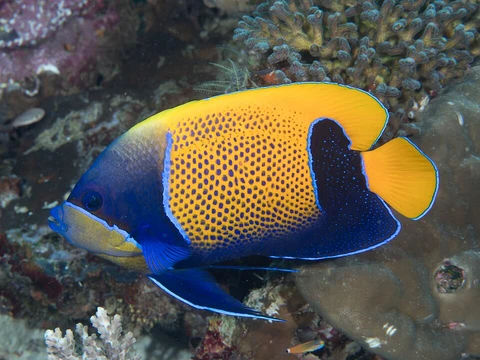
Bluegirdle angelfish (Pomacanthus navarchus)
Source-cited species reference: taxonomy from WoRMS, biology from FishBase, occurrence map from GBIF, conservation from IUCN Red List, description from Wikipedia.

Rickard Zerpe · CC BY 2.0
Pomacanthus navarchus, the blue-girdled angelfish or majestic angelfish, is a marine angelfish from the Indo-Pacific region. It occasionally makes its way into the aquarium trade. P. navarchus is one of the smallest of the larger species of angelfish. It grows to a maximum length of 28 cm, but is usually much smaller than this, and can live to be up to 21 years old. Younger fish stay closer to the shallows, but the more mature fish can be found up to 120 ft deep. Majestic angelfish eat mainly sponges and tunicates. Juvenile fish are mostly blue in color with white stripes. As they mature, they take on a yellow coloration on the flanks, dorsal fin, and tail.
- Scientific name
- Pomacanthus navarchus
- Authority
- (Cuvier, 1831)
- Family
- Pomacanthidae
- Order
- Acanthuriformes
- Maximum length
- 28 cm
- Depth range
- 3–40 m
- Habitat zone
- reef-associated
- Iucn red list
- Least Concern
- Gbif occurrence records
- 574
Physical Form and Color Transformation
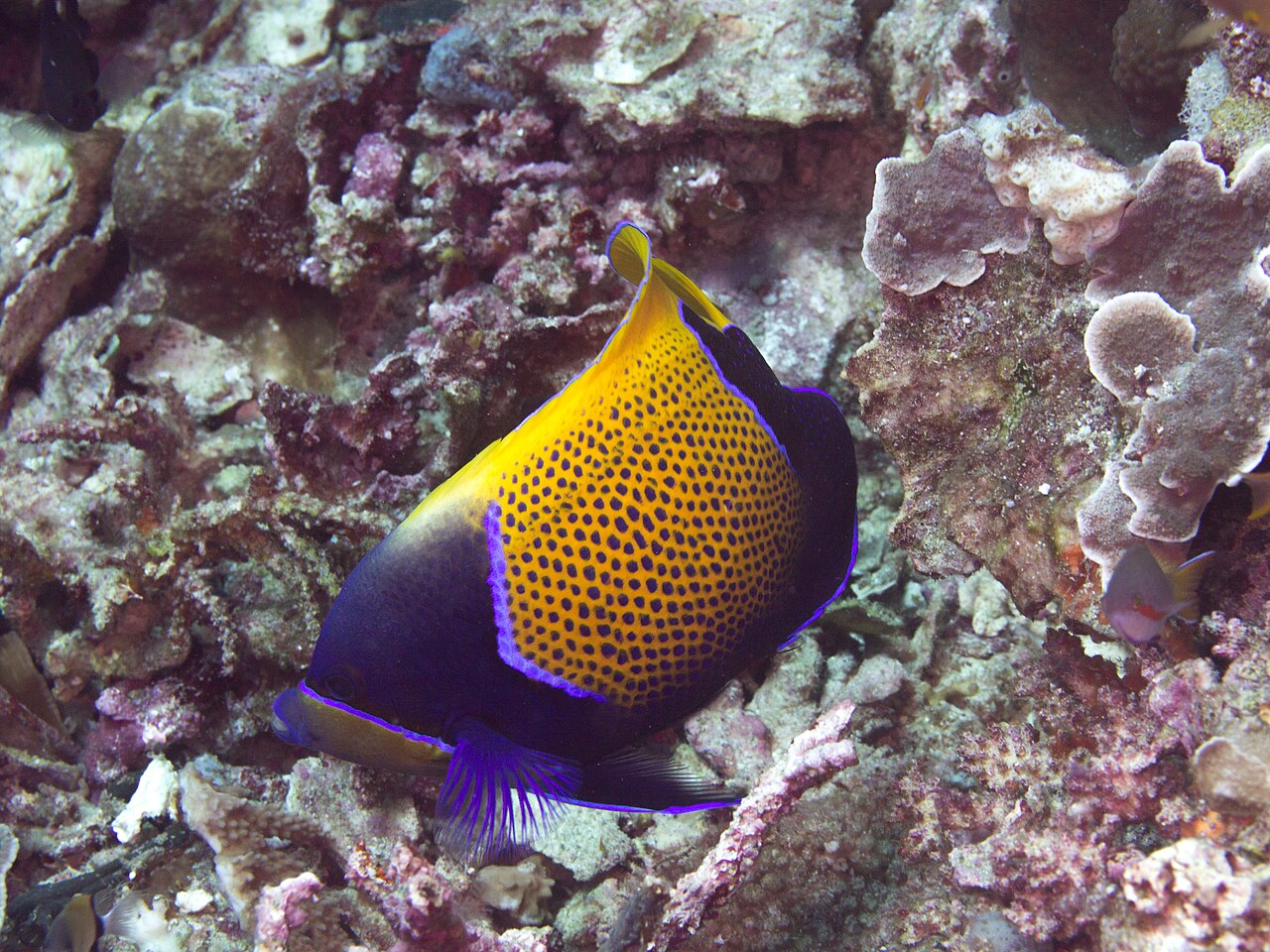
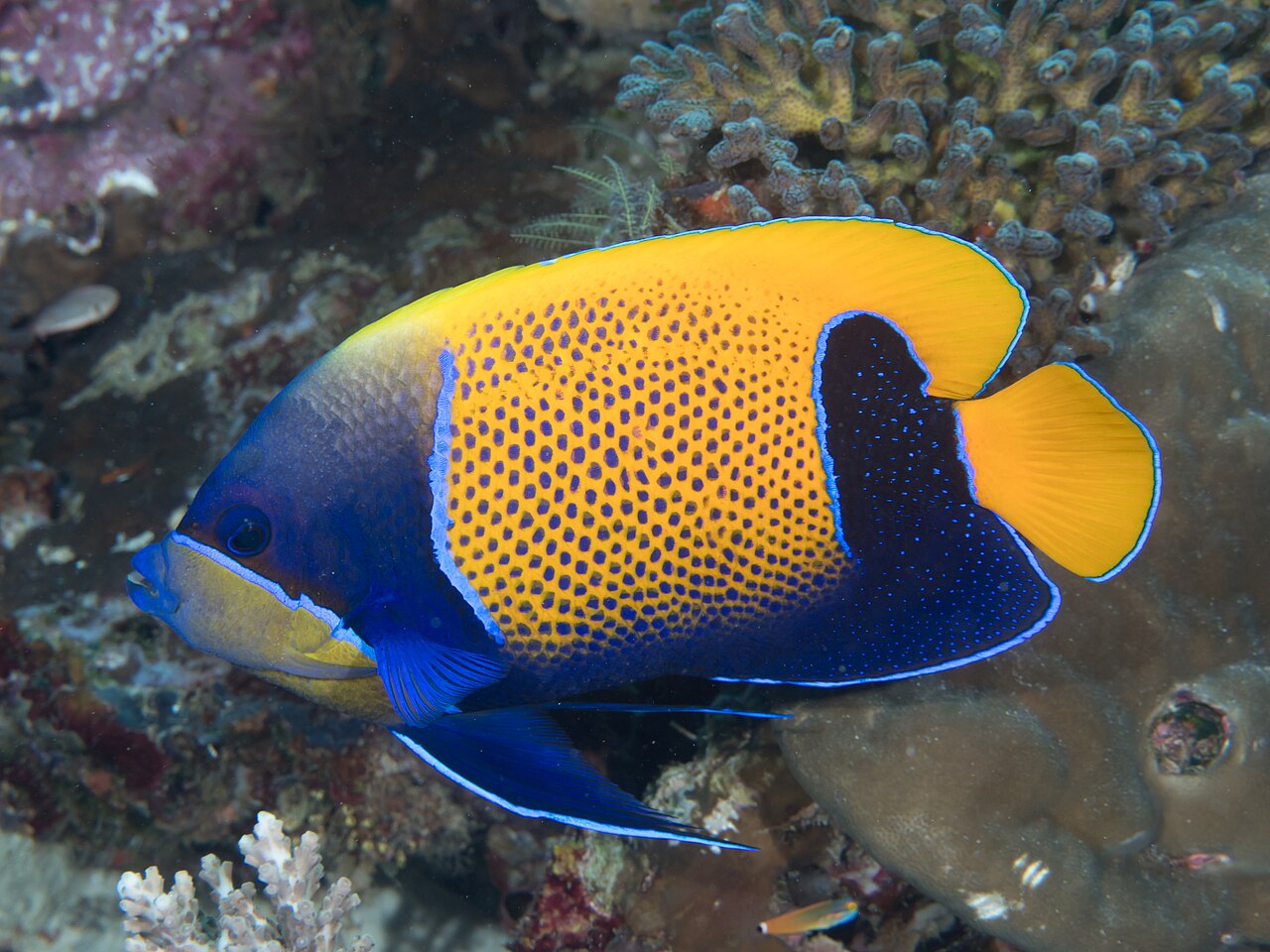
The bluegirdled angelfish presents a strikingly segmented appearance that sets it apart among its reef-dwelling relatives. Its body is compressed laterally, giving it a broad, disc-like profile. In adulthood, the coloration divides into three distinct zones. The frontmost region, spanning the area ahead of the eyes and the forward body, glows in a vivid lemon yellow. The middle zone takes on a funnel shape and is saturated in deep blue. The rear section displays a reticulated pattern mixing bright yellow and blue. These three zones are demarcated by pale blue bands that carry a sharp black edge. The mouth, lips, and the rays of the pectoral and anal fins all share a blue hue, while the dorsal and caudal fins are yellow trimmed with pale blue. A notable defensive feature is a long spine projecting from the gill cover. Juveniles look entirely different—dark blue bodies marked with slightly curved white lateral stripes. The transition to adult coloration occurs abruptly, with virtually no intermediate phase in between.
Geographic Range and Habitat
The bluegirdled angelfish is a creature of the tropical Indo-Pacific, with a distribution that stretches across a remarkable arc of ocean. Its native range encompasses Indonesia and the Philippines, extends to the northern and eastern coastlines of Australia, includes the Great Barrier Reef, and reaches as far as Micronesia and the Hawaiian Islands. Within these waters, the species favors coral-rich environments, specifically outer reef slopes, underwater channels, and sheltered lagoons. It has been recorded at depths reaching approximately 40 meters, or about 130 feet, below the surface. There is a notable depth-related shift tied to the fish's life stage: younger individuals tend to remain in shallower waters, while mature adults venture considerably deeper, with records placing them at around 120 feet, roughly 37 meters. This vertical migration through the water column as the fish ages reflects a gradual expansion of its ecological niche from the sunlit shallows toward the dimmer, structurally complex outer reef environments where its preferred food sources are more abundant.
Social Behavior and Reproductive Biology
In the wild, the bluegirdled angelfish is predominantly a solitary animal. It is territorial by nature and is most commonly encountered alone, patrolling a defined stretch of reef. Pairs or small groups do occur, but they remain the exception rather than the rule. The species occupies the demersal zone, where it forages on a varied diet that includes sponges, algae, tunicates, zooplankton, and small invertebrates. Perhaps the most biologically remarkable aspect of this fish is its reproductive strategy. It is a protogynous hermaphrodite, meaning every individual begins its adult life as a female and, at a later stage, transitions to becoming a male. This sequential sex change means that the population's sex ratio is not fixed at birth but shifts over the lifetime of each fish. The combination of territorial solitary behavior, a broad invertebrate-based diet, and this sex-change mechanism makes the bluegirdled angelfish a fascinating subject for marine biologists studying reef community dynamics and reproductive ecology.
Size, Longevity, and the Aquarium Trade
Among the larger species of marine angelfish, the bluegirdled angelfish occupies a relatively modest position in terms of body size. Its maximum recorded length is 28 centimeters, about 11 inches, yet most individuals encountered in the wild are considerably smaller than this upper limit. Despite its moderate stature, the species boasts a remarkable lifespan for a reef fish, with individuals documented to reach 21 years of age. This longevity, combined with its territorial temperament and specific dietary needs centered on sponges and tunicates, makes long-term captive care a demanding undertaking. The bluegirdled angelfish does occasionally appear in the aquarium trade, but its presence in home or public aquaria remains relatively uncommon. Those who do keep it must account for its lateral body shape, its need for open swimming space near coral structures, and the fact that its coloration will shift dramatically and abruptly as it matures from the striped juvenile phase into the tri-colored adult form.
Gallery
Spotted an error? Know more?
Reader corrections go straight into our review queue. Suggest an edit · How this site is sourced