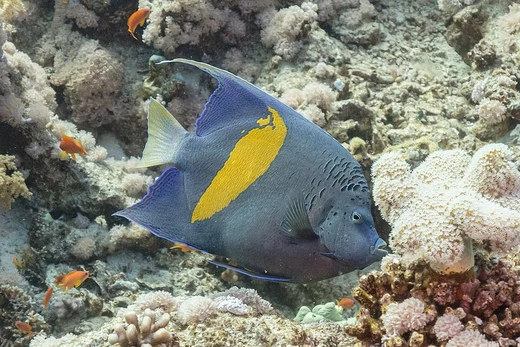
Yellowbar angelfish (Pomacanthus maculosus)
Source-cited species reference: taxonomy from WoRMS, biology from FishBase, occurrence map from GBIF, conservation from IUCN Red List, description from Wikipedia.

Exaybachay · CC BY 3.0
Pomacanthus maculosus, the yellowbar angelfish, half-moon angelfish, yellow-marked angelfish, yellowband angelfish or yellow-blotched angelfish, is a species of marine ray-finned fish, a marine angelfish belonging to the family Pomacanthidae. It is found in the western Indian Ocean and, more recently, in the eastern Mediterranean Sea.
- Scientific name
- Pomacanthus maculosus
- Authority
- (Forsskål, 1775)
- Family
- Pomacanthidae
- Order
- Acanthuriformes
- Maximum length
- 50 cm
- Depth range
- 4–60 m
- Habitat zone
- reef-associated
- Iucn red list
- Least Concern
- Gbif occurrence records
- 716
Physical Form and Coloration
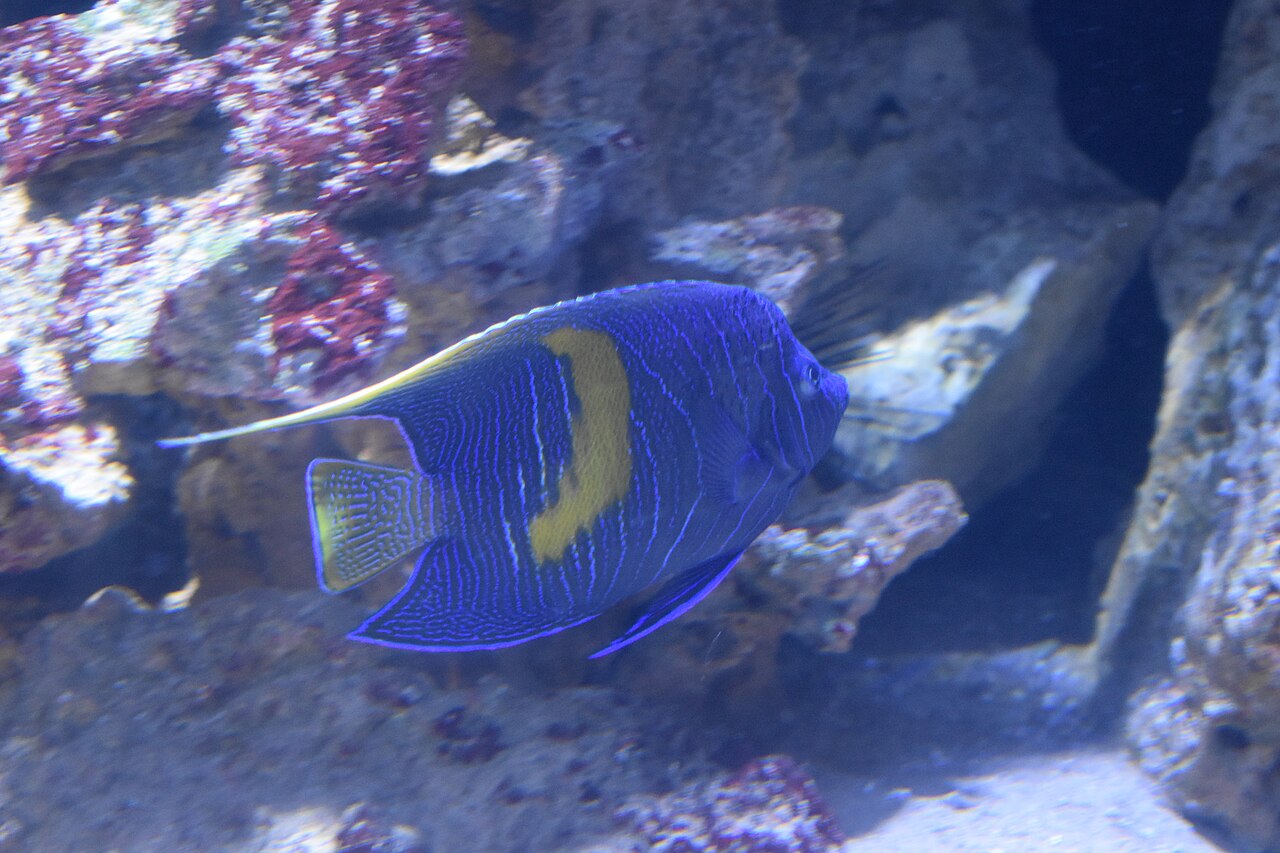
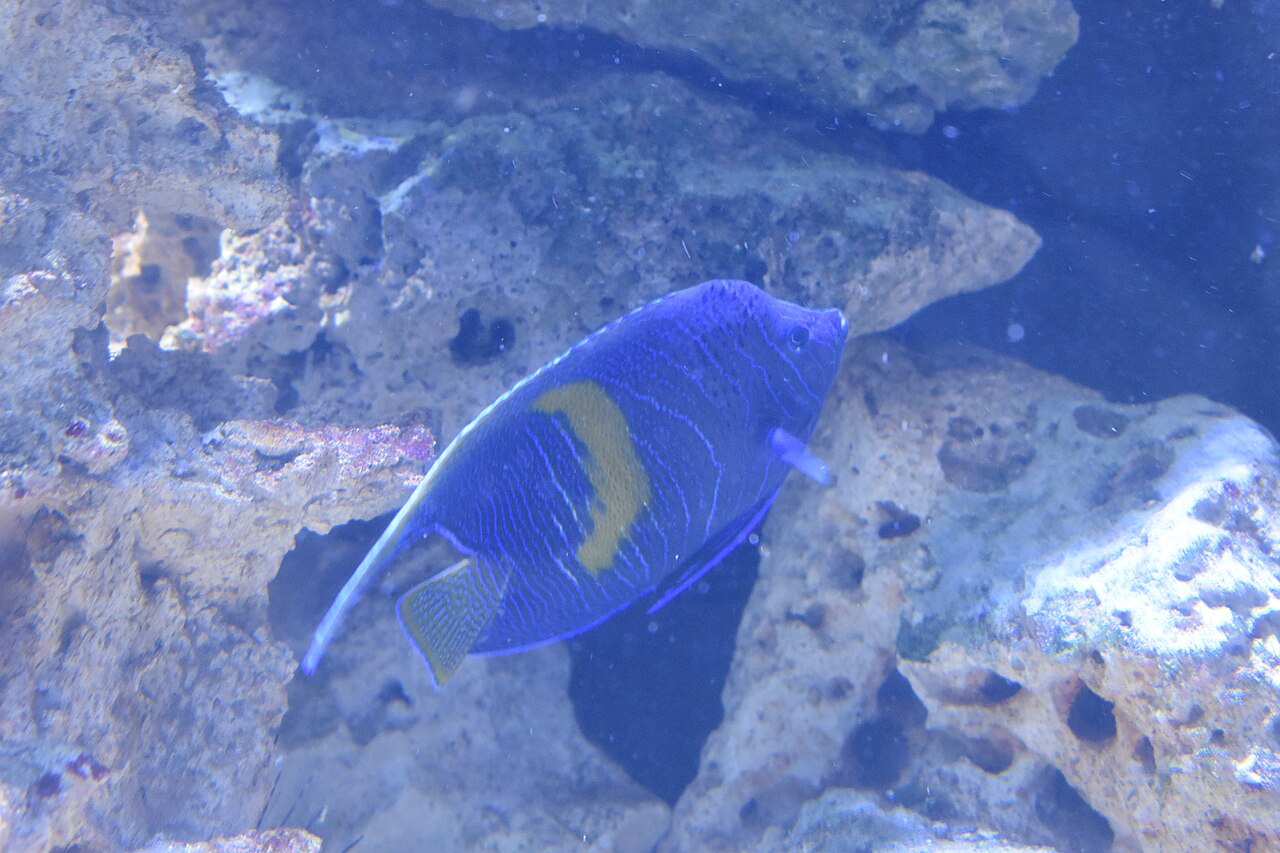
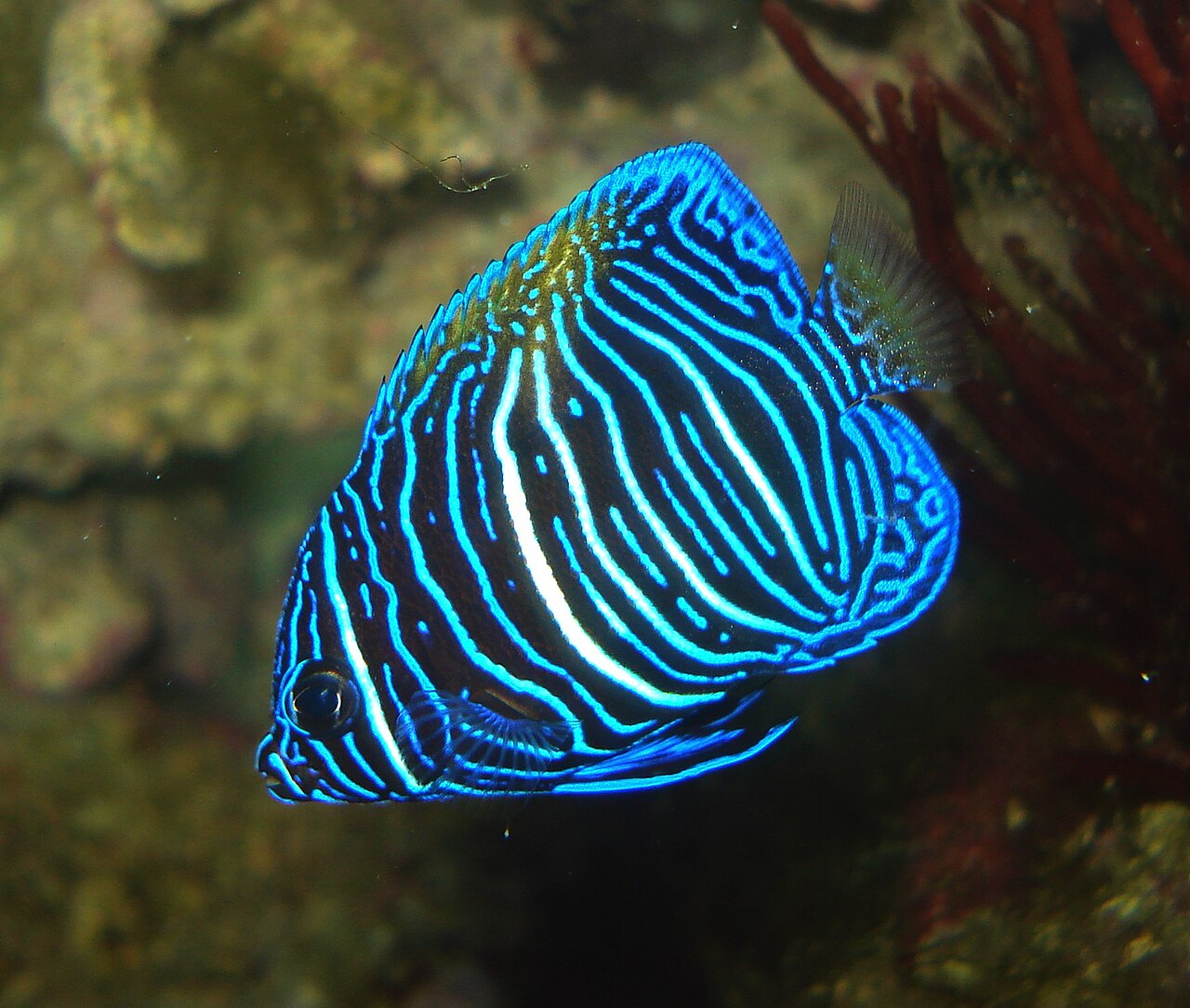
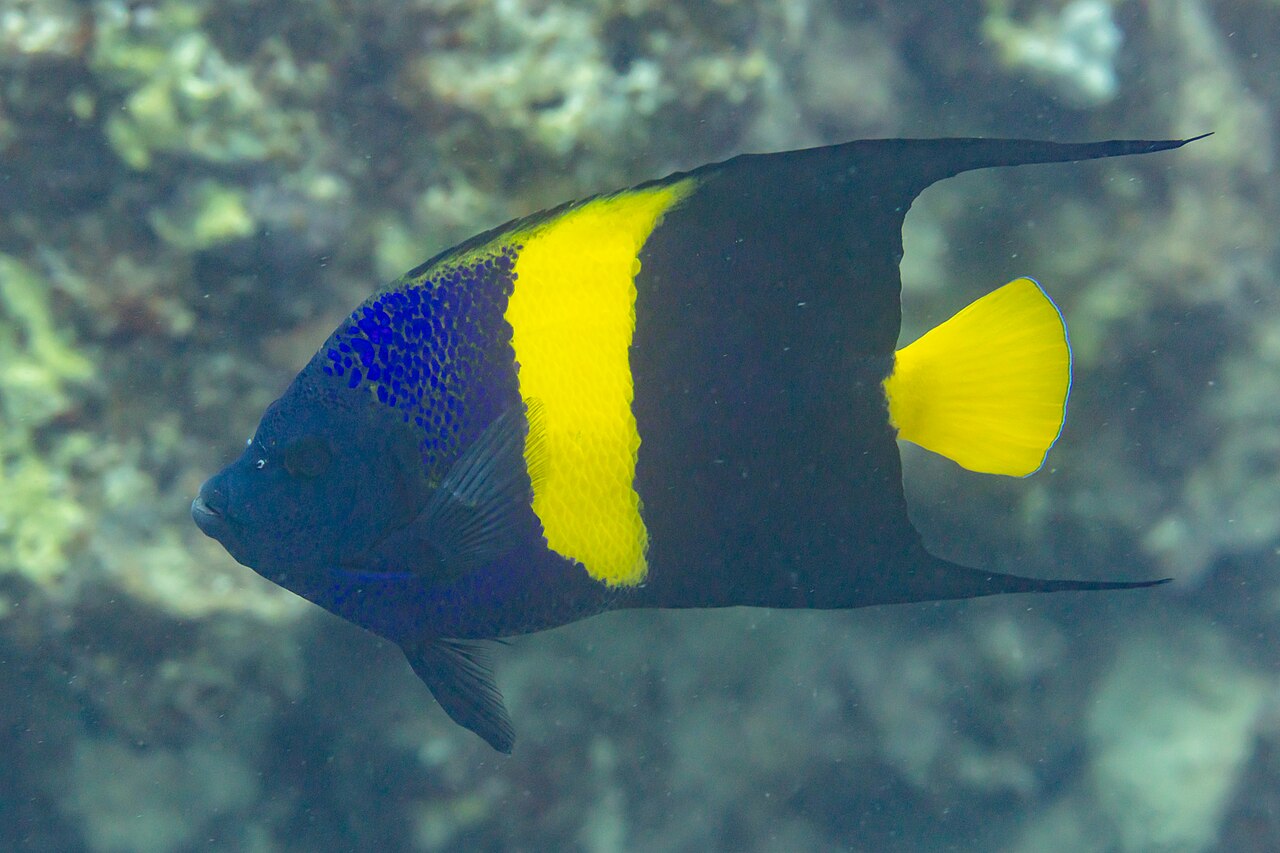
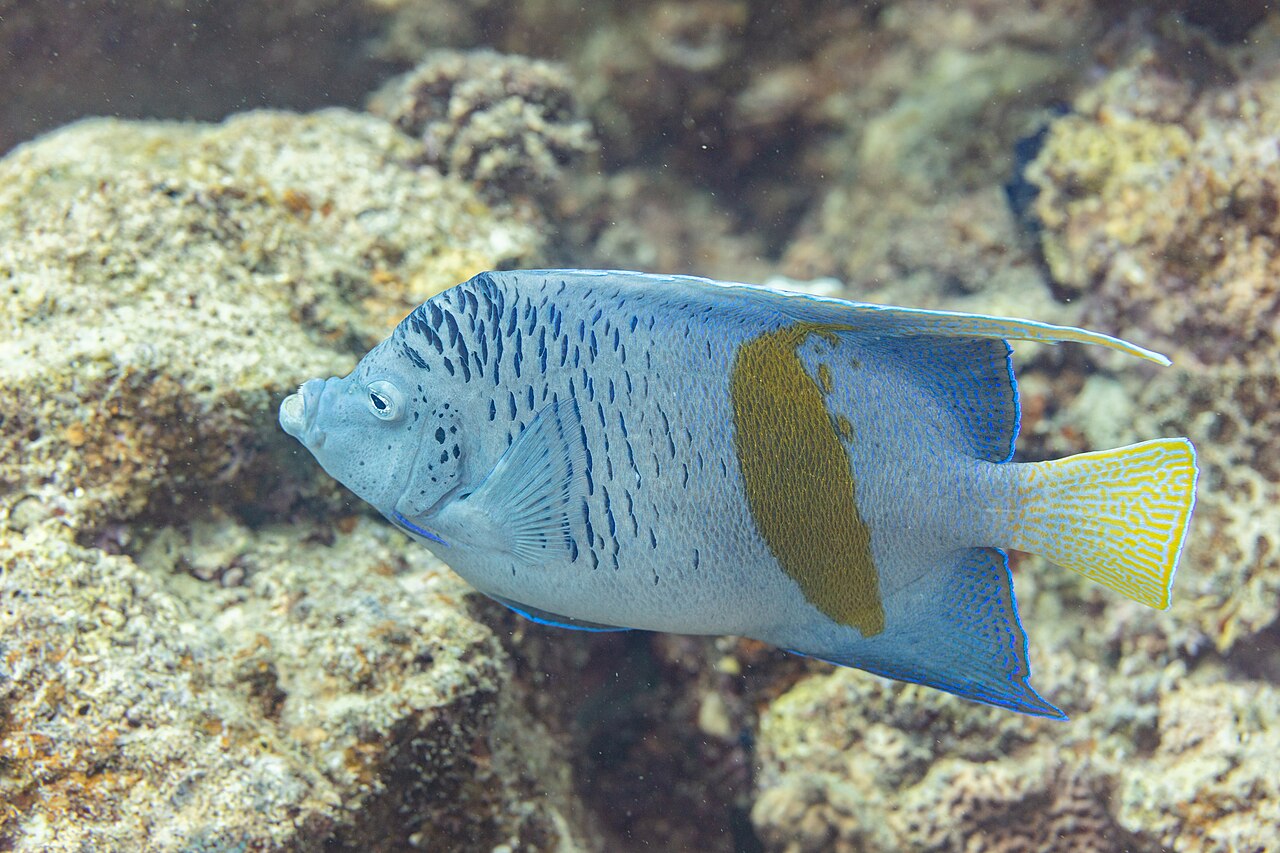
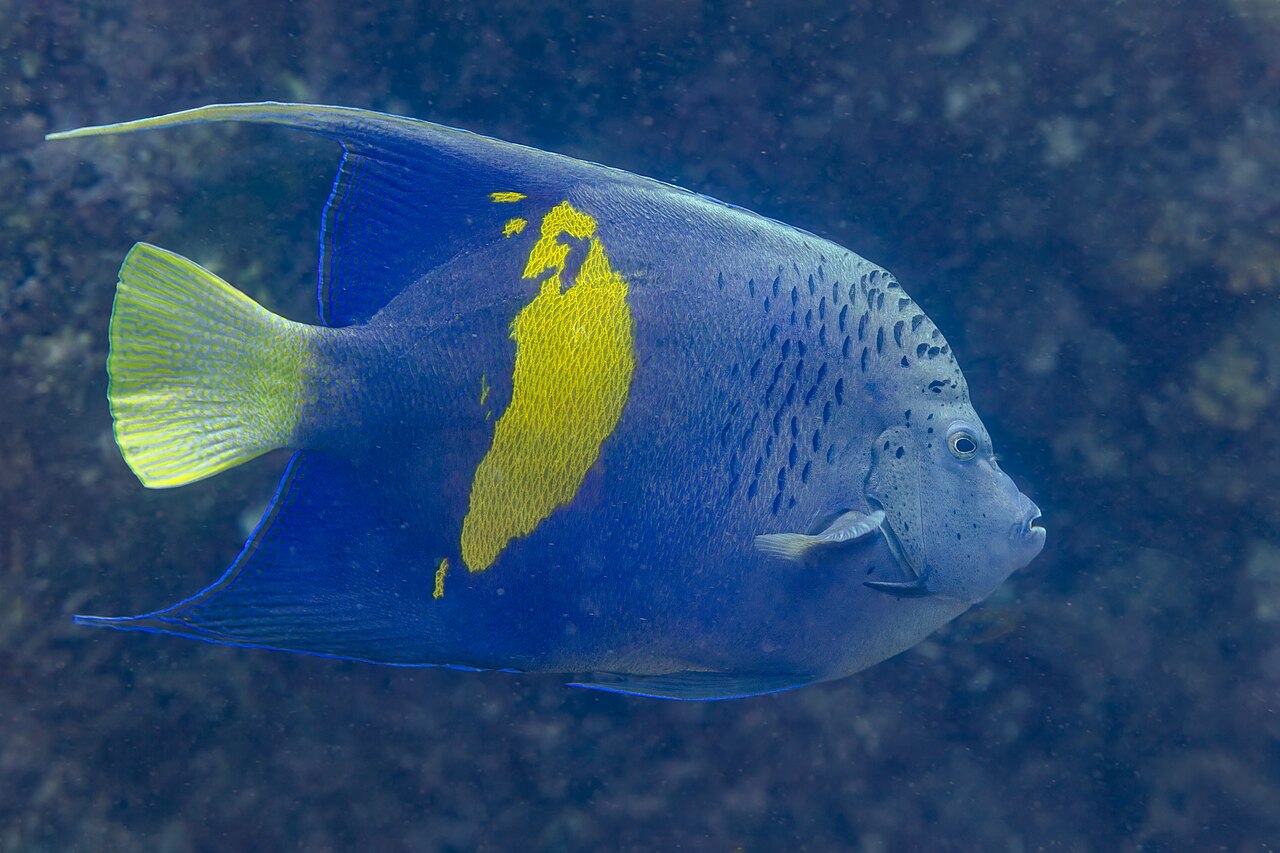
The yellowbar angelfish presents a strikingly deep, laterally compressed silhouette, capped by a small mouth lined with fine, bristle-like teeth. A prominent spine sits at the angle of the preoperculum, adding a distinctive angular feature to the head. In mature individuals, slender filaments trail backward from the soft-rayed portions of both the dorsal and anal fins, stretching well beyond the tail. The adult coloration is a rich brownish blue, with each scale edged in a vivid blue margin that gives the whole body a predominantly blue appearance. An irregular yellow bar sits near the middle of the flanks, while dark blue, vertically stretched spots cluster toward the head. The caudal fin displays wavy blue lines set against a pale yellow ground. Juveniles look almost entirely different: their bodies are predominantly black, crossed by numerous arced vertical blue lines and three broader white stripes, with yellow restricted to only the rear third of the tail. The dorsal fin carries twelve to thirteen spines and twenty-one soft rays, while the anal fin holds three spines and nineteen to twenty soft rays. This species can grow to a maximum total length of fifty centimeters, roughly twenty inches.
Geographic Range and Unusual Sightings
Native to the western Indian Ocean, the yellowbar angelfish is a resident of the Red Sea, the Persian Gulf, and the Gulf of Oman, where it has long been a familiar sight in sheltered reef habitats. However, its range has expanded in unexpected ways. Since 2008, this species has been recorded on distinct but relatively rare occasions in the eastern Mediterranean Sea, marking a notable extension beyond its traditional Indian Ocean home. Even more remarkable are sightings off the coasts of Florida and Brazil, which researchers attribute to deliberate releases from the aquarium trade rather than natural dispersal. These transoceanic records underscore how human activity can reshape the geographic footprint of a marine species. As a member of the family Pomacanthidae, the yellowbar angelfish belongs to the broader group of marine angelfishes, yet its distribution pattern—concentrated in warm, semi-enclosed waters of the western Indian Ocean with sporadic appearances far afield—sets it apart from many of its relatives. The combination of a stable core range and scattered, human-mediated outliers makes its biogeography a subject of ongoing interest among ichthyologists.
Behavior, Diet, and Reproductive Strategy
Living at depths between four and fifty meters, the yellowbar angelfish is a solitary creature that favors sheltered zones where coral growth meets sandy silt. Rather than forming groups, individuals tend to occupy their own territory in these mixed habitats. Their feeding is heavily specialized: sponges and tunicates make up the bulk of their diet, though they will opportunistically consume other invertebrates when the chance arises. Reproductively, this species follows a protogynous hermaphroditic strategy. Females reach sexual maturity at roughly five and a half years of age and a total length of about twenty-one and a half centimeters. In populations where males are scarce, older females can transition to the male role, a flexibility that helps sustain breeding success. The maximum recorded longevity for this species is thought to be around thirty-six years. Divers who encounter them consistently describe the fish as curious and unafraid of human presence, making it a popular subject for underwater observation. Its larvae, by contrast, are planktonic, drifting in open water before settling into the structured reef environments where adults reside.
Taxonomic History and Common Names
The yellowbar angelfish was first formally described in 1775 by Peter Forsskål, a Finnish-born Swedish naturalist who lived from 1732 to 1763. Forsskål originally placed the species in the genus Chaetodon, naming it Chaetodon maculosus, with the type locality recorded as Al-Luhayya in Yemen. Over time, taxonomists reassigned it to its current genus Pomacanthus, and some authorities further nest it within the subgenus Arusetta. The specific epithet maculosus is Latin for "spotted," a reference that could apply to either the blue spots adorning each scale or the prominent yellow blotch on the flanks. The species carries a remarkable variety of common names—yellowbar, half-moon, yellow-marked, yellowband, and yellow-blotched angelfish—each reflecting a different visual feature that catches the observer's eye. This proliferation of names speaks to the fish's distinctive and memorable appearance, which has made it a recognizable figure in both scientific literature and the aquarium hobby. In parts of the Persian Gulf, it has even appeared in local fish markets, while it is occasionally collected for the international aquarium trade, further cementing its presence in human cultural awareness.
Gallery
Spotted an error? Know more?
Reader corrections go straight into our review queue. Suggest an edit · How this site is sourced