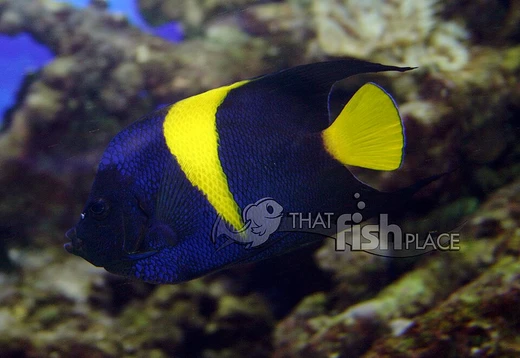
Arabian angelfish (Pomacanthus asfur)
Source-cited species reference: taxonomy from WoRMS, biology from FishBase, occurrence map from GBIF, conservation from IUCN Red List, description from Wikipedia.

Pomacanthus asfur, the Arabian angelfish, is a species of marine ray-finned fish, a marine angelfish belonging to the family Pomacanthidae. It is found in the Western Indian Ocean.
- Scientific name
- Pomacanthus asfur
- Authority
- (Forsskål, 1775)
- Family
- Pomacanthidae
- Order
- Acanthuriformes
- Maximum length
- 40 cm
- Depth range
- 3–30 m
- Habitat zone
- reef-associated
- Iucn red list
- Least Concern
- Gbif occurrence records
- 75
A Dramatic Metamorphosis of Color and Form
The Arabian angelfish undergoes one of the most striking visual transformations in the marine world. As a juvenile, this fish presents a blue body adorned with pale-blue and white striping — a look that bears almost no resemblance to the adult form. As the individual matures, yellow markings gradually appear on the dorsal and caudal fins, marking the beginning of the transition. By the time full maturity is reached, the overall palette shifts to a deep dark blue body paired with a distinctly blackish face. A vivid yellow caudal fin stands out against the darker tones, and perhaps the most eye-catching feature is a broad crescent-shaped yellow band that runs vertically across the flanks. Structurally, the species carries a dorsal fin armed with twelve spines and between nineteen and twenty soft rays, while the anal fin holds three spines over a similar range of soft rays. Each pectoral fin contains seventeen or eighteen rays. At its largest, an individual reaches a total length of forty centimetres, roughly sixteen inches, making it a notably substantial reef dweller.
A Home in the Western Indian Ocean
The Arabian angelfish is a creature of the western Indian Ocean, where its range stretches from the Red Sea through the Gulf of Aden and along the eastern African coastline as far south as the waters around Zanzibar. The Persian Gulf also falls within its natural distribution. Beyond this core range, the species has turned up in unexpected places: a handful of sightings off Florida's eastern coast and from Malta are believed to stem from escaped aquarium specimens rather than natural dispersal. In more recent times, several individuals have been observed in the Mediterranean waters off Israel and Lebanon, broadening the known geographic footprint of the species. In its preferred habitat, this angelfish inhabits depths between three and thirty metres, favouring relatively sheltered inshore reefs. These reefs are characterised by abundant growth of both soft and hard corals, interspersed with occasional patches of silty seabed. The combination of structural complexity and biological richness makes these environments well suited to a fish that values cover and a steady supply of food.
Solitude, Shyness, and a Shift in Sex
The Arabian angelfish is a solitary and shy animal by nature, rarely seen in groups and difficult for divers to approach. It normally keeps to the shadows of caves and crevices within the reef structure, using the three-dimensional complexity of the habitat as a natural refuge. Its feeding strategy reflects this preference for concealment: the diet is dominated by sponges and tunicates, organisms that cling to reef surfaces and can be consumed without the fish needing to venture far from its hiding spot. Perhaps the most remarkable biological trait of this species is its reproductive biology. The Arabian angelfish is a protogynous hermaphrodite, meaning that individuals begin life as females and, under the right social conditions, can transition to becoming males. In a paired group, it is the larger fish that undergoes this sex change, taking on the male role. This flexible reproductive strategy adds a meaningful layer of complexity to the species' social dynamics and breeding success.
A Name from Yemen and a Place in the Aquarium
The formal scientific description of Pomacanthus asfur was published in 1775 by the Danish zoologist Johan Christian Fabricius, though the species has long been commonly attributed to Peter Forsskål, a Finnish-born Swedish naturalist who died in 1763. The type locality is recorded as Al-Luhayya in Yemen, and the specific epithet "asfur" is simply the Arabic name used for this fish in that region. Taxonomically, some authorities have placed the species within the subgenus Arusetta, of which it serves as the type species — a position that underscores its foundational role in that grouping. In the aquarium trade, the Arabian angelfish is an infrequent sight, but it has been successfully bred in captivity. Captive-bred specimens occasionally enter the market under the trade name "half-moon angelfish." Despite its relative obscurity in the hobby, the species' successful captive breeding represents a meaningful achievement, offering an alternative to wild-caught specimens and reducing pressure on natural populations in the Red Sea and surrounding waters.
Spotted an error? Know more?
Reader corrections go straight into our review queue. Suggest an edit · How this site is sourced