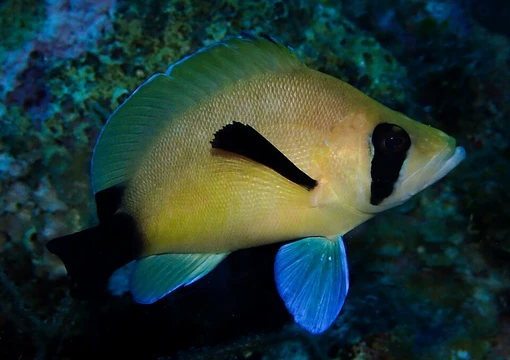
The Eel
A living ribbon of teeth and patience, coiled in the dark between the reef's bones.

Eels (order Anguilliformes) are a diverse assemblage of elongated, serpentine ray-finned fish found in marine and freshwater habitats across every ocean. Characterized by a continuous, unbroken fin running the length of the body—fusing dorsal, anal, and caudal structures into a single undulating membrane—eels occupy niches from shallow coral crevices to abyssal plains. The order encompasses more than 600 described species across roughly 20 families, including the reef-dwelling morays (Muraenidae), the deep-water congers (Congridae), and the catadromous freshwater eels (Anguillidae).
In reef ecology, eels function as both apex ambush predators and prey items for larger elasmobranchs and groupers. Their elongated bodies allow them to inhabit tight rocky and coral interstices inaccessible to most other teleosts, making them a keystone component of benthic community structure. The European eel (Anguilla anguilla), one of the most-studied members, exemplifies the extraordinary migratory physiology found in the order, completing trans-Atlantic spawning journeys in the Sargasso Sea before returning as glass eels to European estuaries.
- Taxonomic rank
- Order Anguilliformes (within class Actinopterygii)
- Body plan
- Elongate, laterally compressed or cylindrical; continuous perioral fin
- Predation strategy
- Ambush / sit-and-wait; many species lack pelvic fins
- Habitat range
- Tropical to polar; intertidal to abyssal (>4,000 m); marine and freshwater
- Reproductive mode
- Mostly oviparous; several families exhibit catadromous or anadromous migration
- Distinguishing feature
- No clear demarcation between dorsal, anal, and caudal fin rays
Lore & Background
The anguilliform body plan is one of the most successful in the teleost radiation. By merging the three posterior fins into a single undulating surface, eels generate continuous thrust with minimal drag, enabling them to slither through crevices, burrow in sand, and hold station in strong current with almost no visible movement. Most species have reduced or absent pelvic fins, further streamlining the profile for a life spent wedged in rock, coral, or sediment.
Predation among eels is overwhelmingly ambush-based. A moray eel (Muraenidae) will position its head at the mouth of a crevice, gills flaring to pump water, and strike with a lateral head-whip that can exceed two metres in a single motion. The elongated gut—often two to three times body length—reflects a diet of whole prey items: crabs, small fish, octopus, and in some species, even the occasional invertebrate or detritus. Conger eels (Congridae) in deeper waters employ a similar strategy but target larger, slower prey such as herring and squid at depths where most other predators are scarce.
The life cycles of many anguilliforms remain among the most intricate in vertebrate biology. The European eel's catadromous migration, in which juveniles (elvers) drift across the North Atlantic to spawn in the Sargasso Sea and then return as glass eels to European coasts, spans thousands of kilometres and several years. The mechanism by which adults navigate to the spawning ground, and how larvae locate their natal estuaries, continues to be an active area of research. In reef-associated morays, by contrast, reproduction is largely benthic: females guard adhesive egg masses in cavities, and free-swimming larvae (leptocephali) drift on currents before metamorphosing into juvenile eels that settle back onto reefs.
Reader's Guide
Ring name: The Eel | Real-name (taxon): Order Anguilliformes, ~600+ species across ~20 families
Mask design: No mask in the traditional sense. The "face" is a long, tubular snout with a gape of interlocking, needle-thin teeth; the eyes are small, forward-set, and often ringed with a faint iridescent sheen. The continuous dorsal-anal-caudal fin runs the full length of the body like a single unbroken collar, giving the impression of a living ribbon rather than a segmented creature.
Signature move: The Head-Whip Strike. The eel remains motionless, head protruding from a crevice, gills flaring. In a single lateral contraction of the anterior musculature, the head and first third of the body lunge forward two to three body-lengths, jaws gaping, to seize prey. The remaining body stays coiled in the shelter, anchoring the strike.
Faction allegiance: Benthic Ambush Coalition (reef crevice dwellers, sand burrowers, and deep-water congers). Allied with octopods and stonefish in the "Stillness Pact"; natural antagonists of groupers, moray-hawks, and large elasmobranchs.
Narrative hook: In the old reef-lore, the Eel is the character who never leaves the stage. While the clownfish and wrasse perform their bright, public routines, the Eel waits in the dark between the acts—patient, toothed, and utterly indifferent to the audience. It is the Hamlet who has already decided the play's ending and simply refuses to speak until the final curtain. Every other creature on the reef knows it is there. None can prove it. And in the end, it is the Eel's silence, not its strike, that keeps the whole company in check.
Did You Know?
- The continuous fin of eels is a single fused structure—there is no anatomical boundary between the dorsal, anal, and caudal fins, unlike in virtually all other ray-finned fish.
- The larval stage of most eels, called a leptocephalus, is a transparent, leaf-shaped drift organism that can spend weeks or months in the open ocean before metamorphosing into a recognizable juvenile eel.
- Moray eels continue to breathe while resting by rhythmically opening and closing their gill openings to pump water over the gill filaments, a behavior visible even when the body is completely still.
More in Fish
Elsewhere in Masked Hamlet
Spotted an error? Know more?
Reader corrections go straight into our review queue. Suggest an edit · How this site is sourced