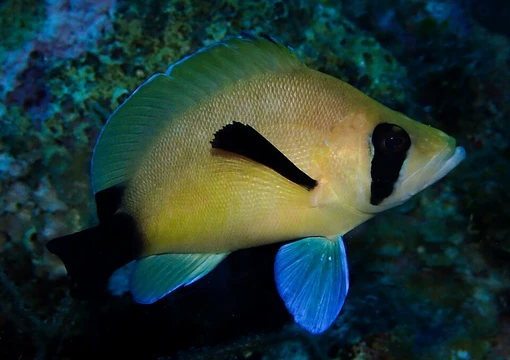
The Angler
A living lantern in the abyss, fishing the dark with a stolen star.

Anglerfish (order Lophiiformes) are a group of predominantly deep-sea fishes distinguished by a modified first dorsal-fin spine—the illicium—bearing a bioluminescent appendage called the esca. This 'lure' is colonised by symbiotic bioluminescent bacteria and functions as a visual attractant in the near-total darkness of the bathypelagic zone, drawing curious prey within striking distance of the fish's enormous, tooth-lined mouth.
Within the order, the most celebrated members (families Melanocetidae, Ceratioidei, and relatives) display extreme sexual dimorphism: the male is a tiny, jawless parasite that fuses to the female's body, while she grows to a size the male can never approach. This obligate monogamy, combined with the ambush-hunting strategy, makes Lophiiformes one of the most ecologically distinctive and visually iconic groups in the deep ocean.
- Taxonomic order
- Lophiiformes
- Distinguishing structure
- Illicium (modified dorsal spine) bearing the esca lure
- Bioluminescence source
- Symbiotic bioluminescent bacteria in the esca
- Predation strategy
- Ambush / lure-based
- Sexual dimorphism
- Extreme in deep-sea species; male fuses to female
- Primary habitat
- Bathypelagic zone (deep open ocean)
Lore & Background
In the lightless waters below roughly 1,000 metres, the anglerfish suspends itself in a slow, almost motionless drift. The illicium arcs forward from the head like a crooked fishing rod, and at its tip the esca glows with a cold, blue-green phosphorescence produced not by the fish's own tissue but by colonies of symbiotic bacteria housed in a specialised vascular organ. The glow is intermittent—flickering, pulsing—mimicking the flash of a small prey organism, luring lanternfish, amphipods, or even smaller fish closer. When the prey is within the gape, the jaw unhinges and the mouth engulfs it in a fraction of a second; the teeth, long and needle-sharp, point inward to prevent escape.
The reproductive biology of the deep-sea anglerfish (genus Melanocetus and close relatives) is among the most extreme in the animal kingdom. The male, a fraction of the female's size, locates her by chemoreception in the featureless dark. He bites into her flank, his jaws dissolve, and his body fuses with hers through a shared circulatory system. He essentially becomes a permanent gonad, producing sperm for her lifetime. This obligate parasitic monogamy is a direct adaptation to a habitat where encounters between individuals are so rare that a male who finds a female must never let go.
Fossil and phylogenetic evidence places Lophiiformes among the older teleost lineages, with the deep-sea radiations diversifying over tens of millions of years. The bioluminescent lure, the jaw morphology, and the sexual dimorphism are convergent solutions to the same problem: how to feed and reproduce in a realm where light is scarce, prey is sparse, and the cost of a missed opportunity is measured in years of drifting darkness.
Reader's Guide
Common name: Anglerfish (deep-sea; Melanocetidae and related families). Morphology / 'mask design': The head is broad and flattened, dominated by a hinged, overhanging jaw lined with long, inward-curving needle teeth. Above the snout, the illicium—a modified first dorsal-fin spine—arches forward and downward, terminating in the esca, a fleshy, bulbous lure colonised by bioluminescent bacteria that emits a cold blue-green glow. The body is a compressed, mottled grey-brown, nearly featureless, with a small eye set high on the head. Signature 'move': The ambush strike. The fish holds a suspended, motionless posture with the esca pulsing; when prey enters the kill radius, the jaw unhinges and the mouth engulfs the target in under a second, the inward-pointing teeth locking the prey in place. Ecological 'faction': Sole ambush predator of the bathypelagic open ocean; occupies a top-predator niche in a community where photosynthetic production is absent and all energy derives from surface-derived detritus or chemosynthetic seeps. Narrative hook: In the evolutionary 'drama' of the deep sea, the anglerfish is the solitary protagonist of a play with no audience—every act performed in absolute darkness, every line spoken in the silent language of a bioluminescent signal. The male's lifelong fusion to the female is the final, irreversible scene: a love story written in dissolved bone and shared blood, staged in a theatre that has no walls, no light, and no second act.
Did You Know?
- The bioluminescent glow of the esca is produced by symbiotic bacteria, not by the anglerfish's own cells; the fish maintains a specialised vascular organ to house and feed the bacterial colony.
- The illicium is a modified first dorsal-fin spine, meaning the 'fishing rod' is literally a repurposed fin ray—an evolutionary repurposing of a structure originally meant for locomotion.
- Anglerfish of the order Lophiiformes also include shallow-water species (e.g., European anglerfish, Lophius) that use the same lure mechanism in well-lit coastal waters, showing the trait predates the deep-sea radiation.
More in Fish
Elsewhere in Masked Hamlet
Spotted an error? Know more?
Reader corrections go straight into our review queue. Suggest an edit · How this site is sourced