Luidia magellanica
Source-cited species reference: taxonomy from WoRMS, biology from SeaLifeBase, occurrence map from GBIF, description from Wikipedia.
Last updated

Hugo Alberto Medina Gómez · via Wikipedia: Luidia magellanica · CC0
Luidia magellanica is a species of starfish in the family Luidiidae. It is found in the southeastern Pacific Ocean on the coast of South America.
Scientific classification
- KingdomAnimalia
- PhylumEchinodermata
- ClassAsteroidea
- OrderPaxillosida
- FamilyLuidiidae
- GenusLuidia
- SpeciesLuidia magellanica
Named by Leipoldt, 1895
Close relatives
Other species of Luidia with a Codexery entry.
- Gray sand star (Luidia foliolata) Luidia foliolata
- Lined sea star (Luidia clathrata) Luidia clathrata
- Luidia maculata Luidia maculata
- Luidia savignyi Luidia savignyi
- Magnificent star Luidia magnifica
- Luidia senegalensis
- Luidia ciliaris
- Luidia quinaria
Sources: Wikipedia taxobox: Luidia magellanica (CC BY-SA 4.0) · order, family and genus agree with WoRMS AphiaID 368133 (CC BY 4.0)
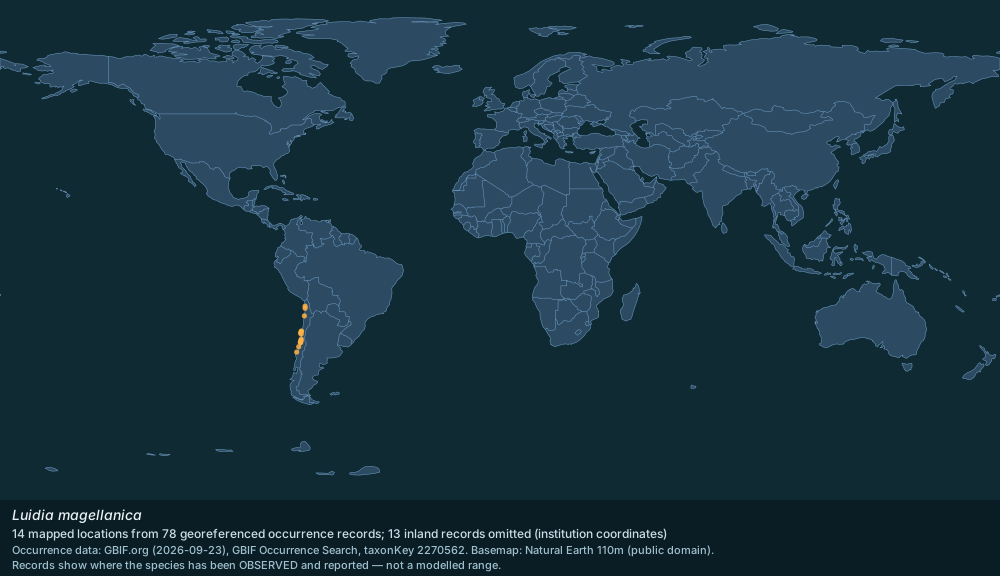
Where the luidia magellanica has been recorded
Each dot is a place where the species has been observed and reported (78 records, half-degree grid) — not a modelled range. 13 inland records left out (institution coordinates).
Map: drawn by Codexery. Data: GBIF occurrence search (records CC0 / CC BY) · Natural Earth basemap (public domain)
Quick Facts
- Authority
- Leipoldt, 1895
- Family
- Luidiidae
- Order
- Paxillosida
- Habitat zone
- benthic
- Gbif occurrence records
- 78
Facts from the source article.
Classification (WoRMS)
Full classification as recorded by WoRMS: Kingdom: Animalia · Phylum: Echinodermata · Class: Asteroidea · Order: Paxillosida · Family: Luidiidae · Genus: Luidia.
Accepted name: Luidia magellanica · Authority: Leipoldt, 1895 · Taxonomic status: accepted · AphiaID: 368133.
Synonyms and superseded combinations recorded for this taxon: Asterias (Smilasterias) terwieli Goldschmidt, 1924; Smilasterias terweili (Goldschmidt, 1924).
Source: World Register of Marine Species (WoRMS) — https://www.marinespecies.org/aphia.php?p=taxdetails&id=368133 (CC BY 4.0). Accessed 2026-09-25.
Biology and life history (SeaLifeBase)
Measured values published by SeaLifeBase for Luidia magellanica. Only fields the database actually holds for this species are shown; these are database values, not aquarium guidance.
Habitat zone: benthic · Aquarium trade: never/rarely.
Source: SeaLifeBase species summary (SpecCode 154544) — https://www.sealifebase.se/summary/Luidia-magellanica.html (CC BY-NC 3.0 — non-commercial use only). Accessed 2026-09-25.
Distribution and occurrence records (GBIF)
78 georeferenced occurrence records for Luidia magellanica are published through GBIF from 2 countries or marine areas. The map above plots 14 distinct locations from a sample of 78 records, omitting 13 inland records that carry an institution's coordinates rather than a collection site; it shows where the species has been observed and reported, not a modelled range.
Most records by country or area: Chile (56); Peru (22).
Source: GBIF Occurrence Search (taxonKey 2270562) — https://www.gbif.org/occurrence/search?taxon_key=2270562&has_coordinate=true (records CC0 / CC BY); WoRMS distribution records (MarineRegions) — https://www.marinespecies.org/aphia.php?p=taxdetails&id=368133 (CC BY 4.0); Natural Earth 110m basemap — https://www.naturalearthdata.com/ (public domain). Accessed 2026-09-25.
Description and natural history (Wikipedia)
Luidia magellanica occurs subtidally in the southeastern Pacific Ocean, on the coasts of Peru and Chile. Its typical habitat is on rock bottoms with encrusting red algae, Lithophyllum, or soft sediments composed of coarse sand and shell fragments.
Luidia magellanica is a large and aggressive specialist predator of other echinoderms. Its diet includes brittle stars such as Ophiactis, sea urchins such as Tetrapygus niger and starfish such as Patiria. In the subtidal zone of temperate Chile it feeds on eight different species of echinoderm, and with Meyenaster gelatinosus is the dominant predator. Many of the starfish in this zone have missing or regenerating arms, and this is likely to be as a result of a near-lethal encounter with either L. magellanica or M. gelatinosus.
Both of these species also exhibit cannibalism. When attacked by M. gelatinosus or by a larger member of its own species, L. magellanica tends to autotomise some 4 to 5 cm of a single arm. In a study off the coast of Chile, between 50 and 70% of individual L. magellanica were found to have regenerating arms.
Other species of starfish recorded in the same zone in the cold waters off Peru are Patiria chilensis, Stichaster striatus and Meyenaster gelatinosus. L. magellanica plays an important role in the control of grazing echinoids, and such factors as El Niño events can alter the population dynamics. If fewer L. magellanica are recruited because of temperature and other factors, more grazers such as Tetrapygus niger survive, and barren areas occur. Alternatively, when more of the starfish are present, fewer grazers cause less damage and the kelp flourishes unchecked.
Source: Wikipedia: Luidia magellanica — https://en.wikipedia.org/wiki/Luidia_magellanica (CC BY-SA 4.0). Accessed 2026-09-25.
Sources
Compiled from Wikipedia and the sources listed below. Text from Wikipedia is available under CC BY-SA 4.0; this entry is adapted from it.
- Wikipedia: Luidia magellanica (CC BY-SA 4.0).
- Classification: the source article's taxobox; order, family and genus checked against WoRMS, the World Register of Marine Species (CC BY 4.0).
- Occurrence records: GBIF (CC0 / CC BY). Basemap: Natural Earth (public domain).
- Biology values: SeaLifeBase species summary (CC BY-NC 3.0, non-commercial).
- Word definitions: the , each quoted from its Wikipedia article.
Spotted an error? Know more?
Reader corrections go straight into our review queue. Suggest an edit · How this site is sourced