
Gray sand star (Luidia foliolata)
Source-cited species reference: taxonomy from WoRMS, biology from SeaLifeBase, occurrence map from GBIF, description from Wikipedia.
Luidia foliolata, the sand star, is a species of starfish in the family Luidiidae found in the northeastern Pacific Ocean on sandy and muddy seabeds at depths to about 600 m.
- Scientific name
- Luidia foliolata
- Authority
- Grube, 1866
- Family
- Luidiidae
- Order
- Paxillosida
- Maximum length
- 60 cm
- Depth range
- 4–613 m
- Habitat zone
- benthic
- Gbif occurrence records
- 126,238
Classification (WoRMS)
Full classification as recorded by WoRMS: Kingdom: Animalia · Phylum: Echinodermata · Class: Asteroidea · Order: Paxillosida · Family: Luidiidae · Genus: Luidia.
Accepted name: Luidia foliolata · Authority: Grube, 1866 · Taxonomic status: accepted · AphiaID: 368114.
Source: World Register of Marine Species (WoRMS) — https://www.marinespecies.org/aphia.php?p=taxdetails&id=368114 (CC BY 4.0). Accessed 2026-09-23.
Biology and life history (SeaLifeBase)
Measured values published by SeaLifeBase for Luidia foliolata. Only fields the database actually holds for this species are shown; these are database values, not aquarium guidance.
Maximum length: 60 cm · Depth range: 4–613 m · Habitat zone: benthic · Vulnerability index: 44 of 100.
SeaLifeBase notes: Usually found in shallow soft bottoms, i.e., muddy, sandy or soft substrates with broken shells (Ref. 93256).
Source: SeaLifeBase species summary (SpecCode 48679) — https://www.sealifebase.se/summary/Luidia-foliolata.html (CC BY-NC 3.0 — non-commercial use only). Accessed 2026-09-23.
Distribution and occurrence records (GBIF)
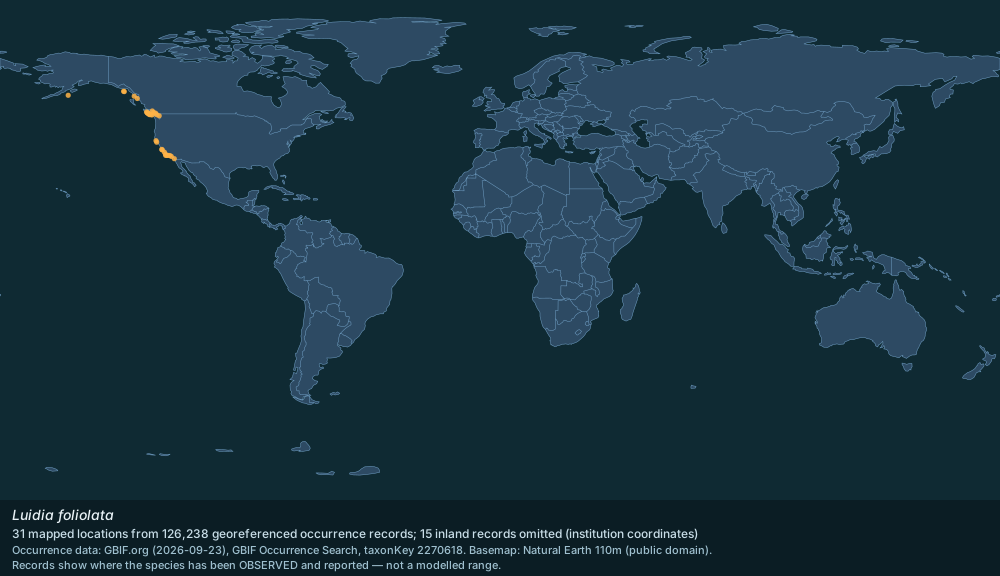
126,238 georeferenced occurrence records for Luidia foliolata are published through GBIF from 10 countries or marine areas. The map above plots 31 distinct locations from a sample of 3,000 records, omitting 15 inland records that carry an institution's coordinates rather than a collection site; it shows where the species has been observed and reported, not a modelled range.
Most records by country or area: United States of America (123,574); Canada (2,639); Mexico (11); Ecuador (7); Guatemala (2).
The full country table, WoRMS marine regions and the sampling notes are on this species' Distribution page.
Source: GBIF Occurrence Search (taxonKey 2270618) — https://www.gbif.org/occurrence/search?taxon_key=2270618&has_coordinate=true (records CC0 / CC BY); WoRMS distribution records (MarineRegions) — https://www.marinespecies.org/aphia.php?p=taxdetails&id=368114 (CC BY 4.0); Natural Earth 110m basemap — https://www.naturalearthdata.com/ (public domain). Accessed 2026-09-23.
Description and natural history (Wikipedia)
The sand star has a small disc and five long, flattened arms with tapering tips. It can grow to a diameter of 40 cm, and is a grey, greenish-grey, or pale brown colour, sometimes speckled with white. The arms have rows of large marginal plates, each with several spines, but these are not visible from the aboral (upper) side. The tube feet have no suckers, but instead end with blunt points. The sand star could be confused with Astropecten verrilli, but in that species, the large marginal plates are visible from above. This starfish seems to be easily damaged, and often breaks in pieces if raised from the seabed by trawling. Even when brought up intact, it often has missing or regenerating arms, perhaps the result of attacks by predatory crabs or fish.
The sand star is found at depths to 600 m on soft substrates in the northeastern Pacific Ocean, with a range extending from Alaska to the Galapagos Islands and Nicaragua.
The sand star is well-camouflaged on the sandy and muddy seabeds where it is found, and is often half-covered with sediment. It can create a shallow depression and work its way under the bivalve molluscs, polychaete worms, brittle stars, and sea cucumbers on which it feeds. Unlike some other starfish, it cannot evert its stomach, so is limited to smaller-sized prey. It is agile, and can right itself rapidly if turned upside down. The long, pointed tube feet are specially adapted for movement over soft sediments, but lose traction if the sand star tries to scale steeply sloping rocks. It is a fast traveller, and can move across the seabed at the rate of 280 cm per minute, many times faster than slow species such as the leather star (Dermasterias imbricata), which can only traverse 15 cm in a minute.
Source: Wikipedia: Luidia foliolata — https://en.wikipedia.org/wiki/Luidia_foliolata (CC BY-SA 4.0). Accessed 2026-09-23.
Gallery
Related in Gray sand star
Links follow this subject's own source article.
Elsewhere in Gray sand star
Spotted an error? Know more?
Reader corrections go straight into our review queue. Suggest an edit · How this site is sourced