
Lined sea star (Luidia clathrata)
Source-cited species reference: taxonomy from WoRMS, biology from SeaLifeBase, occurrence map from GBIF, description from Wikipedia.
Luidia clathrata is a tropical species of starfish in the family Luidiidae. It is variously known as the slender-armed starfish, the gray sea star, or the lined sea star. It is found in the western Atlantic Ocean.
- Scientific name
- Luidia clathrata
- Authority
- (Say, 1825)
- Family
- Luidiidae
- Order
- Paxillosida
- Depth range
- 0–175 m
- Habitat zone
- benthic
- Gbif occurrence records
- 2,924
Classification (WoRMS)
Full classification as recorded by WoRMS: Kingdom: Animalia · Phylum: Echinodermata · Class: Asteroidea · Order: Paxillosida · Family: Luidiidae · Genus: Luidia.
Accepted name: Luidia clathrata · Authority: (Say, 1825) · Taxonomic status: accepted · AphiaID: 158497.
Synonyms and superseded combinations recorded for this taxon: Asterias clathrata Say, 1825.
Source: World Register of Marine Species (WoRMS) — https://www.marinespecies.org/aphia.php?p=taxdetails&id=158497 (CC BY 4.0). Accessed 2026-09-23.
Biology and life history (SeaLifeBase)
Measured values published by SeaLifeBase for Luidia clathrata. Only fields the database actually holds for this species are shown; these are database values, not aquarium guidance.
Depth range: 0–175 m · Habitat zone: benthic.
SeaLifeBase notes: Maximum depth from Ref. 111335. Known from shallow-waters (Ref. 86570). Prefers to feed on infaunal bivalve Mulinia lateralis . May shift from intraoral macrofaunal feeding to intra- and extraoral detrital feeding (Ref. 111333).
Source: SeaLifeBase species summary (SpecCode 48680) — https://www.sealifebase.se/summary/Luidia-clathrata.html (CC BY-NC 3.0 — non-commercial use only). Accessed 2026-09-23.
Distribution and occurrence records (GBIF)
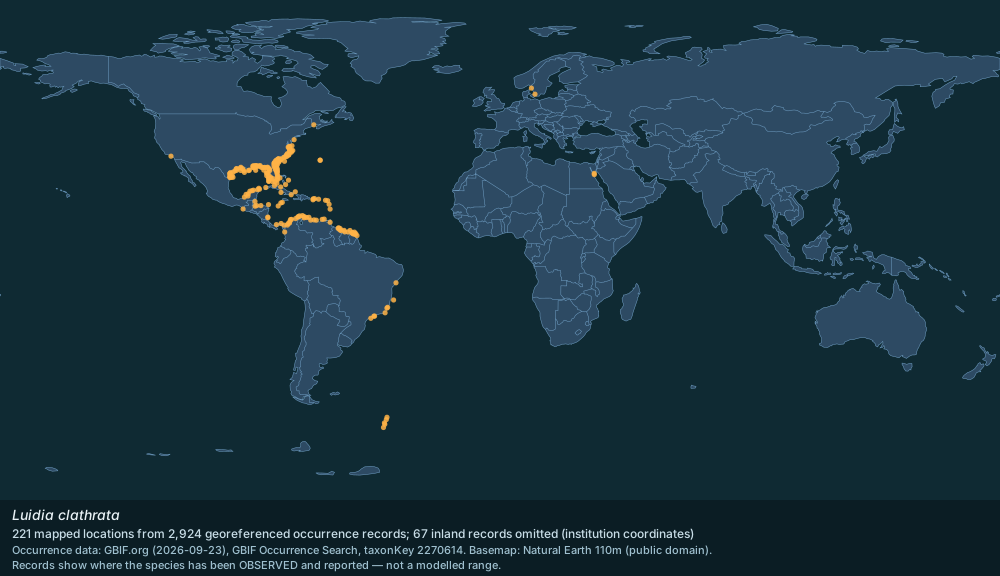
2,924 georeferenced occurrence records for Luidia clathrata are published through GBIF from 29 countries or marine areas. The map above plots 221 distinct locations from a sample of 2,924 records, omitting 67 inland records that carry an institution's coordinates rather than a collection site; it shows where the species has been observed and reported, not a modelled range.
Most records by country or area: United States of America (2,654); Brazil (65); Colombia (27); Mexico (25); French Guiana (17).
The full country table, WoRMS marine regions and the sampling notes are on this species' Distribution page.
Source: GBIF Occurrence Search (taxonKey 2270614) — https://www.gbif.org/occurrence/search?taxon_key=2270614&has_coordinate=true (records CC0 / CC BY); WoRMS distribution records (MarineRegions) — https://www.marinespecies.org/aphia.php?p=taxdetails&id=158497 (CC BY 4.0); Natural Earth 110m basemap — https://www.naturalearthdata.com/ (public domain). Accessed 2026-09-23.
Description and natural history (Wikipedia)
Luidia clathrata is a large, flattish starfish, sometimes growing to a diameter of 30 cm. It has a relatively small disc and five slender arms, which are two or three times the diameter of the disc. The upper surface of the disc and arms is clad in longitudinal rows of calcified plates called ossicles, and in paxillae, pillar-like spines with flattened summits covered with minute spinules. No plates are found along the margins of the arms, these being replaced by paxillae, but on the underside, the marginal plates are large and themselves covered with paxillae. The tube feet, found in longitudinal rows on the underside, do not have suckers, but have two swollen regions. A mouth is in the centre of the underside, with an oesophagus and cardiac stomach which can be everted. The gonads are underneath the sides of each arm. Its colour is usually grey or light brown, but can be tinged with pink. The central row of plates on the upper side of the arms is usually dark grey or black. The underside of the starfish is a paler colour.
L. clathrata is found around the coastlines of the western Atlantic Ocean, from Virginia south to Brazil, the Caribbean Sea, and the Gulf of Mexico. It is usually on sandy or muddy sea beds down to a depth around 40 m, although it is occasionally found in deeper waters down to 100 m.
When L. clathrata loses part or all of an arm through predation, it can regenerate the limb. The damaged area is sealed off, and a new small arm-tip appears within a week. Subsequent development is at the rate of about 3.7 mm a month, although this slows down when regeneration is nearly complete. A study on the regenerative capacity of L. clathrata found that increased ocean acidification, as is likely to happen under global warming, had no significant effect on the starfish's ability to regenerate its limbs.
L. clathrata is both a predator and a forager. It selectively feeds on the "coot clam", Mulinia lateralis, when it is abundant, using chemoreceptors to help it find its prey. The coot clam is the preferred food of L. clathrata in Tampa Bay in Florida. At other times, it feeds by ingesting sediment and straining the material through spines around its mouth, extracting food particles in the process. Its diet includes both gastropod and bivalve molluscs, foraminiferans, nematodes, ostracods, small crustaceans, and detritus. It is photosensitive and mostly spends the daylight hours buried in the sediment. While buried, it sometimes everts its stomach to ingest detritus.
L. clathrata spawns annually. The larvae pass through a planktonic bipinnaria stage, which lasts about a month before settling on the seabed, undergoing metamorphosis, and becoming juvenile starfish.
Source: Wikipedia: Luidia clathrata — https://en.wikipedia.org/wiki/Luidia_clathrata (CC BY-SA 4.0). Accessed 2026-09-23.
Gallery
Related in Lined sea star
Links follow this subject's own source article.
Elsewhere in Lined sea star
Spotted an error? Know more?
Reader corrections go straight into our review queue. Suggest an edit · How this site is sourced