Luidia maculata
Source-cited species reference: taxonomy from WoRMS, biology from SeaLifeBase, occurrence map from GBIF, description from Wikipedia.
Last updated

لا روسا · via Wikipedia: Luidia maculata · CC BY-SA 3.0
Luidia maculata is a species of starfish in the family Luidiidae in the order Paxillosida. It is native to the Indo-Pacific region. It is commonly known as the eight-armed sea star because, although the number of arms varies from five to nine, eight arms seems to be the most common.
Scientific classification
- KingdomAnimalia
- PhylumEchinodermata
- ClassAsteroidea
- OrderPaxillosida
- FamilyLuidiidae
- GenusLuidia
- SpeciesLuidia maculata
Named by Müller & Troschel, 1842
Close relatives
Other species of Luidia with a Codexery entry.
- Luidia savignyi Luidia savignyi
- Magnificent star Luidia magnifica
- Gray sand star (Luidia foliolata) Luidia foliolata
- Lined sea star (Luidia clathrata) Luidia clathrata
- Luidia magellanica Luidia magellanica
- Luidia senegalensis
- Luidia ciliaris
- Luidia quinaria
Sources: Wikipedia taxobox: Luidia maculata (CC BY-SA 4.0) · order, family and genus agree with WoRMS AphiaID 213112 (CC BY 4.0)
How big is it?
Largest length in the source, 0.6 m, next to a 1.8 m person.
Diagram: drawn by Codexery, schematic shapes to scale (not a likeness). Length: SeaLifeBase species summary
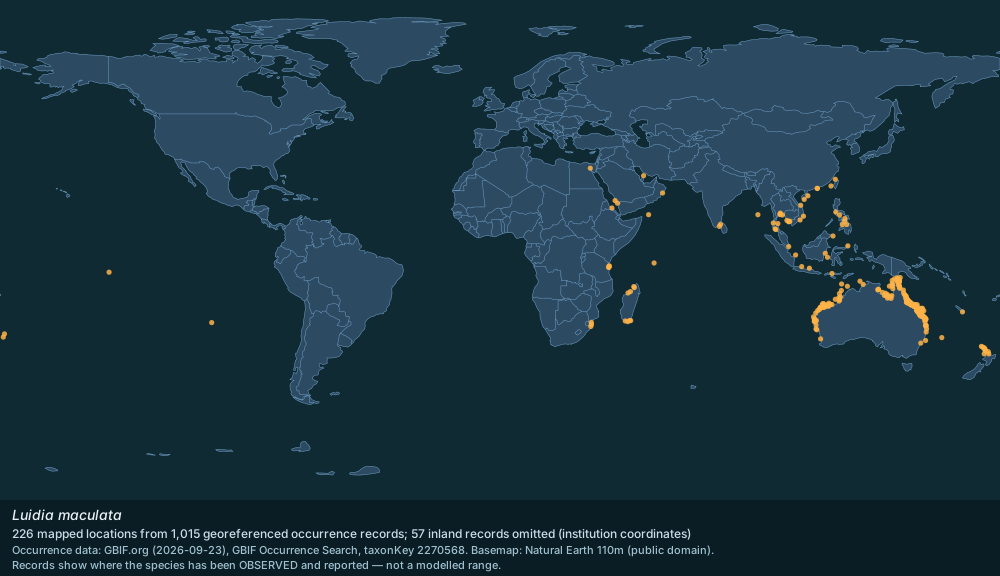
Where the luidia maculata has been recorded
Each dot is a place where the species has been observed and reported (1,015 records, half-degree grid) — not a modelled range. 57 inland records left out (institution coordinates). 4 isolated far-off records not drawn.
Map: drawn by Codexery. Data: GBIF occurrence search (records CC0 / CC BY) · Natural Earth basemap (public domain)
Classification (WoRMS)
Full classification as recorded by WoRMS: Kingdom: Animalia · Phylum: Echinodermata · Class: Asteroidea · Order: Paxillosida · Family: Luidiidae · Genus: Luidia.
Accepted name: Luidia maculata · Authority: Müller & Troschel, 1842 · Taxonomic status: accepted · AphiaID: 213112.
Synonyms and superseded combinations recorded for this taxon: Luidia maculata var. ceylonica Döderlein, 1920; Luidia varia Mortensen, 1925.
Source: World Register of Marine Species (WoRMS) — https://www.marinespecies.org/aphia.php?p=taxdetails&id=213112 (CC BY 4.0). Accessed 2026-09-25.
Biology and life history (SeaLifeBase)
Measured values published by SeaLifeBase for Luidia maculata. Only fields the database actually holds for this species are shown; these are database values, not aquarium guidance.
Maximum length: 60 cm · Depth range: 0–512 m · Habitat zone: reef-associated · Vulnerability index: 44 of 100 · Aquarium trade: never/rarely.
SeaLifeBase notes: Occurs on soft bottoms, exposed or buried in the sand (Also Ref. 129602) at depths of 0 to 90 m (Ref. 800). Also found on seagrass (Ref. 102259). Carnivorous and feeds on other echinoderms and molluscs (Ref. 800). Swallows prey as a whole, instead of protruding the stomach out to digest a prey (Ref. 125532).
Source: SeaLifeBase species summary (SpecCode 86691) — https://www.sealifebase.se/summary/Luidia-maculata.html (CC BY-NC 3.0 — non-commercial use only). Accessed 2026-09-25.
Distribution and occurrence records (GBIF)
1,015 georeferenced occurrence records for Luidia maculata are published through GBIF from 34 countries or marine areas. The map above plots 226 distinct locations from a sample of 1,015 records, omitting 57 inland records that carry an institution's coordinates rather than a collection site; it shows where the species has been observed and reported, not a modelled range.
Most records by country or area: Australia (573); Singapore (98); New Zealand (94); Hong Kong (62); Philippines (28).
The full country table, WoRMS marine regions and the sampling notes are on this species' Distribution page.
Source: GBIF Occurrence Search (taxonKey 2270568) — https://www.gbif.org/occurrence/search?taxon_key=2270568&has_coordinate=true (records CC0 / CC BY); WoRMS distribution records (MarineRegions) — https://www.marinespecies.org/aphia.php?p=taxdetails&id=213112 (CC BY 4.0); Natural Earth 110m basemap — https://www.naturalearthdata.com/ (public domain). Accessed 2026-09-25.
Description and natural history (Wikipedia)
Luidia maculata is a large starfish, up to 25 cm in diameter. There are usually seven or eight (sometimes nine) long, slender, pointed arms and a relatively small central disc. The aboral (upper) surface is flat, with some granulations, the surface covered with flat-topped, table-like structures known as paxillae. Rows of pale-coloured tube feet that end in points rather than suction pads, are visible on the sides of the arms and the oral (lower) surface.
There are two different colour forms of this starfish; some individuals are a uniform shade of dark brown or greenish-brown, while others are dark brown with orange-brown chevron-shaped markings, or light brown with dark markings. This starfish could be confused with some other member of the Luidia genus, particularly L. savignyi, but that species is spiny whereas L. maculata is smooth. Another similar species is L. magnifica, but that typically has nine or ten arms.
Distribution and habitat
Luidia maculata is native to the tropical Indian and Pacific Ocean. Its usual habitat is muddy sand on the floor of lagoons, but it may also be found on other soft sediments and in seagrass beds. Its depth range is from a few metres down to about 35 m.
Ecology
Luidia maculata partially buries itself in soft sediment rendering itself difficult to spot. It is a predator, feeding mostly on sea urchins, particularly irregular sand dollars and similar echinoderms which also live buried in sand. Unlike some related species which practice external digestion, it draws its prey inside its mouth to consume.
When it emerges from hiding, it often leaves behind inedible fragments of test from its prey in the hollow it vacated. Other dietary items include sea cucumbers, brittle stars, bivalves, snails, crustaceans and worms. Unlike other starfish that practice extra oral digestion Luidia maculata ingests its prey at the oral orifice in the center of the disc, ventral surface, and consumes it inside itself.
Source: Wikipedia: Luidia maculata — https://en.wikipedia.org/wiki/Luidia_maculata (CC BY-SA 4.0). Accessed 2026-09-25.
Related in Luidia maculata
Links follow this subject's own source article.
Elsewhere in Luidia maculata
Sources
Compiled from Wikipedia and the sources listed below. Text from Wikipedia is available under CC BY-SA 4.0; this entry is adapted from it.
- Wikipedia: Luidia maculata (CC BY-SA 4.0).
- Classification: the source article's taxobox; order, family and genus checked against WoRMS, the World Register of Marine Species (CC BY 4.0).
- Occurrence records: GBIF (CC0 / CC BY). Basemap: Natural Earth (public domain).
- Biology values: SeaLifeBase species summary (CC BY-NC 3.0, non-commercial).
- Word definitions: the , each quoted from its Wikipedia article.
Spotted an error? Know more?
Reader corrections go straight into our review queue. Suggest an edit · How this site is sourced