
Broadleaf seagrass (Halophila stipulacea)
Source-cited species reference: taxonomy from WoRMS, biology from SeaLifeBase, occurrence map from GBIF, conservation from IUCN Red List, description from Wikipedia.

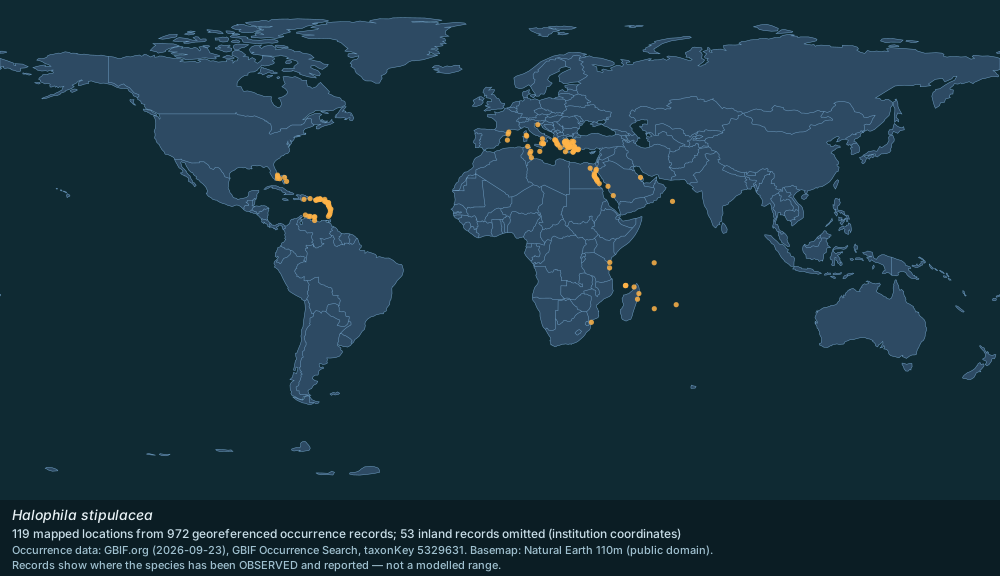
Distribution map plotted from GBIF.org occurrence records; basemap Natural Earth 110m · GBIF records CC0 / CC BY; Natural Earth public domain
Halophila stipulacea is a species of seagrass in the Hydrocharitaceae family. It is native to the Indian Ocean that spread into the Mediterranean after the opening of the Suez Canal. This seagrass is widespread through the Gulf of Aqaba. Recently it has arrived in the Caribbean where it is also spreading.
- Scientific name
- Halophila stipulacea
- Authority
- (Forsskål) Ascherson, 1867
- Family
- Hydrocharitaceae
- Order
- Alismatales
- Depth range
- 1–30 m
- Habitat zone
- sessile
- Iucn red list
- Least Concern
- Gbif occurrence records
- 972
Classification (WoRMS)
Full classification as recorded by WoRMS: Kingdom: Plantae · Phylum: Tracheophyta · Class: Magnoliopsida · Order: Alismatales · Family: Hydrocharitaceae · Genus: Halophila.
Accepted name: Halophila stipulacea · Authority: (Forsskål) Ascherson, 1867 · Taxonomic status: accepted · AphiaID: 145714.
Synonyms and superseded combinations recorded for this taxon: Thalassia stipulacea (Forsskål) K.D.König, 1805; Zostera bullata Delile, 1813; Zostera stipulacea Forsskål, 1775.
Source: World Register of Marine Species (WoRMS) — https://www.marinespecies.org/aphia.php?p=taxdetails&id=145714 (CC BY 4.0). Accessed 2026-09-23.
Biology and life history (SeaLifeBase)
Measured values published by SeaLifeBase for Halophila stipulacea. Only fields the database actually holds for this species are shown; these are database values, not aquarium guidance.
Depth range: 1–30 m · Habitat zone: sessile · Aquarium trade: never/rarely.
SeaLifeBase notes: Rarely occurs intertidally but extends down to 70 m on fine sand. Important source of primary production, nursery ground and is grazed by fish ( Siganus , Zebrasoma ), turtles and dugongs (Ref. 801).
Source: SeaLifeBase species summary (SpecCode 163900) — https://www.sealifebase.se/summary/Halophila-stipulacea.html (CC BY-NC 3.0 — non-commercial use only). Accessed 2026-09-23.
Distribution and occurrence records (GBIF)
972 georeferenced occurrence records for Halophila stipulacea are published through GBIF from 48 countries or marine areas. The map above plots 119 distinct locations from a sample of 972 records, omitting 53 inland records that carry an institution's coordinates rather than a collection site; it shows where the species has been observed and reported, not a modelled range.
Most records by country or area: Greece (249); Martinique (83); Virgin Islands (U.S.) (83); Guadeloupe (73); Kenya (62); Egypt (52); Bonaire, Sint Eustatius and Saba (47); Puerto Rico (39); Dominica (32); United States of America (23); Italy (19); Virgin Islands (British) (19); Curaçao (17); Tunisia (15); Saint Martin (French part) (14).
Marine regions with a valid WoRMS distribution record: Mediterranean Sea; European waters (ERMS scope); Kenyan Exclusive Economic Zone; Madagascar; Red Sea; Watamu; Maltese part of the Mediterranean Sea - Eastern Basin; Greek part of the Aegean Sea; Aegean Sea; Ionian sea; Mediterranean Sea - Eastern Basin; Mediterranean Sea - Western Basin; Greece; Levantine Sea; Albanian part of the Adriatic Sea; Italian part of the Tyrrhenian Sea; Italian part of the Ionian Sea; Western Indian Ocean; Guadeloupe & Martinique part of the Caribbean Sea; Dominican part of the Caribbean Sea; Saint Lucia part of the Caribbean Sea; Grenadian part of the Caribbean Sea; Aruban part of the Caribbean Sea; Curaçaoan part of the Caribbean Sea; Bonaire part of the Caribbean Sea; Venezuelan part of the Caribbean Sea; Saint Vincent and the Grenadines part of the Caribbean Sea; Martinican Exclusive Economic Zone; Guadeloupean Exclusive Economic Zone; Sint-Eustasius part of the Caribbean Sea.
Source: GBIF Occurrence Search (taxonKey 5329631) — https://www.gbif.org/occurrence/search?taxon_key=5329631&has_coordinate=true (records CC0 / CC BY); WoRMS distribution records (MarineRegions) — https://www.marinespecies.org/aphia.php?p=taxdetails&id=145714 (CC BY 4.0); Natural Earth 110m basemap — https://www.naturalearthdata.com/ (public domain). Accessed 2026-09-23.
Conservation status (IUCN Red List)
The IUCN Red List assesses Halophila stipulacea (Forssk.) Asch. as Least Concern (code LC). No trend, population estimate or threat analysis is given here, because none is available from this source without the Red List API; follow the source link for the full assessment, including its date.
Source: IUCN Red List of Threatened Species (taxon 173319) — https://www.iucnredlist.org/species/173319/0; GBIF IUCN Red List category endpoint (taxonKey 5329631) — https://api.gbif.org/v1/species/5329631/iucnRedListCategory. Accessed 2026-09-23.
Description and natural history (Wikipedia)
It is suggested that the expansion of H. stipulacea from the Red Sea into the Mediterranean Sea was a result of the opening of the Suez Canal in 1869. The invasion into the Mediterranean was first documented in 1894.
This species was first reported in the Caribbean in Grenada, Dominica, and St. Lucia in 2002, 2007, and 2008 respectively. By 2017, H. stipulacea had expanded to nineteen other Caribbean islands. In the United States Virgin Islands, H. stipulacea was first observed in 2012 along the northeast coast of St. John, followed by St. Thomas and St. Croix in 2013 and 2016 respectively. H. stipulacea was observed for the first time on the Venezuelan coast at Playa Mansa, near Naiguatá in Vargas state.
H. stipulacea has been classified as an invasive species because of its ability to displace native species. It can do this by forming thick mats, adapt to changes in environmental conditions, and exist along an extreme depth gradient.
Source: Wikipedia: Halophila stipulacea — https://en.wikipedia.org/wiki/Halophila_stipulacea (CC BY-SA 4.0). Accessed 2026-09-23.
Gallery
Spotted an error? Know more?
Reader corrections go straight into our review queue. Suggest an edit · How this site is sourced