
Spoon seagrass (Halophila ovalis)
Source-cited species reference: taxonomy from WoRMS, biology from SeaLifeBase, occurrence map from GBIF, conservation from IUCN Red List, description from Wikipedia.

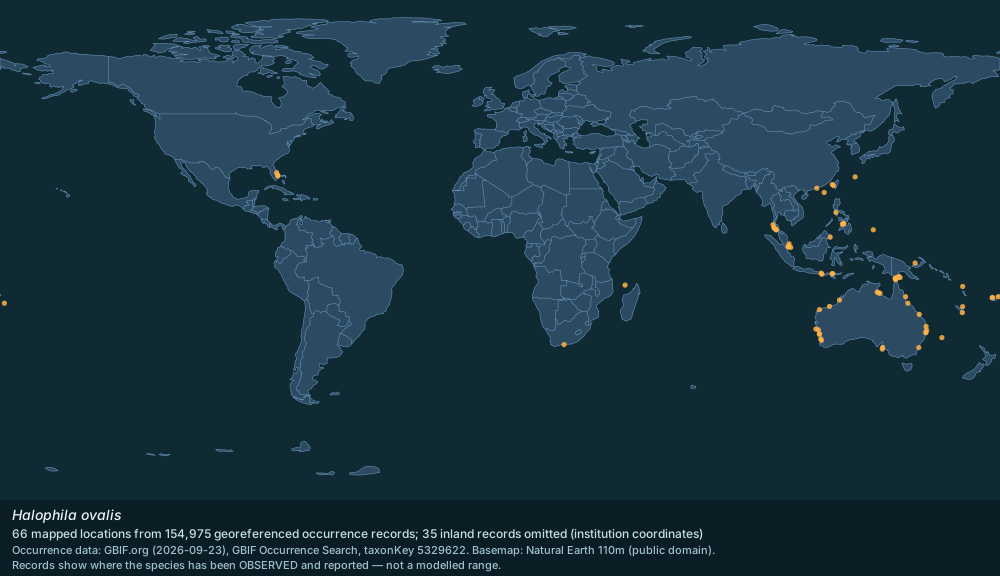
Distribution map plotted from GBIF.org occurrence records; basemap Natural Earth 110m · GBIF records CC0 / CC BY; Natural Earth public domain
Halophila ovalis, commonly known as paddle weed, spoon grass or dugong grass, is a seagrass in the family Hydrocharitaceae. It is a small herbaceous plant that naturally occurs in sea beds and other saltwater environments in the Indo-Pacific. It was introduced as isolated populations in Florida, Cuba and Antigua.
- Scientific name
- Halophila ovalis
- Authority
- (R.Brown) J.D.Hooker, 1858
- Family
- Hydrocharitaceae
- Order
- Alismatales
- Depth range
- 2–79 m
- Habitat zone
- sessile
- Iucn red list
- Least Concern
- Gbif occurrence records
- 154,975
Classification (WoRMS)
Full classification as recorded by WoRMS: Kingdom: Plantae · Phylum: Tracheophyta · Class: Magnoliopsida · Order: Alismatales · Family: Hydrocharitaceae · Genus: Halophila.
Accepted name: Halophila ovalis · Authority: (R.Brown) J.D.Hooker, 1858 · Taxonomic status: accepted · AphiaID: 208930.
Synonyms and superseded combinations recorded for this taxon: Caulinia ovalis R.Brown, 1810; Halophila madagascarensis Doty & B.C.Stone, 1967; Halophila ovalis var. ovata (Gaudichaud) Ascherson, 1868; Halophila ovata Gaudichaud, 1827.
Source: World Register of Marine Species (WoRMS) — https://www.marinespecies.org/aphia.php?p=taxdetails&id=208930 (CC BY 4.0). Accessed 2026-09-23.
Biology and life history (SeaLifeBase)
Measured values published by SeaLifeBase for Halophila ovalis. Only fields the database actually holds for this species are shown; these are database values, not aquarium guidance.
Depth range: 2–79 m · Habitat zone: sessile · Aquarium trade: never/rarely.
SeaLifeBase notes: Found on more sheltered muddy substrates. Rare intertidally but extends down to 28 m. Grazed by fish, dugongs and turtles (Ref. 801).
Source: SeaLifeBase species summary (SpecCode 2380981) — https://www.sealifebase.se/summary/Halophila-ovalis.html (CC BY-NC 3.0 — non-commercial use only). Accessed 2026-09-23.
Distribution and occurrence records (GBIF)
154,975 georeferenced occurrence records for Halophila ovalis are published through GBIF from 41 countries or marine areas. The map above plots 66 distinct locations from a sample of 3,000 records, omitting 35 inland records that carry an institution's coordinates rather than a collection site; it shows where the species has been observed and reported, not a modelled range.
Most records by country or area: Australia (140,755); Japan (12,965); Thailand (187); Indonesia (147); Philippines (114).
The full country table, WoRMS marine regions and the sampling notes are on this species' Distribution page.
Source: GBIF Occurrence Search (taxonKey 5329622) — https://www.gbif.org/occurrence/search?taxon_key=5329622&has_coordinate=true (records CC0 / CC BY); WoRMS distribution records (MarineRegions) — https://www.marinespecies.org/aphia.php?p=taxdetails&id=208930 (CC BY 4.0); Natural Earth 110m basemap — https://www.naturalearthdata.com/ (public domain). Accessed 2026-09-23.
Conservation status (IUCN Red List)
The IUCN Red List assesses Halophila ovalis (R.Br.) Hook.f. as Least Concern (code LC). No trend, population estimate or threat analysis is given here, because none is available from this source without the Red List API; follow the source link for the full assessment, including its date.
Source: IUCN Red List of Threatened Species (taxon 169015) — https://www.iucnredlist.org/species/169015/0; GBIF IUCN Red List category endpoint (taxonKey 5329622) — https://api.gbif.org/v1/species/5329622/iucnRedListCategory. Accessed 2026-09-23.
Description and natural history (Wikipedia)
The first description of the species was by Robert Brown as Caulinia ovalis, this was transferred to the genus Halophila by Joseph Dalton Hooker in Flora Tasmaniae (1858).
The species name Halophila ovata is now regarded as a synonym of this species.
The plant occurs around reefs, estuaries, islands, inter-tidal areas, on soft sand or mud substrates. The leaves are ovate in outline, appearing on stems that emerge from rhizome beneath the sand. The roots get up to 800 mm long and covered in fine root hairs. It is often found in meadows that dominate a sand bank or other patch of sea floor. The arrangement of the plant, above and below ground, provides stability to the sea floor and habitat for other species. It is used as food by dugong, as is therefore known as dugong grass.
A clone of Halophila ovalis known as Johnson's seagrass occurs only on the southeastern coast of Florida. It was formerly treated as the species Halophila johnsonii, a synonym of Halophila ovalis subsp. ovalis.
Source: Wikipedia: Halophila ovalis — https://en.wikipedia.org/wiki/Halophila_ovalis (CC BY-SA 4.0). Accessed 2026-09-23.
Gallery
Related in Spoon seagrass
Links follow this subject's own source article.
Elsewhere in Spoon seagrass
Spotted an error? Know more?
Reader corrections go straight into our review queue. Suggest an edit · How this site is sourced