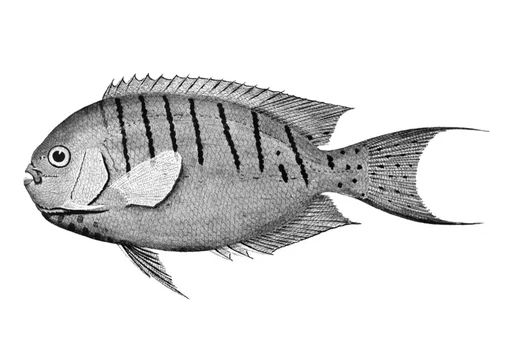
Halfbanded angelfish (Genicanthus semicinctus)
Source-cited species reference: taxonomy from WoRMS, biology from FishBase, occurrence map from GBIF, conservation from IUCN Red List, description from Wikipedia.

Edgar Waite · CC BY 3.0
The halfbanded angelfish (Genicanthus semicinctus) is a species of marine ray-finned fish, a marine angelfish belonging to the family Pomacanthidae. It is found in the southwestern Pacific Ocean.
- Scientific name
- Genicanthus semicinctus
- Authority
- (Waite, 1900)
- Family
- Pomacanthidae
- Order
- Acanthuriformes
- Maximum length
- 21 cm
- Depth range
- 10–100 m
- Habitat zone
- reef-associated
- Iucn red list
- Least Concern
- Gbif occurrence records
- 53
A Study in Contrasting Colours
Like other members of the genus Genicanthus, the halfbanded angelfish displays striking sexual dichromatism, meaning the two sexes are easily distinguishable by their colouration and patterning. Males present a bold, high-contrast appearance: thin, closely spaced, wavy black bars run vertically from the dorsal surface down roughly two-thirds of the flanks, while the remaining lower third glows in a warm yellowish-orange. The dorsal fin is a solid yellow, and the caudal fin features yellow lobes trailing long filamentous extensions, punctuated by scattered black spots that also dot the chest. Females, by contrast, adopt a far more subdued palette. Their backs are a uniform dark grey, fading to a pale whitish belly. The caudal fin lobes are dark, and the edges of their fins carry delicate thin blue lines. A distinctive black blotch sits above each eye, outlined in vivid blue. Structurally, the species carries fifteen spines and fifteen to sixteen soft rays in the dorsal fin, while the anal fin bears three spines and seventeen soft rays. Adults reach a maximum total length of twenty-one centimetres, or about eight and a half inches.
A Narrow Slice of the Southwestern Pacific
The halfbanded angelfish occupies an exceptionally restricted portion of the southwestern Pacific Ocean. Its entire known range is limited to two island groups: Lord Howe Island, an Australian territory situated in the Tasman Sea, and the Kermadec Islands, a chain of outlying islands belonging to New Zealand. Within these localities, the species favours the deep outer slopes of both coral and rocky reef structures, typically encountered at depths ranging from ten to one hundred metres—roughly thirty-three to three hundred and twenty-eight feet. This preference for the outer, deeper reef zones sets it apart from shallower reef-dwelling angelfishes. The combination of its narrow geographic footprint and its commitment to relatively deep, structurally complex habitat makes the halfbanded angelfish a species of limited ecological range, confined to a handful of isolated island systems in an otherwise vast ocean basin.
Harem Life and the Male's Succession
Socially, the halfbanded angelfish lives in small, tightly structured groups. The typical unit is a harem consisting of a single male accompanied by as many as four females. This arrangement is underpinned by a remarkable reproductive strategy: the species is a protogynous hermaphrodite, meaning every individual begins life as a female. Should the dominant male in a harem die or otherwise vanish, the hierarchy reorganises itself. The most dominant female in the group undergoes a sex change, transforming into a functional male over a period of a few weeks. This biological mechanism ensures that the social group retains a breeding male without the need for a new individual to immigrate, preserving the stability of the harem. The process highlights how the species has evolved a self-sustaining reproductive system well suited to its isolated, island-reef habitat, where encounters with outside individuals may be infrequent.
From Waite's Desk to the Rare Aquarium
The halfbanded angelfish was first formally described in the scientific literature in 1900 by Edgar Ravenswood Waite, a British-born ichthyologist who spent his career in Australia. Waite originally placed the species in the genus Holocanthus, giving it the binomial Holocanthus semicinctus, with Lord Howe Island designated as the type locality. The specific epithet is a Latin compound: semi, meaning "half," and cinctus, meaning "bands"—a fitting reference to the male's distinctive partial vertical striping. The species is now classified within the genus Genicanthus, family Pomacanthidae, the marine angelfishes. Despite its vivid colouration, the halfbanded angelfish remains exceedingly rare in the aquarium trade. Its restricted range, deep-water habitat preference, and small population centres all contribute to its scarcity as a captive specimen, keeping it largely out of reach for hobbyists and confining its public visibility to the handful of island reefs where it naturally occurs.
Gallery
Spotted an error? Know more?
Reader corrections go straight into our review queue. Suggest an edit · How this site is sourced