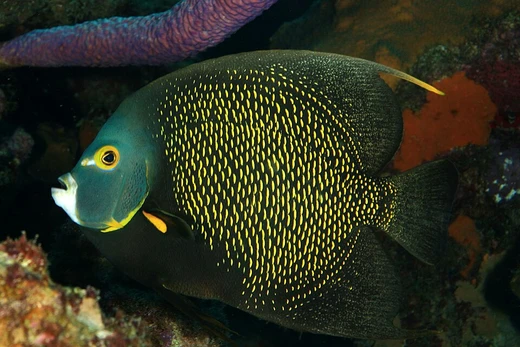
Genicanthus lamarck
A striped Indo-West Pacific angelfish with sex-changing social structure.
Last updated

Diego Delso · via Wikipedia: Genicanthus lamarck · CC BY-SA 4.0
The maximum total length recorded for Genicanthus lamarck is 25 cm.[1] This angelfish is commonly available in the aquarium trade and is considered a food item in the Moluccas.[2]
Scientific classification
- KingdomAnimalia
- PhylumChordata
- ClassActinopterygii
- DivisionTeleostei
- OrderAcanthuriformes
- FamilyPomacanthidae
- GenusGenicanthus
- SpeciesGenicanthus lamarck
Named by (Lacépède, 1802)
Close relatives
Other species of Genicanthus with a Codexery entry.
- Genicanthus bellus Genicanthus bellus
- Blackedged angelfish Genicanthus watanabei
- Genicanthus caudovittatus Genicanthus caudovittatus
- Genicanthus personatus Genicanthus personatus
- Genicanthus semicinctus Genicanthus semicinctus
- Genicanthus semifasciatus Genicanthus semifasciatus
- Genicanthus spinus Genicanthus spinus
- Genicanthus takeuchii Genicanthus takeuchii
Sources: Wikipedia taxobox: Genicanthus lamarck (CC BY-SA 4.0) · order, family and genus agree with WoRMS AphiaID 211793 (CC BY 4.0)
Conservation status
Least Concern (LC)
- LC▲ this species
- NT
- VU
- EN
- CR
- EW
- EX
Source: IUCN Red List assessment · GBIF copy of the Red List category
How big is it?
Largest length in the source, 0.25 m, next to a 1.8 m person.
Diagram: drawn by Codexery, schematic shapes to scale (not a likeness). Length: Wikipedia: Genicanthus lamarck
Where the genicanthus lamarck has been recorded
Each dot is a place where the species has been observed and reported (469 records, half-degree grid) — not a modelled range. 15 inland records left out (institution coordinates). 2 isolated far-off records not drawn.
Map: drawn by Codexery. Data: GBIF occurrence search (records CC0 / CC BY) · Natural Earth basemap (public domain) · place coordinates: Wikipedia (CC BY-SA 4.0)
Biology and range
The Fishes of Australia account records it in the Australian EEZ from Ashmore Reef, Cartier Island, and the northern Great Barrier Reef.[3] The Saltcorner! account notes that males have black pelvic fins and white caudal lobes, while females show the opposite coloration.[4] The reefbuilders.com article notes that all Genicanthus species are sexually dichromatic and adopt a haremic or lek mating style.[5] This species inhabits depths ranging from 10 to 50 meters, typically in locations with dense coral growth on seaward reef slopes and steep drop-offs.[2]
Zooplankton constitutes the usual food source for this species.[6]
What the specialist sources record
The Fishes of Australia account gives the species citation as Holacanthus lamarck Lacépède, 1802, and states the species is named in honour of the French naturalist Jean-Baptiste Lamarck.[3] The GBIF backbone taxonomy lists the species as Genicanthus lamarck (Lacepède, 1802), with 717 occurrence records as of 8 October 2026.[7] The reefbuilders.com article documents that Genicanthus bellus x Genicanthus lamarck hybrids have been collected from Indonesia for the aquarium trade.[5] The Saltcorner! account gives the range as the Indo-West Pacific Ocean from East Africa to the Philippines, New Guinea, Indonesia, north to southern Japan, and south to the northern Great Barrier Reef.[4]
The reefbuilders.com article notes that Genicanthus bellus is often collected for the aquarium trade together with G. watanabei, G. semifasciatus, G. melanospilos, and G. lamarck.[5]
References
- Wikipedia, "Genicanthus lamarck" (CC BY-SA 4.0) en.wikipedia.org
- Wikipedia, "Genicanthus lamarck" (CC BY-SA 4.0), which cites: Pyle, R., "Genicanthus lamarck", 2010 (original not read by us) en.wikipedia.org
- Bray, D.J., "Genicanthus lamarck", Fishes of Australia, 2020. facts only, no text reused. fishesofaustralia.net.au
- "Genicanthus lamarck", Saltcorner!, 2012. facts only, no text reused. saltcorner.com
- Lemon Tyk, "Bellissima bellus: The biology and hybridization of Genicanthus bellus", reefbuilders.com, 15 July 2015. facts only, no text reused. reefbuilders.com
- Wikipedia, "Genicanthus lamarck" (CC BY-SA 4.0), which cites: Bray, D.J., "Genicanthus lamarck", Fishes of Australia, 2020 (we also read that source) en.wikipedia.org
- GBIF Backbone Taxonomy and occurrence index, Genicanthus lamarck (taxon key 2396466). CC BY 4.0 (backbone); counts are facts. gbif.org
Each numbered sentence above was checked against the source it cites before publication. Sentences citing Wikipedia adapt text from the English Wikipedia article Genicanthus lamarck (contributors), used under CC BY-SA 4.0; this entry is available under the same licence. Other sources were used for facts only; no text or images are copied from them.
More in Marine Angelfish
Sources
Compiled from Wikipedia and the sources listed below. Text from Wikipedia is available under CC BY-SA 4.0; this entry is adapted from it.
- Wikipedia: Genicanthus lamarck (CC BY-SA 4.0).
- Classification: the source article's taxobox; order, family and genus checked against WoRMS, the World Register of Marine Species (CC BY 4.0).
- Conservation status: IUCN Red List assessment.
- Occurrence records: GBIF (CC0 / CC BY). Basemap: Natural Earth (public domain).
- Word definitions: the , each quoted from its Wikipedia article.
Spotted an error? Know more?
Reader corrections go straight into our review queue. Suggest an edit · How this site is sourced