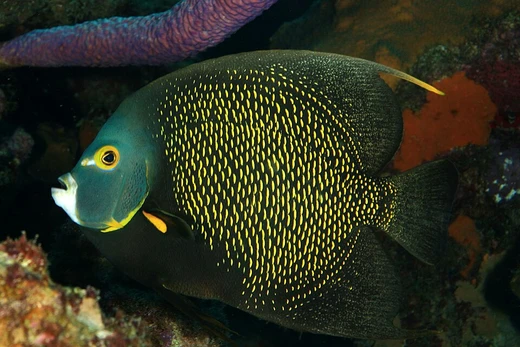
Genicanthus personatus
Endemic to Hawaii, a rare angelfish with dramatic color changes.
Last updated

George Berninger Jr. · via Wikipedia: Genicanthus personatus · CC BY-SA 3.0
John Ernest Randall (1924–2020), an American ichthyologist, provided the first formal description of Genicanthus personatus in 1975, designating the type locality as Honolulu on Oahu.[1]
Scientific classification
- KingdomAnimalia
- PhylumChordata
- ClassActinopterygii
- DivisionTeleostei
- OrderAcanthuriformes
- FamilyPomacanthidae
- GenusGenicanthus
- SpeciesGenicanthus personatus
Named by Randall, 1975
Close relatives
Other species of Genicanthus with a Codexery entry.
- Blackedged angelfish Genicanthus watanabei
- Genicanthus bellus Genicanthus bellus
- Genicanthus caudovittatus Genicanthus caudovittatus
- Genicanthus lamarck Genicanthus lamarck
- Genicanthus semicinctus Genicanthus semicinctus
- Genicanthus semifasciatus Genicanthus semifasciatus
- Genicanthus spinus Genicanthus spinus
- Genicanthus takeuchii Genicanthus takeuchii
Sources: Wikipedia taxobox: Genicanthus personatus (CC BY-SA 4.0) · order, family and genus agree with WoRMS AphiaID 279094 (CC BY 4.0)
Conservation status
Least Concern (LC)
- LC▲ this species
- NT
- VU
- EN
- CR
- EW
- EX
Source: IUCN Red List assessment · GBIF copy of the Red List category
How big is it?
Largest length in the source, 0.21 m, next to a 1.8 m person.
Diagram: drawn by Codexery, schematic shapes to scale (not a likeness). Length: Wikipedia: Genicanthus personatus
Where the genicanthus personatus has been recorded
Each dot is a place where the species has been observed and reported (313 records, half-degree grid) — not a modelled range. 1 inland record left out (institution coordinates).
Map: drawn by Codexery. Data: GBIF occurrence search (records CC0 / CC BY) · Natural Earth basemap (public domain) · place coordinates: Wikipedia (CC BY-SA 4.0)
Biology and range
Over rocky reefs and on outer reef slopes, Genicanthus personatus inhabits depths ranging from 10 to 150 m.[2] At every life stage, this fish displays a predominantly brilliant white body color.[3] A large black patch covers most of the head in juvenile specimens.[3] As the fish matures, the black pigmentation on the head gradually diminishes.[3]
Sex change from female to male can occur once the fish reaches a length of 15 to 18 cm.[3] The maximum recorded total length for this species is 21 cm.[3]
What the specialist sources record
The Jake Adams account on reefs.com states that the masked angelfish was first discovered in 1972 from a single female specimen captured near Waikiki.[4] Adams reports that adolescent masked angelfish develop a mostly black tail and the black facial mask becomes punctuated with bluish white lips.[4] Adams notes that a fully grown female retains the mostly black tail, yellow pelvic fins, and a reduced black mask.[4] Adams describes that the male develops bright yellow-orange color on its pectoral fins, entire face, and fin edges.[4]
Adams states that the species has been bred only once in captivity and remains one of the most high profile marine aquarium fish.[4] The GBIF database lists 330 occurrence records for this taxon as of 8 October 2026.[5]
References
- Wikipedia, "Genicanthus personatus" (CC BY-SA 4.0), which cites: ; "Order ACANTHURIFORMES (part 1): Families LOBOTIDAE, POMACANTHIDAE, DREPANEIDAE and CHAETODONTIDAE", The ETYFish Project Fish Name Etymology Database, 21 July 2020 (original not read by us) en.wikipedia.org
- Wikipedia, "Genicanthus personatus" (CC BY-SA 4.0), which cites: Pyle, R., "Genicanthus personatus", 2010; "GENICANTHUS PERSONATUS - T.B.", De Jong Marine Life (original not read by us) en.wikipedia.org
- Wikipedia, "Genicanthus personatus" (CC BY-SA 4.0), which cites: Jake Adams, "Genicanthus personatus: The Masked Angelfish", reefs.com, 2016; (we also read that source) en.wikipedia.org
- Jake Adams, "Genicanthus personatus: The Masked Angelfish", reefs.com, 2016. facts only, no text reused. reefs.com
- GBIF Backbone Taxonomy and occurrence index, Genicanthus personatus (taxon key 2396452). CC BY 4.0 (backbone); counts are facts. gbif.org
Each numbered sentence above was checked against the source it cites before publication. Sentences citing Wikipedia adapt text from the English Wikipedia article Genicanthus personatus (contributors), used under CC BY-SA 4.0; this entry is available under the same licence. Other sources were used for facts only; no text or images are copied from them.
More in Marine Angelfish
Test yourself
Three questions drawn from this entry’s sources. Pick an answer to check it.
Answers checked against the source article
Sources
Compiled from Wikipedia and the sources listed below. Text from Wikipedia is available under CC BY-SA 4.0; this entry is adapted from it.
- Wikipedia: Genicanthus personatus (CC BY-SA 4.0).
- Classification: the source article's taxobox; order, family and genus checked against WoRMS, the World Register of Marine Species (CC BY 4.0).
- Conservation status: IUCN Red List assessment.
- Occurrence records: GBIF (CC0 / CC BY). Basemap: Natural Earth (public domain).
- Word definitions: the Codexery glossary, each quoted from its Wikipedia article.
Spotted an error? Know more?
Reader corrections go straight into our review queue. Suggest an edit · How this site is sourced