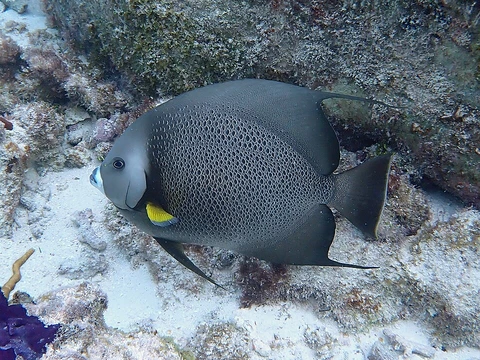
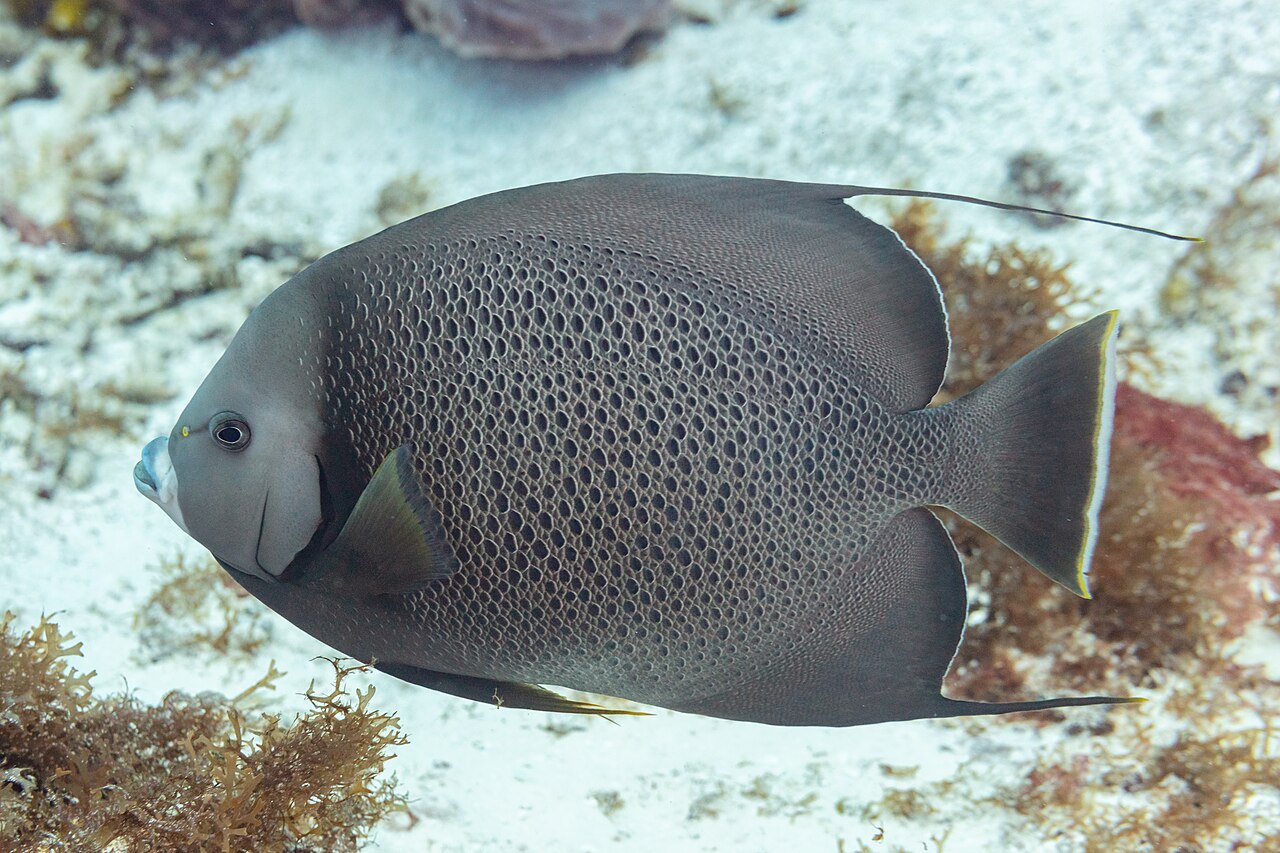
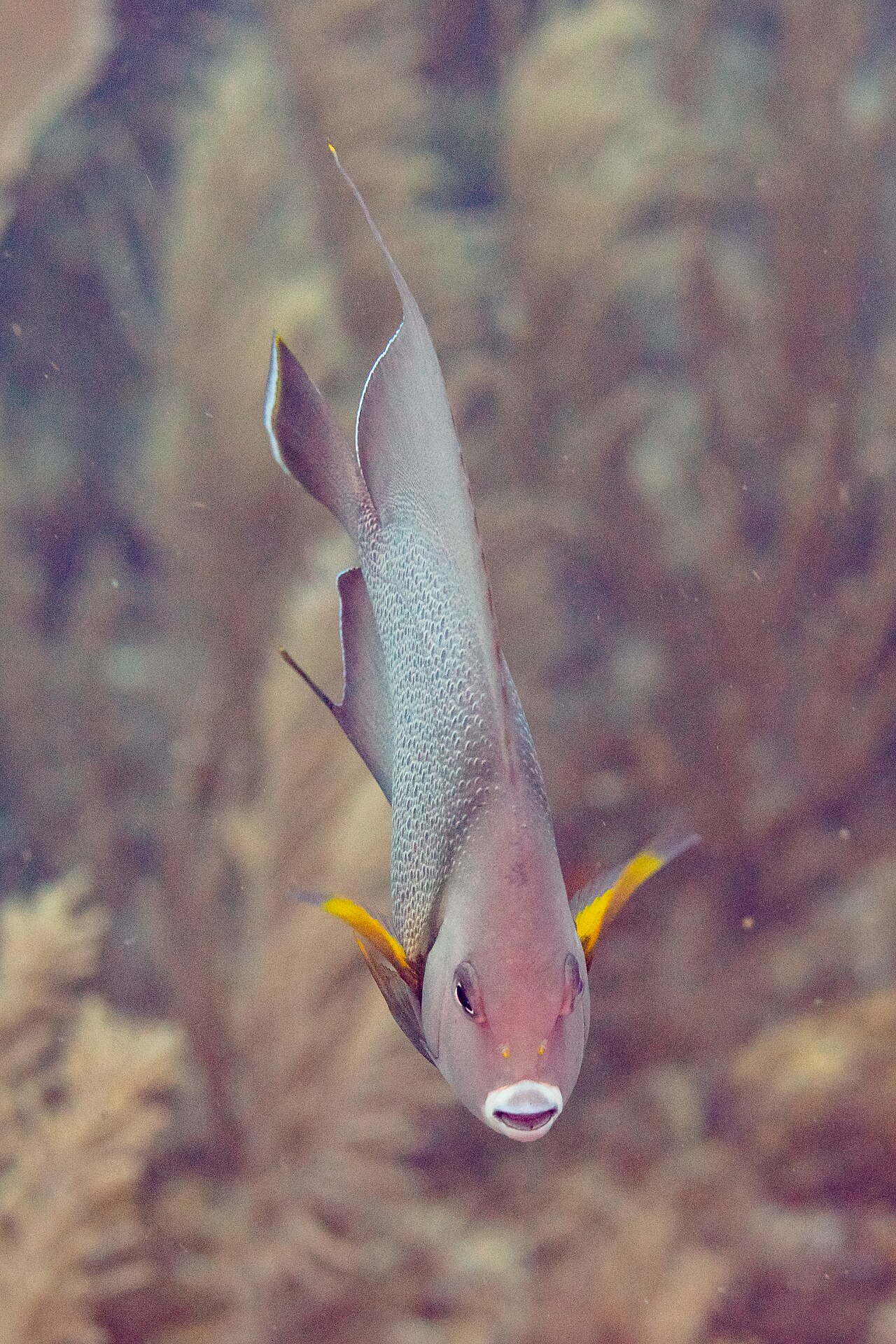
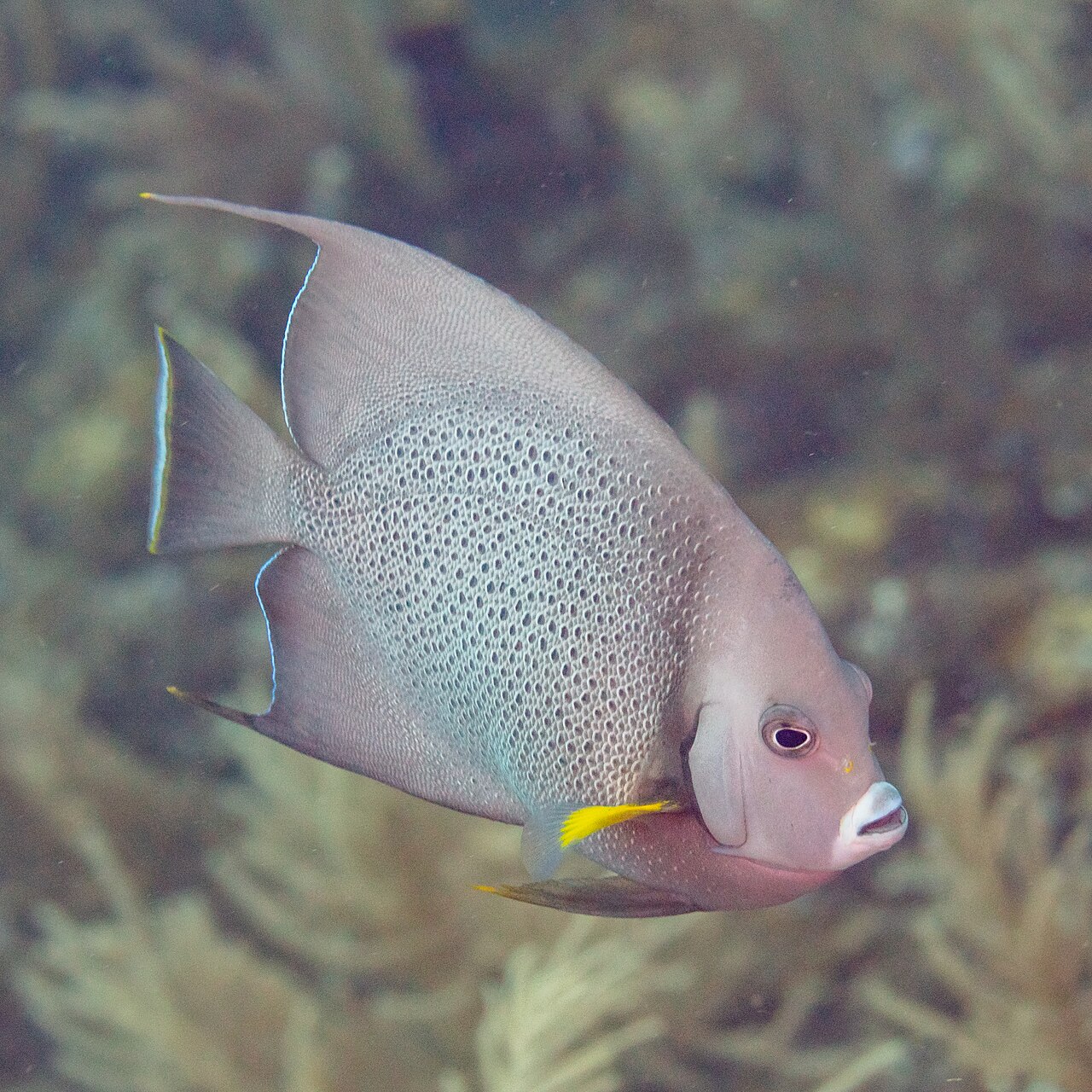
Gray angelfish (Pomacanthus arcuatus)
Source-cited species reference: taxonomy from WoRMS, biology from FishBase, occurrence map from GBIF, conservation from IUCN Red List, description from Wikipedia.

Diego Delso · CC BY-SA 4.0
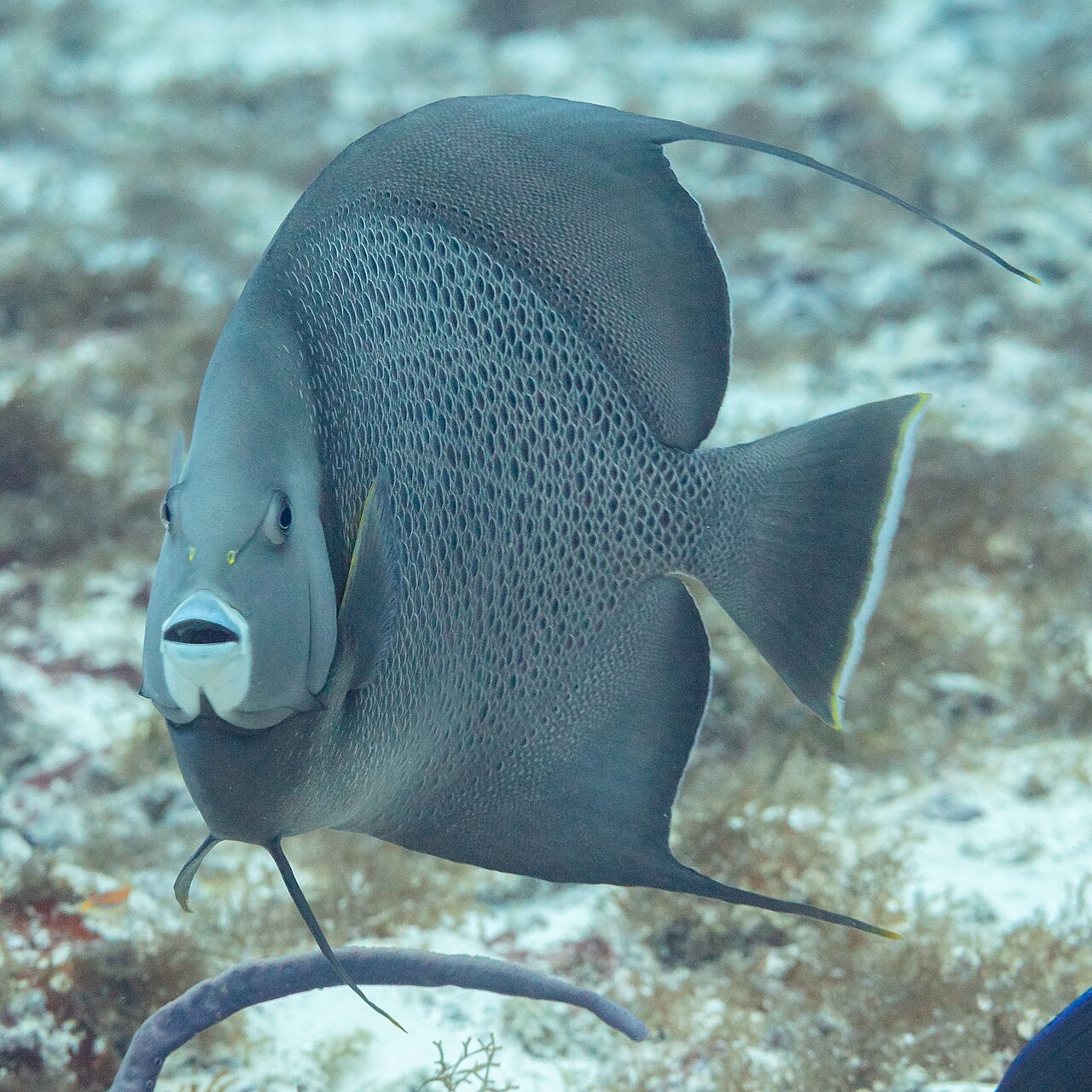
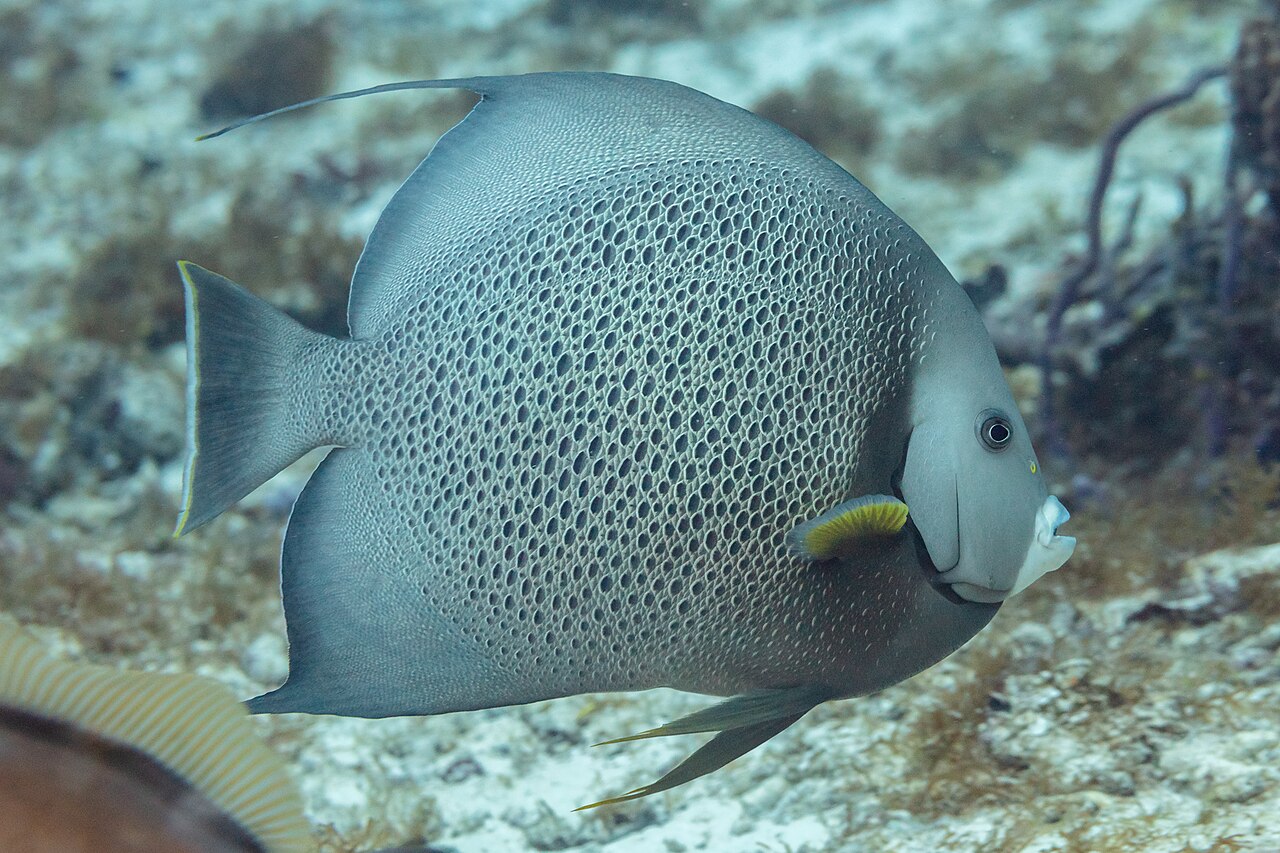
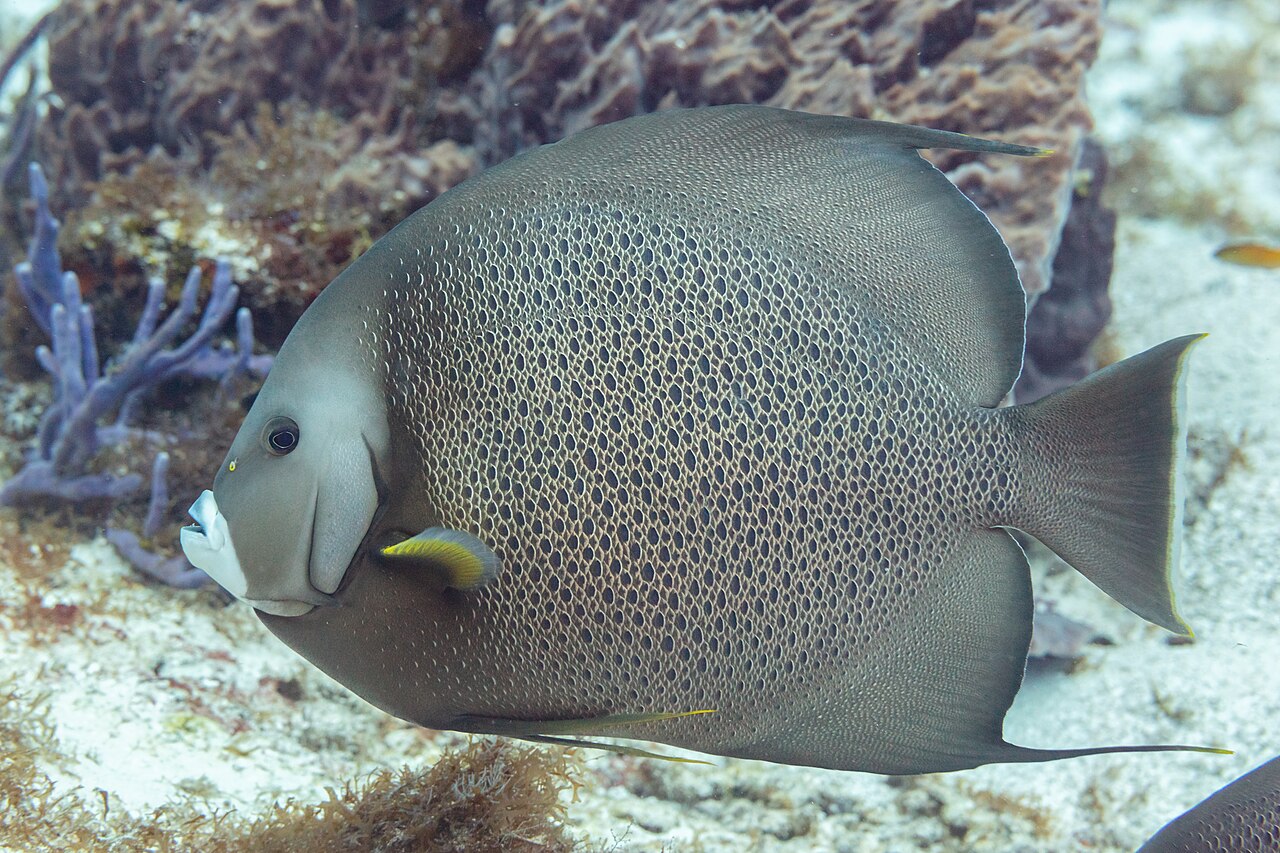
The gray angelfish (Pomacanthus arcuatus), also written as grey angelfish and known in Jamaica as the pot cover, is a species of marine ray-finned fish belonging to the marine angelfish family, Pomacanthidae. It is found in the Western Atlantic Ocean.
- Scientific name
- Pomacanthus arcuatus
- Authority
- (Linnaeus, 1758)
- Family
- Pomacanthidae
- Order
- Acanthuriformes
- Maximum length
- 60 cm
- Depth range
- 2–60 m
- Habitat zone
- reef-associated
- Iucn red list
- Least Concern
- Gbif occurrence records
- 38,870
Physical Form and the Juvenile-to-Adult Transformation
The French angelfish presents a striking silhouette: a deep body compressed vertically so that, viewed head-on, it appears almost flattened. Its coloration is bold and contrasting—a dark gray or black base overlaid with vivid yellow tips on most scales, a white mouth, and a yellow ring around the eye. The pectoral fins carry a broad orange-yellow band, and the soft-rayed portion of the dorsal fin extends into a long, filamentous yellow thread. Fin structure is precise: ten spines and twenty-nine to thirty-one soft rays in the dorsal, three spines and twenty-two to twenty-four in the anal. Males reach roughly forty-five centimetres, females slightly less, with the species maximum recorded at forty-one centimetres. The head is deep with a short snout ending in a small mouth packed with bristle-like teeth, and a single prominent spine marks the corner of the preoperculum. Perhaps most dramatically, juveniles look like an entirely different creature: nearly solid black interrupted by five vertical yellow bands running the full height of the body, from the mouth region to the caudal peduncle.
Dietary Shift and the Cleaning-Station Niche
Adult French angelfish are heavily sponge-specialists, with roughly seventy percent of their intake coming from sponges, their comb-like teeth adapted to grind sponge tissue into manageable pieces. Their broader diet also includes algae, bryozoans, zoantharians, gorgonians, hydroids, coral, and tunicates. Juveniles, however, occupy a completely different ecological role. Rather than browsing on reef invertebrates, young French angelfish act as cleaner fish, picking ectoparasites, mucus, dead tissue, and other unwanted particles from the bodies of larger species. Documented clients include jacks, snappers, morays, grunts, surgeonfishes, and wrasses. In the Caribbean, these juveniles even service green sea turtles at shared cleaning stations on the ocean floor, focusing on the turtles' heads, carapace, and plastron alongside other cleaner species. As juveniles grow, their diet shifts: they begin incorporating twelve to fifteen sponge species, mirroring the adult pattern. This creates a clear size-dependent gradient—larger juveniles consume proportionally more sponge than smaller ones—marking a smooth transition from parasite-remover to sponge-grazer.
Monogamy, Territoriality, and the Dusk Mating Display
Unlike its closest relative, the grey angelfish, which mates in polygamous groups, the French angelfish forms strict monogamous pairs. These pairs are fiercely territorial, both individuals vigorously defending their patch—often near sea fans—against neighbouring fish. There is no obvious sexual dimorphism and no elaborate courtship ritual has been documented. What has been observed is a remarkable dusk mating display. Around sunset, a pair ascends the water column in a wide, shallow arc, one fish leading and the other directly behind. They travel roughly seven to ten metres horizontally while climbing two to three metres vertically, tilting their bodies slightly so their vents remain in close contact, sometimes touching. They hold this posture through the apex of the curve before separating on the descent. Neighbouring pairs have been seen performing the same manoeuvre above the reef at approximately the same moment, without interfering with one another. Observers could not confirm whether gametes were actually released. Additionally, the species is a protogynous hermaphrodite: in the absence of a male, a female can transition to male.
Range, Depth, and a Remarkable Longevity
The French angelfish ranges across the western Atlantic, from Florida through the Gulf of Mexico, down the coast toward Brazil, and throughout the Caribbean including the Antilles and Roatan. Its distribution also extends into the eastern Atlantic, with records near Ascension Island and St. Paul's Rocks. Habitat is tied to rocky shores and coral reefs, where the fish is typically encountered in pairs. While commonly seen in shallower water above roughly four and a half metres, individuals have also been reported in the mesophotic zone, between thirty and one hundred and fifty metres. The species is described as slow-growing, and this is reflected in its impressive lifespan. Age can be estimated by counting opaque annual bands that form on the sagittae otoliths. A 2016 study of French angelfish otoliths identified the oldest specimen at twenty-seven years old. Taxonomically, the species was first formally described in 1799 by the German physician and naturalist Marcus Elieser Bloch under the name Chaetodon paru, with the type locality given as Brazil and Jamaica. The specific epithet 'paru' derives from the Portuguese common name for the fish.
Gallery
Related in Gray angelfish
Links follow this subject's own source article.
Elsewhere in Gray angelfish
Spotted an error? Know more?
Reader corrections go straight into our review queue. Suggest an edit · How this site is sourced