Where Gray angelfish has been recorded
GBIF occurrence records for Pomacanthus arcuatus, mapped and tabulated by country.

38,870 georeferenced occurrence records with coordinates are published for Pomacanthus arcuatus through GBIF, from 39 countries or marine areas. This page maps those records and lists where they come from. Occurrence records reflect where people have looked as well as where the species lives, so well-surveyed coastlines are over-represented.
- Georeferenced records
- 38,870
- Countries / areas
- 39
- Mapped locations
- 120
- Records sampled for the map
- 3,000
- Inland records omitted
- 34
- Gbif taxonkey
- 2396435
Taxonomy & the Story Behind the Name
The gray angelfish carries a taxonomic history stretching back to 1758, when Carolus Linnaeus formally described the species in the tenth edition of his Systema Naturae under the name Chaetodon arcuatus. Interestingly, Linnaeus recorded the type locality simply as "Indiis," a broad and imprecise geographic label that reflects the limited knowledge of marine biodiversity at the time. The species later became the type species for the genus Pomacanthus when Lacépède established that taxonomic group, anchoring the entire angelfish lineage to this single fish. Within the genus, it sits in the subgenus Pomacanthus itself. The specific epithet arcuatus, meaning "bowed," is a direct reference to the curved lines that trace across the fish's body. In Jamaican waters, locals know the species by the colorful nickname "pot cover," a name that likely evokes the fish's broad, rounded silhouette as it hovers over reef structures.
A Dramatic Metamorphosis: Juvenile to Adult
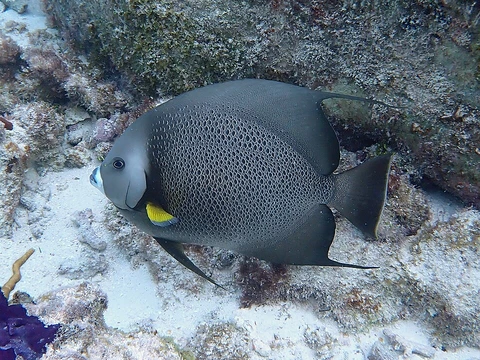
Few marine fish undergo as striking a visual transformation as the gray angelfish. As a juvenile, the species is a bold black canvas punctuated by five vivid yellow vertical stripes—three running down the head and two across the body. The tail fin carries a distinctive black blotch that may appear elongated or rectangular in shape. This dramatic coloration gives way entirely as the fish matures. Adults present as pale grayish bodies scattered with small black spots, their heads a plain pale gray contrasted by a white mouth. The body shape is disk-like and laterally compressed, with a disproportionately large head and a small snout tipped by a mouth lined with tiny bristle-like teeth. The preoperculum bears a prominent spine at its corner alongside a smooth vertical edge. In mature specimens, the dorsal and anal fins often extend into elegant elongated streamers. The dorsal fin carries nine spines and between thirty-one and thirty-three soft rays, while the anal fin holds three spines and twenty-three to twenty-five soft rays. The species reaches a maximum total length of sixty centimeters.
Courtship, Spawning, and the Pelagic Drift
In the northern reaches of its range, the gray angelfish confines its spawning activity to the summer months, roughly April through September. The ritual unfolds above deep reef structures during the early morning hours. A pair will swim one or two meters above the reef, engaging in brief chases while actively driving away any intruders that approach. When the moment arrives, the two fish swim upward together, pressing their bellies against one another to simultaneously release eggs and milt into the water column. A single female can shed anywhere from twenty-five thousand to seventy-five thousand eggs in one event, and the pair may repeat this spawning sequence multiple times. The released eggs are pelagic, drifting with ocean currents, and hatch into larvae after roughly fifteen to twenty hours. These larvae spend their early lives suspended among the plankton, drifting until they grow to approximately fifteen millimeters in length. Only then do they make the critical descent to the reef, where they settle and begin their benthic existence.
Cleaner Stations, Aquariums, and the Ciguatera Question
The gray angelfish occupies a fascinating ecological niche that shifts with age. Juveniles serve as cleaner fish, establishing dedicated cleaning stations on patch reefs and in seagrass beds where larger species visit to have ectoparasites removed and consumed. As adults, the species is diurnal, hiding within reef crevices at night and foraging during the day on sponges, algae, tunicates, zoantharians, gorgonians, hydroids, and bryozoans. Beyond its natural role, the gray angelfish has a significant presence in human commerce. It is a popular aquarium species, with specimens sourced from Florida year-round. Between 1995 and 2000, more than twelve thousand individuals entered the trade, originating from Brazil, and the species has also been successfully bred in captivity. In some regions it is harvested as food, though consumption carries a low but recognized risk of ciguatera poisoning, a toxin-related illness associated with certain reef fish.
Related in Gray angelfish
Links follow this subject's own source article.
Elsewhere in Gray angelfish
Spotted an error? Know more?
Reader corrections go straight into our review queue. Suggest an edit · How this site is sourced