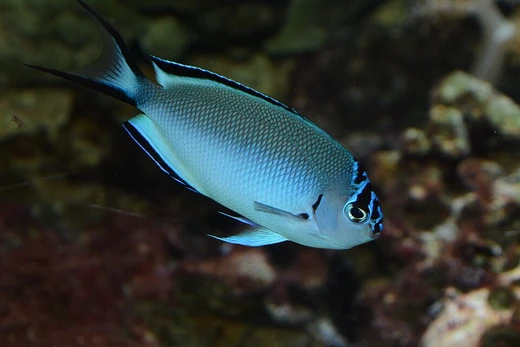
Blackedged angelfish (Genicanthus watanabei)
Source-cited species reference: taxonomy from WoRMS, biology from FishBase, occurrence map from GBIF, conservation from IUCN Red List, description from Wikipedia.

Jokuyken15 · CC BY-SA 4.0
Genicanthus watanabei, the blackedged angelfish or Watanabe's angelfish, is a species of marine ray-finned fish, a marine angelfish belonging to the family Pomacanthidae. It is found in the Pacific Ocean.
- Scientific name
- Genicanthus watanabei
- Authority
- (Yasuda & Tominaga, 1970)
- Family
- Pomacanthidae
- Order
- Acanthuriformes
- Maximum length
- 15 cm
- Depth range
- 21–81 m
- Habitat zone
- reef-associated
- Iucn red list
- Least Concern
- Gbif occurrence records
- 202
Appearance and Sexual Dichromatism
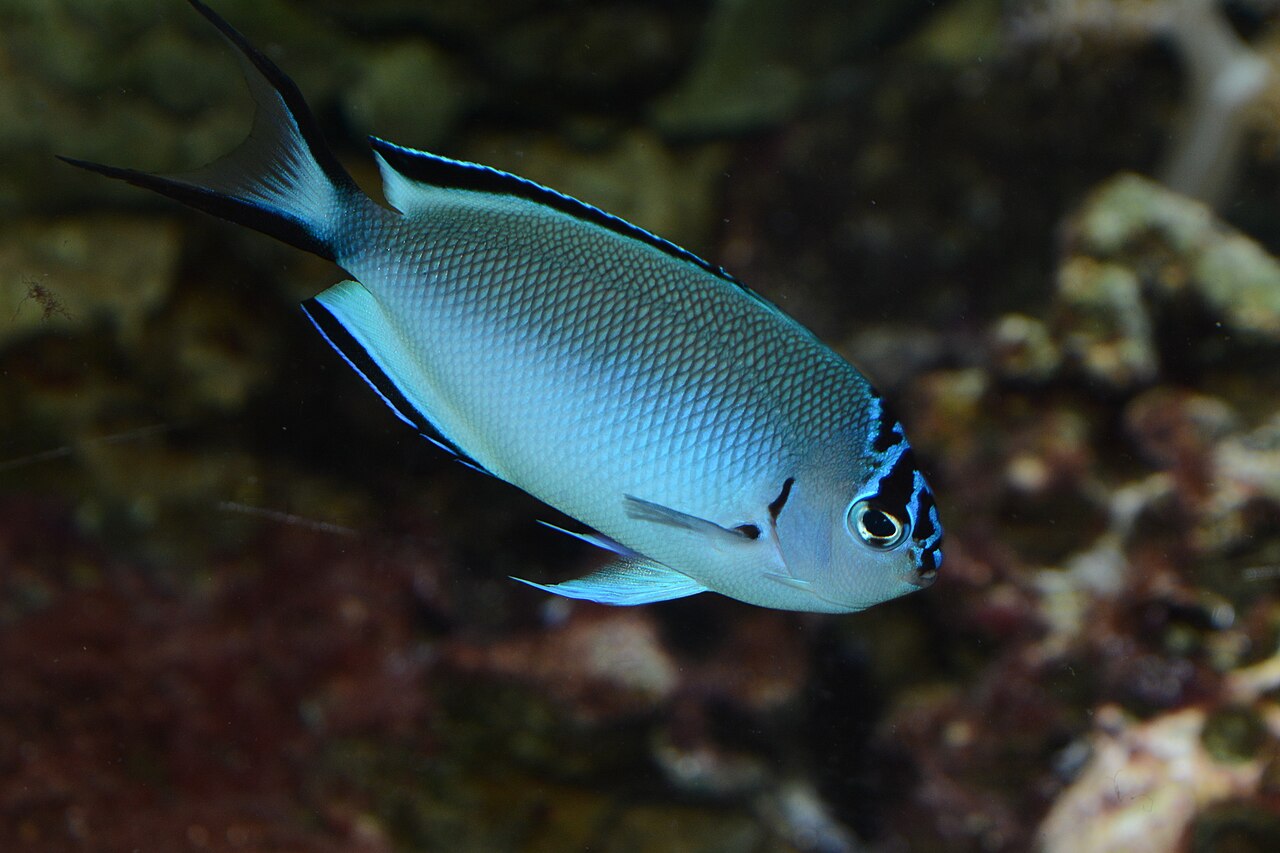
The blackedged angelfish is a small marine species, never exceeding 15 centimetres in total length, yet it displays a strikingly elaborate colour scheme that varies dramatically between the sexes. Males carry a pale blue to bluish-grey wash across the upper third of their body, while the remaining two-thirds are marked by eight thin, horizontal black stripes; the uppermost of these stripes terminates in a distinctive patch of yellow. Females, by contrast, present a more uniform light blue body broken by broad black bars sweeping across the head and a single black spot on the snout. Juveniles echo the female pattern, making young fish easy to confuse with adult females. Both sexes share a wide submarginal band running along the dorsal and anal fins as well as the lobes of the caudal fin. The tail itself is forked and narrows sharply at its base, producing what is commonly called a 'swallow tail' silhouette. Fin counts are precise: the dorsal fin bears 15 to 16 spines alongside 15 to 16 soft rays, while the anal fin carries 3 spines and 14 to 17 soft rays.
Distribution and Habitat
The blackedged angelfish is a Pacific Ocean species with a broad but scattered range. Its distribution stretches from the waters off Taiwan eastward to the Cook Islands and the Tuamotu Archipelago, reaching north to the Ryukyu Islands and south to New Caledonia and the Austral Islands. The species also appears on the Great Barrier Reef, where juvenile individuals have been recorded as far south as Sydney. In terms of vertical habitat, this angelfish occupies depths between 12 and 81 metres, placing it well below the shallow reef crest. It favours the outward slopes of coral reefs and steep drop-offs where strong currents are present, rather than calm lagoon environments. Its feeding strategy is consistent with this open-water preference: the blackedged angelfish is a planktivore, filtering small drifting organisms from the water column rather than grazing on benthic algae or invertebrates. This combination of depth, current, and open-water foraging distinguishes it from many reef-dwelling angelfish that remain close to the substrate.
Reproduction and Social Structure
Like all members of the genus Genicanthus, the blackedged angelfish is a protogynous hermaphrodite, meaning every individual begins life as a female. Under the right social conditions, the dominant female in a group may transition into a male, a shift that reshapes the breeding hierarchy. The species employs a lek mating system, in which large, established males hold and defend individual territories. The more numerous females roam freely among these territories, visiting whichever male they choose. When a female becomes receptive, the male performs a courtship display: he swims on his side and vibrates his fins in a rhythmic fashion to attract her attention. An interesting behavioural nuance is that the largest and most dominant males show a preference for breeding with younger females rather than older ones. This social structure, combining territorial males, mobile females, and a sex-change mechanism, creates a dynamic reproductive community on the reef slopes where the species lives.
Taxonomy and Discovery
The blackedged angelfish was formally described in 1970 by Japanese ichthyologists Fujio Yasuda and Yoshiaki Tominaga, who designated Onna Beach on Okinawa as the type locality. The specific epithet 'watanabei' honours Masao Watanabe, a fellow Japanese ichthyologist at Waseda University in Tokyo, who had originally collected the specimen. Notably, Watanabe himself had misidentified the fish as Genicanthus caudovittatus, a related species, so the new name serves both as recognition and as a correction in the taxonomic record. The species belongs to the family Pomacanthidae, the marine angelfishes, and is classified within the genus Genicanthus. In terms of commercial use, the blackedged angelfish is not a commonly traded species in the aquarium hobby. The limited specimens that do enter the trade are sourced primarily from the Philippines and from Melanesian waters, suggesting that collection pressure remains relatively low compared to more popular reef fish.
Gallery
Spotted an error? Know more?
Reader corrections go straight into our review queue. Suggest an edit · How this site is sourced