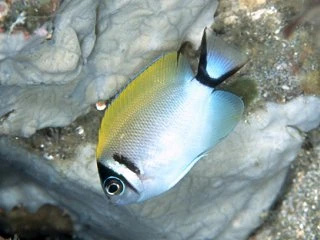
Japanese swallow (Genicanthus semifasciatus)
Source-cited species reference: taxonomy from WoRMS, biology from FishBase, occurrence map from GBIF, conservation from IUCN Red List, description from Wikipedia.

User:Izuzuki · CC BY 4.0
Genicanthus semifasciatus, the Japanese swallow, is a species of marine ray-finned fish, a marine angelfish, belonging to the family Pomacanthidae. It is found in the Western Pacific.
- Scientific name
- Genicanthus semifasciatus
- Authority
- (Kamohara, 1934)
- Family
- Pomacanthidae
- Order
- Acanthuriformes
- Maximum length
- 21 cm
- Depth range
- 15–100 m
- Habitat zone
- reef-associated
- Iucn red list
- Least Concern
- Gbif occurrence records
- 23
Classification (WoRMS)
Full classification as recorded by WoRMS: Kingdom: Animalia · Phylum: Chordata · Class: Teleostei · Order: Acanthuriformes · Family: Pomacanthidae · Genus: Genicanthus.
Accepted name: Genicanthus semifasciatus · Authority: (Kamohara, 1934) · Taxonomic status: accepted · AphiaID: 279096.
Synonyms and superseded combinations recorded for this taxon: Holacanthus semifasciatus Kamohara, 1934.
Source: World Register of Marine Species (WoRMS) — https://www.marinespecies.org/aphia.php?p=taxdetails&id=279096 (CC BY 4.0). Accessed 2026-09-23.
Biology and life history (FishBase)
Measured values published by FishBase for Genicanthus semifasciatus. Only fields the database actually holds for this species are shown; these are database values, not aquarium guidance.
Maximum length: 21 cm · Depth range: 15–100 m · Habitat zone: reef-associated · Body shape: short and / or deep · Vulnerability index: 11 of 100 · Fishery importance: commercial · Aquarium trade: commercial.
FishBase notes: Inhabits seaward rocky and coral reefs (Ref. 9710). Hardy aquarium species; takes standard food such as chopped beef, freeze-dried shrimp, mysids, etc. A protogynous hermaphrodite (Ref. 55367). Forms permanent harem groups composed of a single male and several smaller females (Ref. 55367).
Source: FishBase species summary (SpecCode 11153) — https://www.fishbase.se/summary/Genicanthus-semifasciatus.html (CC BY-NC 3.0 — non-commercial use only). Accessed 2026-09-23.
Distribution and occurrence records (GBIF)
23 georeferenced occurrence records for Genicanthus semifasciatus are published through GBIF from 2 countries or marine areas. The map above plots 12 distinct locations from a sample of 23 records, omitting 4 inland records that carry an institution's coordinates rather than a collection site; it shows where the species has been observed and reported, not a modelled range.
Most records by country or area: Chinese Taipei (13); Japan (10).
Source: GBIF Occurrence Search (taxonKey 2396453) — https://www.gbif.org/occurrence/search?taxon_key=2396453&has_coordinate=true (records CC0 / CC BY); WoRMS distribution records (MarineRegions) — https://www.marinespecies.org/aphia.php?p=taxdetails&id=279096 (CC BY 4.0); Natural Earth 110m basemap — https://www.naturalearthdata.com/ (public domain). Accessed 2026-09-23.
Conservation status (IUCN Red List)
The IUCN Red List assesses Genicanthus semifasciatus (Kamohara, 1934) as Least Concern (code LC). No trend, population estimate or threat analysis is given here, because none is available from this source without the Red List API; follow the source link for the full assessment, including its date.
Source: IUCN Red List of Threatened Species (taxon 165856) — https://www.iucnredlist.org/species/165856/0; GBIF IUCN Red List category endpoint (taxonKey 2396453) — https://api.gbif.org/v1/species/2396453/iucnRedListCategory. Accessed 2026-09-23.
Description and natural history (Wikipedia)
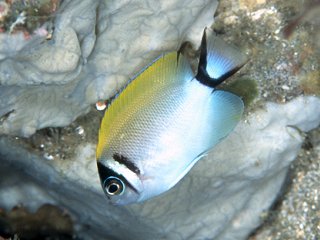
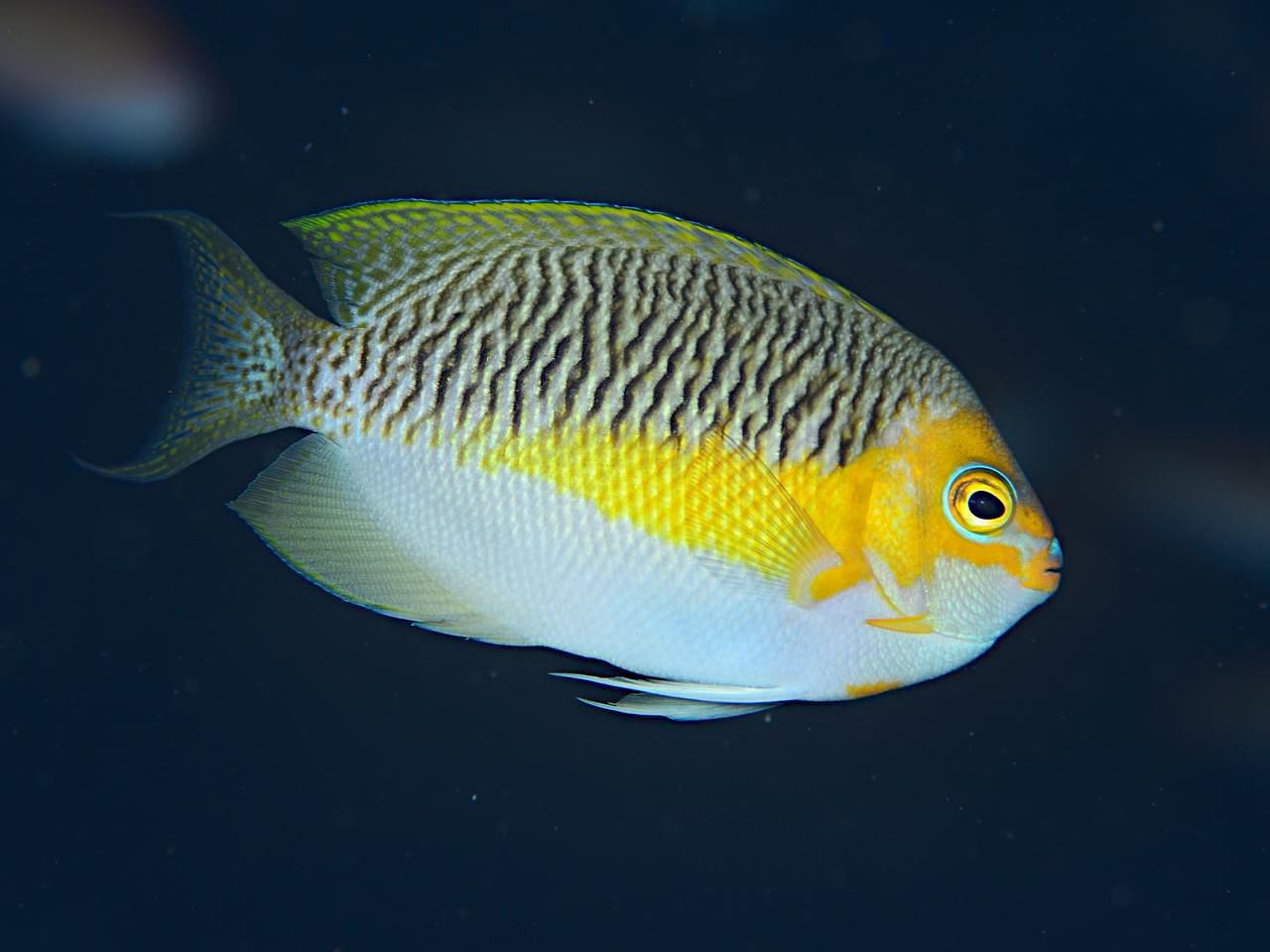
Genicanthus semifasciatus is sexually dichromatic; the males and females show different colouration and patterning. The male has a yellow head and anterior flanks with a darker yellow dorsal area which is marked with dusky vertical bars. The dorsal area of females is greyish brown and white ventrally, with a yellow margin to the dorsal fin with a black head and caudal fin, and black on the head and tail. In both sexes the forked tail narrows at its base to create a "swallow tail". The dorsal fin contains 15 spines and 15–16 soft rays while the anal fin has 3 spines and 17 soft rays. This species attains a maximum total length of 21 cm.
Genicanthus semifasciatus is found in the Western Pacific Ocean. Here it is found from southern Japan, including the Ogasawara Islands, the Izu Islands and the Ryukyu Islands, to the northern Philippines.
Genicanthus semifasciatus occurs at depths between 15 and 200 m. Here it can be found on the seaward sides of rocky and coral reefs. This species is protogynously hermaphroditic and is normally encountered in harems consisting of a male and several females. It feeds on plankton in the water column.
Genicanthus semifasciatus was first formally described in 1934 as Holocanthus semifasciatus by the Japanese ichthyologist Toshiji Kamohara (1901–1972) with the type locality given as Kashiwajima in the Kochi Prefecture of Japan. The specific name is a compound of semi meaning "half" and fasciatus meaning "banded", referring to the banding on the males' backs which does not extend onto the abdomen.
Genicanthus semifasciatus is rather infrequently found in the aquarium trade. The specimens which do appear in the trade usually come from the Philippines.
Source: Wikipedia: Genicanthus semifasciatus — https://en.wikipedia.org/wiki/Genicanthus_semifasciatus (CC BY-SA 4.0). Accessed 2026-09-23.
Gallery
Spotted an error? Know more?
Reader corrections go straight into our review queue. Suggest an edit · How this site is sourced