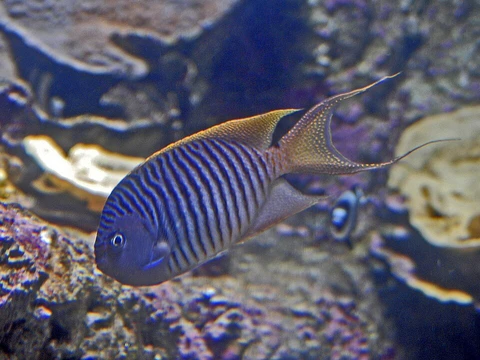
Spotbreast angelfish (Genicanthus melanospilos)
Source-cited species reference: taxonomy from WoRMS, biology from FishBase, occurrence map from GBIF, conservation from IUCN Red List, description from Wikipedia.

Hectonichus · CC BY-SA 3.0
Genicanthus melanospilos, the spotbreast angelfish, blackspot angelfish or swallowtail angelfish, the family Pomacanthidae. It occurs in the Indo-West Pacific region.
- Scientific name
- Genicanthus melanospilos
- Authority
- (Bleeker, 1857)
- Family
- Pomacanthidae
- Order
- Acanthuriformes
- Maximum length
- 18 cm
- Depth range
- 20–45 m
- Habitat zone
- reef-associated
- Iucn red list
- Least Concern
- Gbif occurrence records
- 320
Sexual Dichromatism and Physical Form
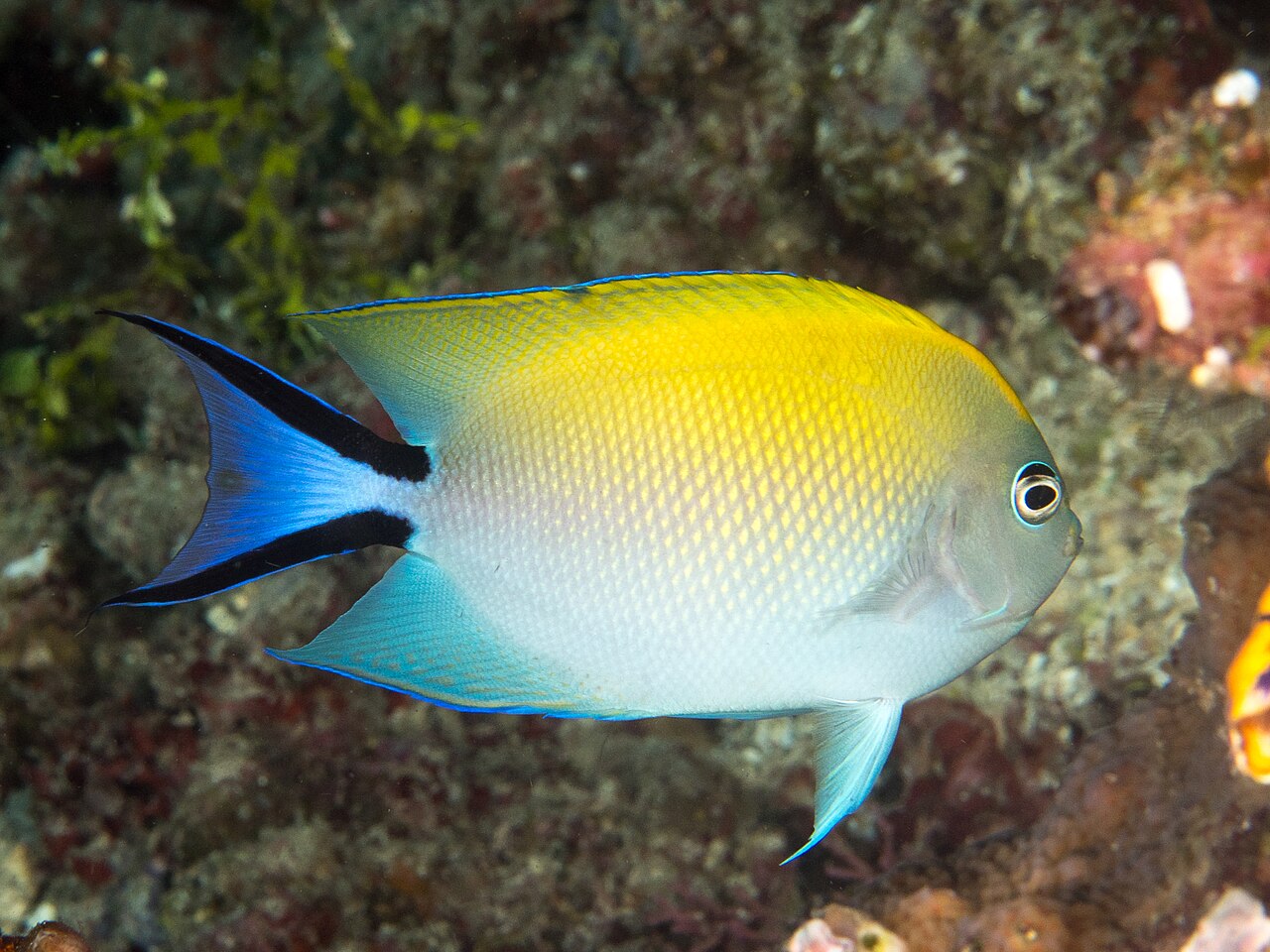
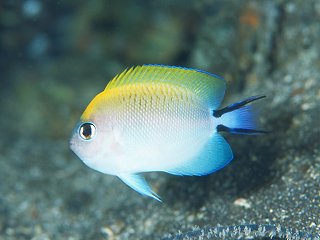
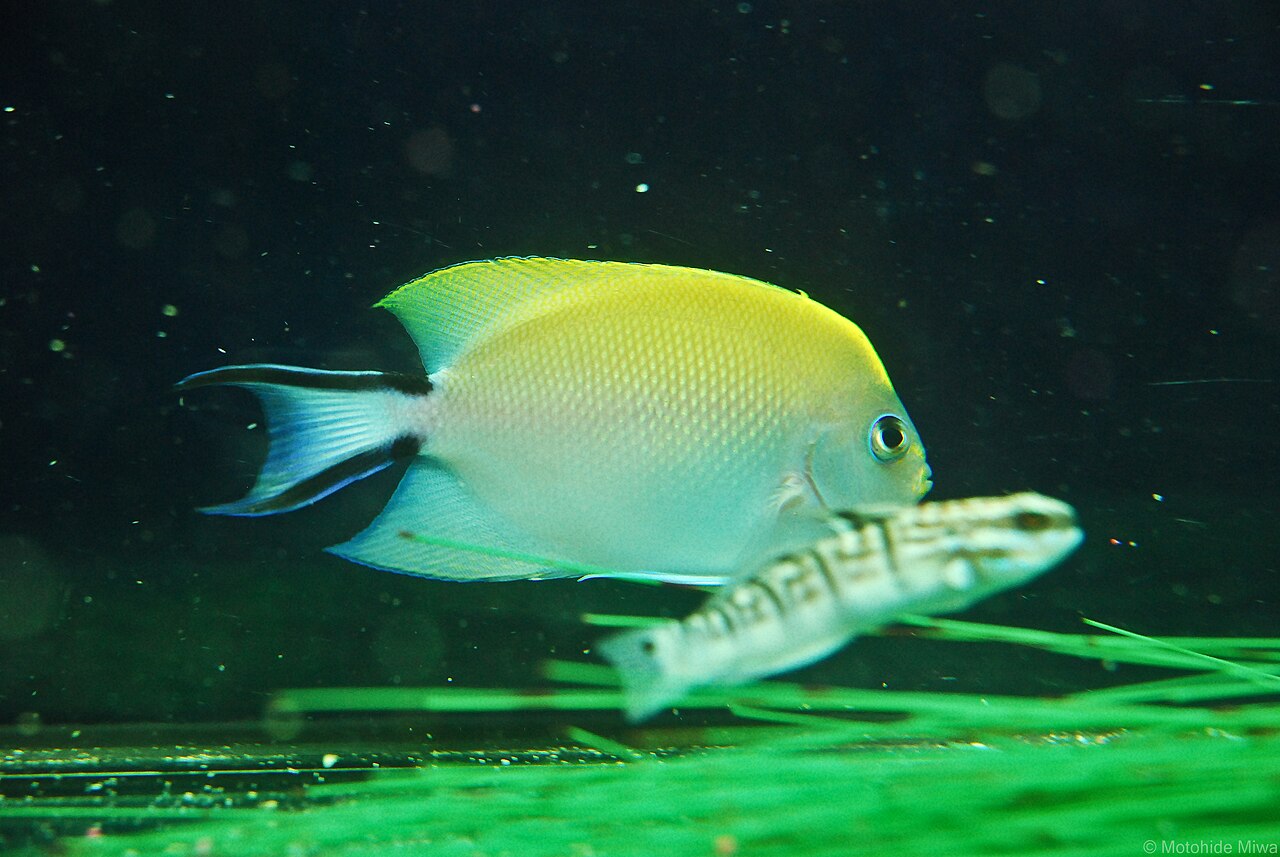
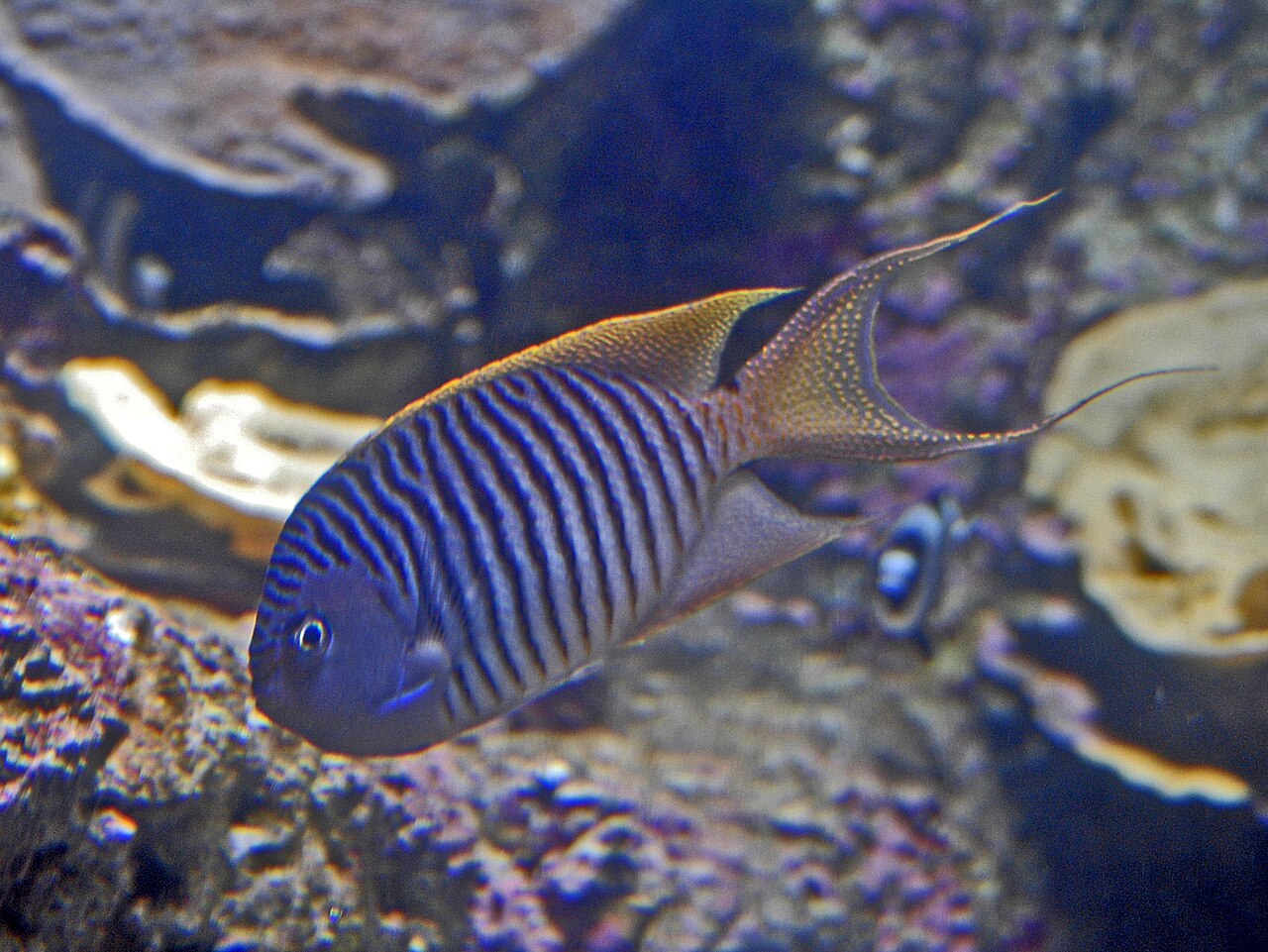
The spotbreast angelfish is one of the more visually striking members of the Pomacanthidae family, and its appearance shifts dramatically depending on sex. Males display a bluish-white body overlaid with numerous reddish-black vertical stripes, while their dorsal, caudal, and anal fins are dotted with yellow spots. The caudal fin in particular is a pale yellow edged in blue and extends into long, filamentous lobes that give the fish an elegant, trailing silhouette. A prominent black spot sits on the breast near the base of the pelvic fins, a feature so distinctive it earned the species its common name. Females, by contrast, show a yellow upper body fading to bluish-white below, with a bluish tail bordered by black stripes along both its upper and lower margins. Both sexes share a forked tail that tapers sharply at its base, producing the characteristic swallowtail profile that lends the fish its third common name. The dorsal fin bears fifteen spines and between fifteen and seventeen soft rays, while the anal fin carries three spines and seventeen to eighteen soft rays. The species reaches a maximum total length of eighteen centimetres, or roughly seven inches.
Geographic Range Across the Indo-West Pacific
Genicanthus melanospilos enjoys a broad distribution spanning the eastern Indian Ocean and the western Pacific. Its range stretches throughout the Malay Archipelago and extends into the southwestern Pacific as far east as Fiji. To the north, populations are recorded as far as the Ryukyu Islands, while to the south the species reaches Australian waters. Within Australian jurisdiction, the fish has been documented at the Cocos (Keeling) Islands and Christmas Island in the Indian Ocean, at Ashmore Reef in the Timor Sea, and along the Great Barrier Reef off the coast of Cairns in Queensland. This wide presence across tropical reef systems—from the Indonesian archipelago through the Timor Sea to the island chains of the central Pacific—makes the spotbreast angelfish a familiar sight for divers operating across much of the Indo-West Pacific. Its preference for coral-rich outer reef slopes and drop-offs means it is most often encountered along the steeper, deeper edges of reef structures rather than in shallower reef zones.
Habitat, Social Structure, and Reproductive Biology
In the wild, the spotbreast angelfish inhabits a depth band between twenty and eighty metres—roughly sixty-six to two hundred and sixty-two feet—on coral-rich outer reef slopes and drop-offs. It favours areas abundant in living coral, particularly the steeper faces where the reef meets open water. Socially, adults typically form small harems consisting of a single male accompanied by several females, a structure that aligns closely with the species' reproductive strategy. Like all members of the angelfish family, Genicanthus melanospilos is a protogynous hermaphrodite: every individual begins life as a female, and the dominant females within a group eventually transform into males. This sex-change mechanism ensures that the harem always retains a breeding male without requiring a separate male to immigrate from elsewhere. For sustenance, the species feeds on zooplankton drifting in the water column above the reef, making it a mid-water forager rather than a benthic grazer on the reef substrate.
Taxonomic History and the Aquarium Trade
The spotbreast angelfish was first formally described in 1857 by the Dutch ichthyologist and herpetologist Pieter Bleeker, who assigned it the name Holocanthus melanospilos. The type locality he recorded was Ambon Island in Indonesia, anchoring the species' scientific identity to the heart of the Malay Archipelago. The specific epithet is a Greek compound: melanos, meaning black, combined with spills, meaning spot, a direct reference to the conspicuous black marking on the male's breast near the pelvic fin base. The species now sits in the genus Genicanthus within the family Pomacanthidae, and is also known colloquially as the blackspot angelfish or the swallowtail angelfish. Beyond its ecological role in Indo-West Pacific reef systems, the spotbreast angelfish holds a prominent place in the aquarium trade, where it is a common presence. Its vivid sexual dichromatism, the dramatic filamentous lobes trailing from the male's caudal fin, and the distinctive swallowtail silhouette all contribute to its appeal among marine aquarists, making it a recognisable and widely kept reef species.
Gallery
Spotted an error? Know more?
Reader corrections go straight into our review queue. Suggest an edit · How this site is sourced