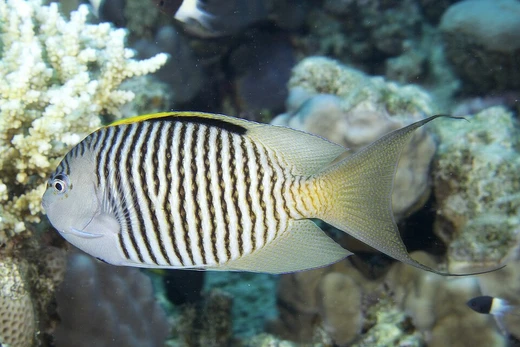
Zebra angelfish (Genicanthus caudovittatus)
Source-cited species reference: taxonomy from WoRMS, biology from FishBase, occurrence map from GBIF, conservation from IUCN Red List, description from Wikipedia.

Zsispeo · CC BY-SA 2.0
Genicanthus caudovittatus, the zebra angelfish, swallowtail angelfish, and lyretail angelfish, is a species of marine ray-finned fish, a marine angelfish belonging to the family Pomacanthidae. It is found in the Indian Ocean.
- Scientific name
- Genicanthus caudovittatus
- Authority
- (Günther, 1860)
- Family
- Pomacanthidae
- Order
- Acanthuriformes
- Maximum length
- 20 cm
- Depth range
- 2–70 m
- Habitat zone
- reef-associated
- Iucn red list
- Least Concern
- Gbif occurrence records
- 266
A Study in Contrasting Colours
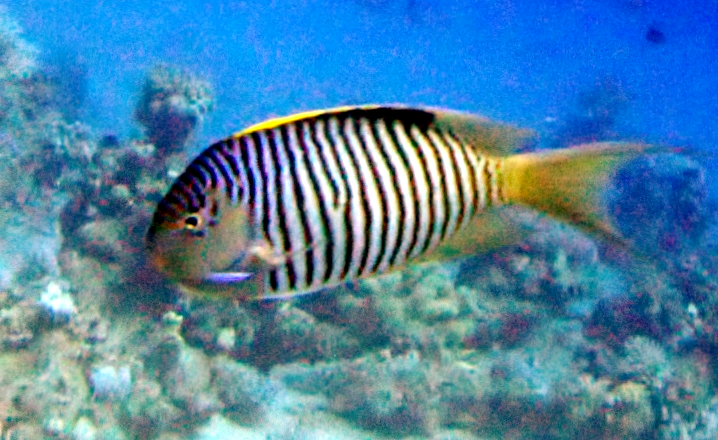
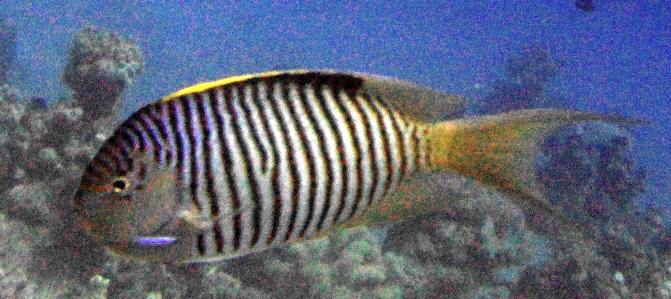
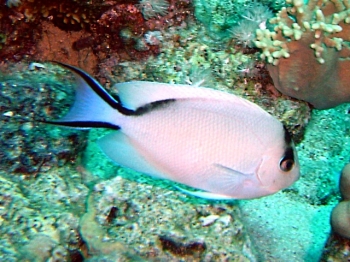
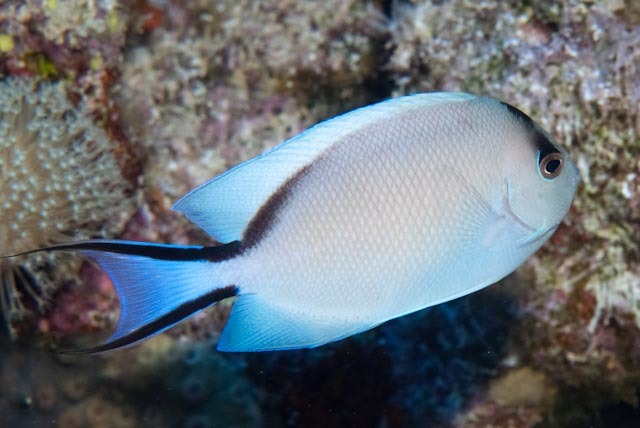
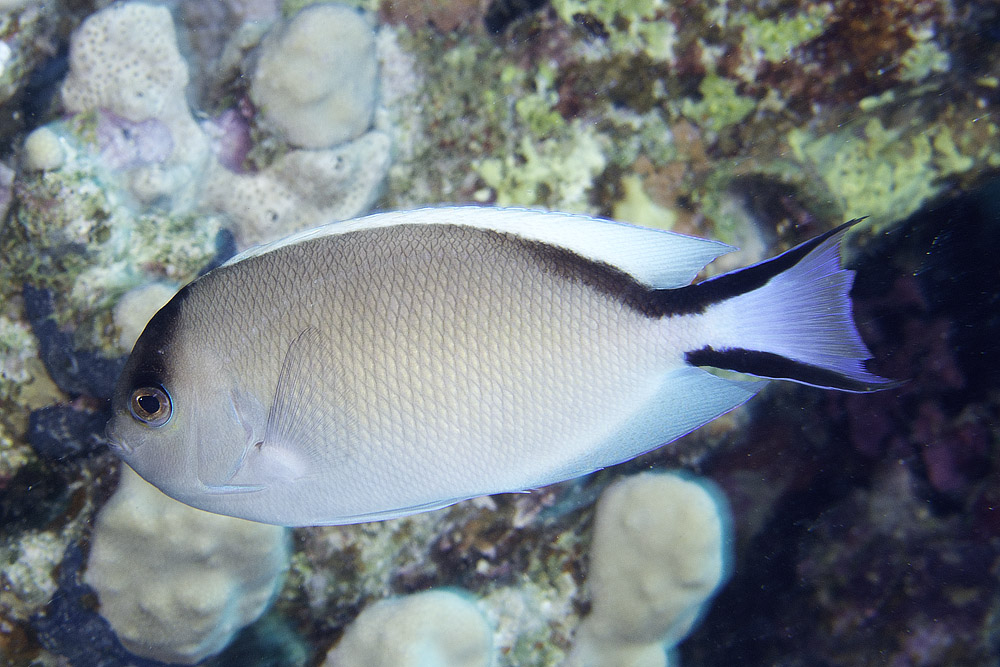
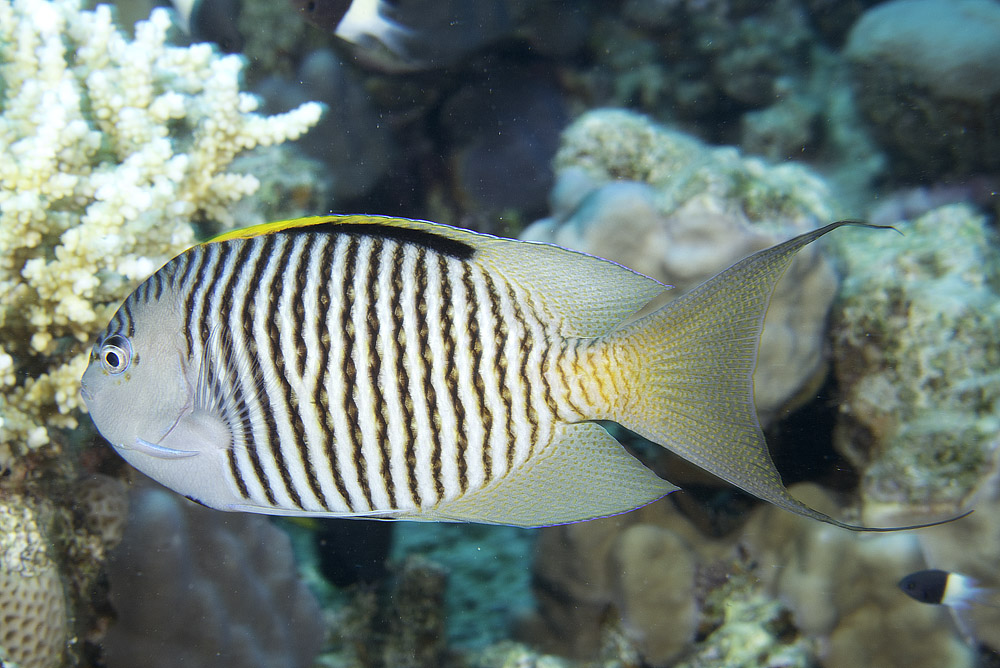
The zebra angelfish is one of the few marine species where the two sexes present dramatically different visual palettes, a trait ichthyologists call sexual dichromatism. Males wear a cool whitish-blue body overlaid with bold vertical bars of dark brown, while a solid black stripe runs along the midpoint of the dorsal fin base. Females, by contrast, display a softer pale pinkish-grey ground colour, punctuated by a dark band sweeping across the eye and a pair of black stripes framing the upper and lower edges of the tail fin. Despite these differences, both sexes share a strikingly forked caudal fin that gives the species its swallowtail and lyretail common names. The dorsal fin is armed with fifteen spines followed by fifteen to seventeen soft rays, and the anal fin carries three spines alongside seventeen to nineteen soft rays. No individual grows beyond twenty centimetres in total length, a modest size for a member of the pomacanthid family.
A Western Indian Ocean Resident
The zebra angelfish is a creature of the western Indian Ocean, with its range stretching along the eastern African coastline from the Red Sea in the north all the way down to KwaZulu-Natal in South Africa. Eastward, its distribution encompasses Madagascar, the Maldives, Mauritius, and Réunion. A separate record also places the species on Weh Island, off the northwestern tip of Sumatra, extending its known range slightly beyond the core African and island waters. In terms of vertical habitat, adults occupy steep outer reef slopes at depths between fifteen and seventy metres. In the Red Sea the fish has been observed in noticeably shallower water than in the Andaman Sea, suggesting some regional flexibility in depth preference. Socially, the species is not solitary; it assembles into small groups typically consisting of one male accompanied by a handful of females. Juveniles, meanwhile, hold at greater depths than their adult counterparts, marking a distinct phase in the species' life cycle.
A Name Born in 1860
The formal scientific recognition of the zebra angelfish dates back to 1860, when the German-born British ichthyologist and herpetologist Albert Günther published its original description under the name Holocanthus caudovittatus. Günther, who lived from 1830 to 1914, designated Mauritius as the type locality for the species. The specific epithet is a Latin compound: caudus meaning tail and vittatus meaning banded, a direct reference to the black markings on the tail. Over time the species was transferred to the genus Genicanthus, where it now sits within the family Pomacanthidae alongside other marine angelfish. In the aquarium and diving communities, the fish is equally well known by its common names—swallowtail angelfish and lyretail angelfish—each evoking the deeply forked shape of the tail fin shared by both sexes. These alternative names have become so entrenched in recreational literature that many enthusiasts recognise the fish by them before ever encountering its binomial.
Plankton, Slopes, and the Aquarium
The zebra angelfish sustains itself on plankton, a diet that ties it to the open water above the steep outer reef slopes where it is found. Its basic social unit is a small group consisting of one male and a few females, and within that grouping the division of depth is notable: adults occupy the fifteen-to-seventy-metre band, while juveniles consistently hold at greater depths. The species' relationship with the human world is modest. It occasionally appears in the marine aquarium trade, though it is far from a commonly stocked or mass-produced species. For most of its range, the zebra angelfish remains a fish of the deep slope, encountered by divers who venture beyond the shallow reef crest into the blue water of the outer wall. Its forked tail and the contrasting colouration between the sexes make it a visually striking subject at depth, and its presence in the aquarium trade, however occasional, serves as a reminder that even the more remote members of the pomacanthid family can cross into human spaces.
Gallery
Spotted an error? Know more?
Reader corrections go straight into our review queue. Suggest an edit · How this site is sourced