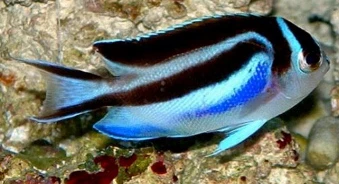
Ornate angelfish (Genicanthus bellus)
Source-cited species reference: taxonomy from WoRMS, biology from FishBase, occurrence map from GBIF, conservation from IUCN Red List, description from Wikipedia.

Genicanthus bellus, the ornate angelfish, bellus angelfish or bellus lyretail angelfish, is a species of marine ray-finned fish, a marine angelfish belonging to the family Pomacanthidae. It is found in the Indo-Pacific region.
- Scientific name
- Genicanthus bellus
- Authority
- Randall, 1975
- Family
- Pomacanthidae
- Order
- Acanthuriformes
- Maximum length
- 18 cm
- Depth range
- 24–110 m
- Habitat zone
- reef-associated
- Iucn red list
- Least Concern
- Gbif occurrence records
- 41
A Study in Contrasting Colours
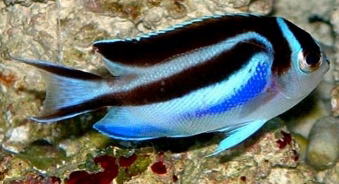
The ornate angelfish is one of the most visually dramatic examples of sexual dichromatism in the marine world. Females and juveniles present a cool, greyish-to-bluesilver canvas overlaid with bold black bands and a blue stripe running along the lower flanks. Their dorsal fin is predominantly black, though in the oldest and largest females it may shift into variable shades of red. Two tiny silvery-white dots sit on their black upper lips, and each of the four prominent black stripes is edged in white or very pale blue. Males, by contrast, carry a paler bluish-grey body streaked with horizontal golden lines along the mid-flanks and lower back, with the bases of their pectoral and dorsal fins echoing that same golden hue. Both sexes share a caudal fin that is largely unpigmented but frequently dotted with orange patches and tipped with vivid blue filamentous extensions, while the lips glow bright blue. The dorsal fin bears fifteen spines and fifteen to sixteen soft rays; the anal fin carries three spines and sixteen to seventeen soft rays. The species reaches a maximum total length of eighteen centimetres.
Life in the Deep Currents
The ornate angelfish inhabits depths ranging from twenty-five to one hundred metres, favouring deep reef structures on outer drop-offs where strong currents sweep the water. Despite living in such remote and challenging environments, the species is notably sociable, gathering into schools that contain harems of three to seven individuals. Researchers have described the mating system as resembling lekking rather than a simple harem arrangement. Like all angelfish, Genicanthus bellus is a sequential protogynous hermaphrodite: every newly adult individual begins life as a female. However, in the absence of a dominant male, a leading female can ramp up testosterone production and complete a sex change to male in as little as two weeks. For sustenance, the species forms midwater shoals to feed primarily on plankton, though it also picks up benthic invertebrates such as polychaetes and bryozoans, along with algae, from the reef substrate below.
A Scattered Indo-Pacific Presence
Although Genicanthus bellus enjoys a broad geographic range spanning the western Pacific and eastern Indian Oceans, its actual occurrences are patchy and localised. Pacific records stretch from Tahiti and the Cook Islands through the Marshall and Philippines archipelagos, extending to southern Japan, southern Indonesia, Guam, Palau, and Tonga. Within Australian jurisdiction, sightings include the Cocos (Keeling) Islands and Christmas Island in the Indian Ocean, plus Holmes Reef in the Coral Sea. Because the ornate angelfish strongly prefers quite deep water, many researchers suspect it is under-recorded; the sheer difficulty of sampling at its typical depth range likely means that additional populations remain undiscovered or unreported. This scattered, depth-restricted distribution makes the species both logistically challenging to study and ecologically intriguing, as isolated populations separated by hundreds of kilometres of open ocean may face very different current regimes, prey availability, and reproductive pressures.
From Deep Water to the Aquarium
The ornate angelfish was formally described in 1979 by American ichthyologist John Ernest Randall, who designated the type locality as the area outside the barrier reef off the District of Paea in Tahiti, at a depth of sixty metres. Randall chose the specific epithet bellus, Latin for "beautiful," a fitting tribute to the fish's striking plumage. Taxonomically, the species is known to produce hybrids with just one other species, the blackstriped angelfish (Genicanthus lamarck). In the aquarium trade, Genicanthus bellus is exceedingly rare and commands premium prices, largely because the depths at which it lives make collection extremely difficult. On the occasions when intensified collecting efforts do bring specimens to market, mortality rates among the captured fish can be high. Nevertheless, individuals that survive the initial acclimation period and establish themselves in captivity tend to prove remarkably hardy and resilient, making them a prized and visually spectacular addition to any deep-reef aquarium.
Gallery
Spotted an error? Know more?
Reader corrections go straight into our review queue. Suggest an edit · How this site is sourced