
Danafungia scruposa
Source-cited species reference: taxonomy from WoRMS, biology from SeaLifeBase, occurrence map from GBIF, conservation from IUCN Red List, description from Wikipedia.
Danafungia scruposa is a species of coral that is the first to have been observed to eat jellyfish. It was described by Klunzinger in 1879 and has a diameter of around 25 cm. It is rated as a least-concern species.
- Scientific name
- Danafungia scruposa
- Authority
- (Klunzinger, 1879)
- Family
- Fungiidae
- Order
- Scleractinia
- Depth range
- 0–40 m
- Habitat zone
- reef-associated
- Iucn red list
- Endangered
- Gbif occurrence records
- 439
Classification (WoRMS)
Full classification as recorded by WoRMS: Kingdom: Animalia · Phylum: Cnidaria · Class: Hexacorallia · Order: Scleractinia · Family: Fungiidae · Genus: Danafungia.
Accepted name: Danafungia scruposa · Authority: (Klunzinger, 1879) · Taxonomic status: accepted · AphiaID: 716609.
Synonyms and superseded combinations recorded for this taxon: Fungia (Danafungia) corona Döderlein, 1901; Fungia (Danafungia) madagascarensis Vaughan, 1906; Fungia (Danafungia) scruposa Klunzinger, 1879; Fungia (Danafungia) subrepanda Döderlein, 1901; Fungia (Verrillofungia) fieldi Gardiner, 1909; Fungia corona Döderlein, 1901; Fungia danai var. vitiensis Döderlein, 1902; Fungia fieldi Gardiner, 1909; Fungia lobulata Ortmann, 1889; Fungia madagascarensis Vaughan, 1906; Fungia madagascariensis Vaughan, 1906; Fungia rugosa Quelch, 1886; Fungia scruposa Klunzinger, 1879; Fungia scruposa var. ternatensis Döderlein, 1902; Fungia subrepanda Döderlein, 1901.
Source: World Register of Marine Species (WoRMS) — https://www.marinespecies.org/aphia.php?p=taxdetails&id=716609 (CC BY 4.0). Accessed 2026-09-23.
Biology and life history (SeaLifeBase)
Measured values published by SeaLifeBase for Danafungia scruposa. Only fields the database actually holds for this species are shown; these are database values, not aquarium guidance.
Depth range: 0–40 m · Habitat zone: reef-associated.
Source: SeaLifeBase species summary (SpecCode 45849) — https://www.sealifebase.se/summary/Danafungia-scruposa.html (CC BY-NC 3.0 — non-commercial use only). Accessed 2026-09-23.
Distribution and occurrence records (GBIF)
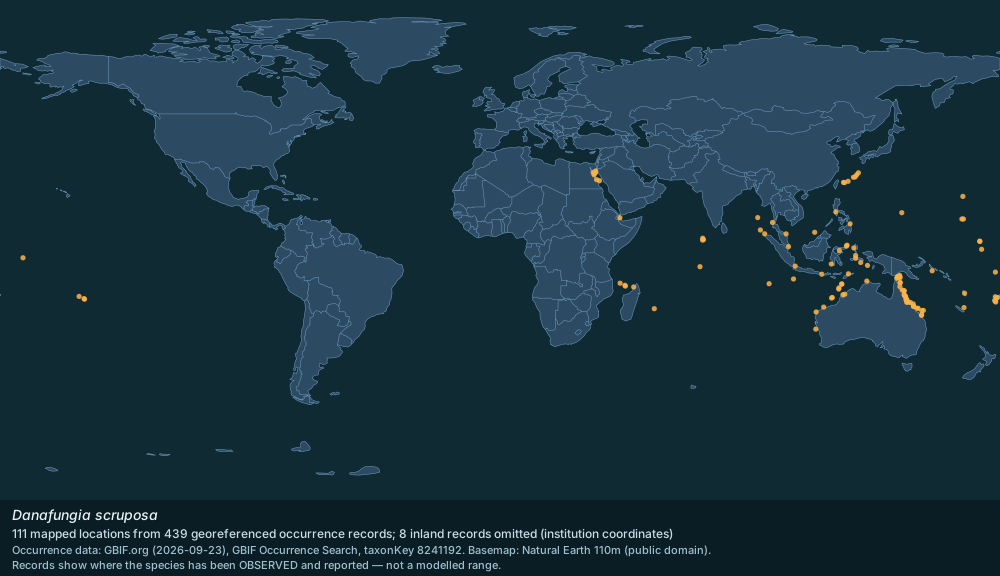
439 georeferenced occurrence records for Danafungia scruposa are published through GBIF from 31 countries or marine areas. The map above plots 111 distinct locations from a sample of 439 records, omitting 8 inland records that carry an institution's coordinates rather than a collection site; it shows where the species has been observed and reported, not a modelled range.
Most records by country or area: Australia (253); Indonesia (40); British Indian Ocean Territory (25); Marshall Islands (15); Mayotte (15); Japan (12); Christmas Island (9); Egypt (7); Fiji (7); French Polynesia (7); Papua New Guinea (6); India (5); Kiribati (5); Madagascar (5); Maldives (4).
Marine regions with a valid WoRMS distribution record: Indo-West Pacific; El Quseir.
Source: GBIF Occurrence Search (taxonKey 8241192) — https://www.gbif.org/occurrence/search?taxon_key=8241192&has_coordinate=true (records CC0 / CC BY); WoRMS distribution records (MarineRegions) — https://www.marinespecies.org/aphia.php?p=taxdetails&id=716609 (CC BY 4.0); Natural Earth 110m basemap — https://www.naturalearthdata.com/ (public domain). Accessed 2026-09-23.
Conservation status (IUCN Red List)
The IUCN Red List assesses Danafungia scruposa (Klunzinger, 1879) as Endangered (code EN). No trend, population estimate or threat analysis is given here, because none is available from this source without the Red List API; follow the source link for the full assessment, including its date.
Source: IUCN Red List of Threatened Species (taxon 133308) — https://www.iucnredlist.org/species/133308/0; GBIF IUCN Red List category endpoint (taxonKey 8241192) — https://api.gbif.org/v1/species/8241192/iucnRedListCategory. Accessed 2026-09-23.
Description and natural history (Wikipedia)
They are about 25 cm in diameter and normally eat a variety of food from bacteria to mesozooplankton measuring 1 mm in diameter. During an algal bloom in 2009 researchers observed the coral consuming the jellyfish Aurelia aurita. This was the first time such behaviour has been seen in the wild. It is not known how the coral captures jellyfish. It may have caught the jellyfish with its tentacles in the same way as some sea anemones feed on other jellyfish species.
This coral is unusual in that it consists of a single oval or circular polyp up to 38 cm across. The species may contain tentacular lobes and it has dense septa. It is blue or brown in colour.
D. scruposa is found in the eastern and western Indian Ocean, the eastern central, northwestern and western central Pacific Ocean, Japan, the East China Sea, the Red Sea, and eastern Australia. No population figures are available for the species but it is believed to be common and is found at depths between 1 and 27 m on the slopes of reefs. A 1991 study of specimens found that 51% were bleached. It is threatened by bleaching, disease, climate change, fishing, preadators, and human activities. F. scruposa is classified as a least concern species by the IUCN.
It was originally described by Carl Benjamin Klunzinger in 1879 as Fungia scruposa. The species is also known by synonym Fungia corona (Döderlein, 1901), among others.
Source: Wikipedia: Danafungia scruposa — https://en.wikipedia.org/wiki/Danafungia_scruposa (CC BY-SA 4.0). Accessed 2026-09-23.
Gallery
Spotted an error? Know more?
Reader corrections go straight into our review queue. Suggest an edit · How this site is sourced