
Cycloseris cyclolites
Source-cited species reference: taxonomy from WoRMS, biology from SeaLifeBase, occurrence map from GBIF, conservation from IUCN Red List, description from Wikipedia.
Cycloseris cyclolites is a species of disc coral in the family Fungiidae. It was first described by the French naturalist Jean-Baptiste Lamarck in 1815. It is native to the tropical and subtropical Indo-Pacific region where it is found on soft sediment in shallow water.
- Scientific name
- Cycloseris cyclolites
- Authority
- (Lamarck, 1815)
- Family
- Fungiidae
- Order
- Scleractinia
- Habitat zone
- reef-associated
- Iucn red list
- Least Concern
- Gbif occurrence records
- 666
Classification (WoRMS)
Full classification as recorded by WoRMS: Kingdom: Animalia · Phylum: Cnidaria · Class: Hexacorallia · Order: Scleractinia · Family: Fungiidae · Genus: Cycloseris.
Accepted name: Cycloseris cyclolites · Authority: (Lamarck, 1815) · Taxonomic status: accepted · AphiaID: 207323.
Synonyms and superseded combinations recorded for this taxon: Cycloseris mortoni (Tenison-Woods, 1880); Cycloseris sibogae (Van der Hors, 1921t); Diaseris japonica (Vaughan, 1906); Diaseris mortoni Tenison-Woods, 1880; Fungia (Cycloseris) cyclolites Lamarck, 1815; Fungia adrianae Van der Horst, 1921; Fungia cyclolites Lamarck, 1815; Fungia glans Dana, 1846; Fungia japonica Vaughan, 1906.
Source: World Register of Marine Species (WoRMS) — https://www.marinespecies.org/aphia.php?p=taxdetails&id=207323 (CC BY 4.0). Accessed 2026-09-23.
Biology and life history (SeaLifeBase)
Measured values published by SeaLifeBase for Cycloseris cyclolites. Only fields the database actually holds for this species are shown; these are database values, not aquarium guidance.
Habitat zone: reef-associated · Aquarium trade: never/rarely.
Source: SeaLifeBase species summary (SpecCode 81817) — https://www.sealifebase.se/summary/Cycloseris-cyclolites.html (CC BY-NC 3.0 — non-commercial use only). Accessed 2026-09-23.
Distribution and occurrence records (GBIF)
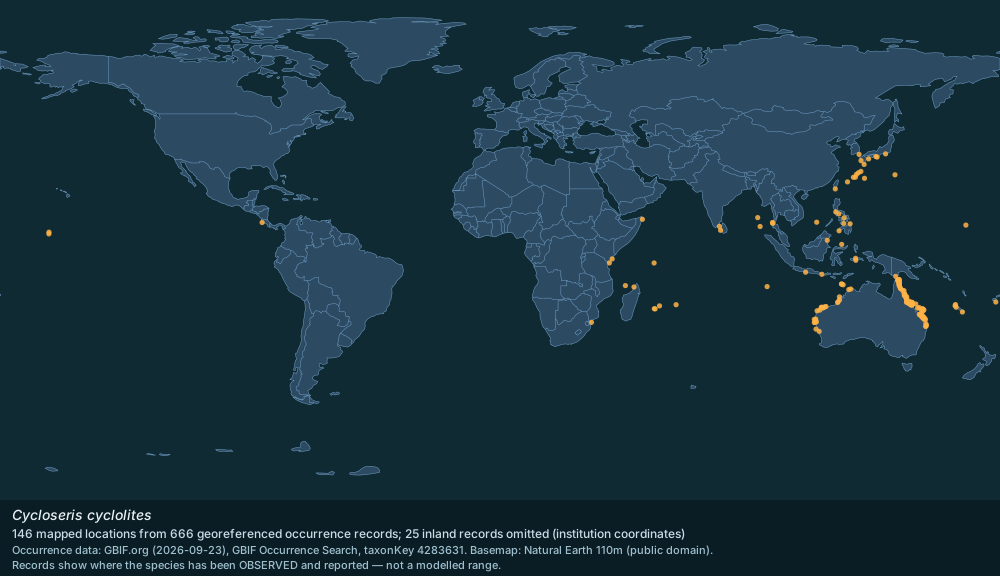
666 georeferenced occurrence records for Cycloseris cyclolites are published through GBIF from 29 countries or marine areas. The map above plots 146 distinct locations from a sample of 666 records, omitting 25 inland records that carry an institution's coordinates rather than a collection site; it shows where the species has been observed and reported, not a modelled range.
Most records by country or area: Australia (521); Japan (33); New Caledonia (22); Indonesia (16); Philippines (12); United States Minor Outlying Islands (8); Papua New Guinea (7); Réunion (5); Fiji (4); India (4); Mozambique (4); Kenya (3); Madagascar (3); Marshall Islands (3); Mayotte (3).
Marine regions with a valid WoRMS distribution record: Madagascar; Aldabra; Réunion Exclusive Economic Zone; Mauritian Exclusive Economic Zone; Rodrigues; Red Sea; Mozambican Exclusive Economic Zone; South Africa (country); Chagos; Southern Ocean; Australian Exclusive Economic Zone; United States Exclusive Economic Zone; Philippine Exclusive Economic Zone; Papua New Guinean Exclusive Economic Zone; Indian Exclusive Economic Zone; Kingman Reef.
Source: GBIF Occurrence Search (taxonKey 4283631) — https://www.gbif.org/occurrence/search?taxon_key=4283631&has_coordinate=true (records CC0 / CC BY); WoRMS distribution records (MarineRegions) — https://www.marinespecies.org/aphia.php?p=taxdetails&id=207323 (CC BY 4.0); Natural Earth 110m basemap — https://www.naturalearthdata.com/ (public domain). Accessed 2026-09-23.
Conservation status (IUCN Red List)
The IUCN Red List assesses Cycloseris cyclolites (Lamarck, 1815) as Least Concern (code LC). No trend, population estimate or threat analysis is given here, because none is available from this source without the Red List API; follow the source link for the full assessment, including its date.
Source: IUCN Red List of Threatened Species (taxon 132954) — https://www.iucnredlist.org/species/132954/0; GBIF IUCN Red List category endpoint (taxonKey 4283631) — https://api.gbif.org/v1/species/4283631/iucnRedListCategory. Accessed 2026-09-23.
Description and natural history (Wikipedia)
A solitary disc coral, C. cyclolites is round or slightly oval, forming a dome up to 4 cm wide with a hollowed out under surface. The primary septa are thick and straight with up to four more whorls of septa in larger specimens. The colour varies, usually being whitish or greenish, but shallow water specimens are sometimes brightly coloured. The primary septa often have white margins.
Cycloseris cyclolites is found in oceans of the tropical and subtropical Indo-Pacific region. Its range extends from Madagascar, the East African coast and the Red Sea through India and Malaysia to northern Australia, Japan and various island groups in the Pacific Ocean. Its typical habitat is on soft substrate, often muddy sand, between reefs, but it also sometimes occurs on the reefs themselves. C. cyclolites is part of a species complex and it is probable that reports of this species in the Western Indian Ocean should be assigned to a different species.
This is a zooxanthellate species of coral, meaning that the soft tissues contain symbiotic unicellular dinoflagellates which provide nutrients to their host. The coral is highly adapted to life on sand or mud in calm waters and is capable of shedding any sediment that threatens to blanket it. Being unattached, it is able to move about freely. Movement is made by a combination of distension of the polyp by inflating the tissues with water, and moving the tentacles about. The polyp can enlarge by 300 or 400% and this reduces the density of the whole animal, allowing it to "float" to the surface of the sediment in which it has become buried.
Source: Wikipedia: Cycloseris cyclolites — https://en.wikipedia.org/wiki/Cycloseris_cyclolites (CC BY-SA 4.0). Accessed 2026-09-23.
Gallery
Spotted an error? Know more?
Reader corrections go straight into our review queue. Suggest an edit · How this site is sourced