
Common cuttlefish (Sepia officinalis)
Source-cited species reference: taxonomy from WoRMS, biology from SeaLifeBase, occurrence map from GBIF, conservation from IUCN Red List, description from Wikipedia.

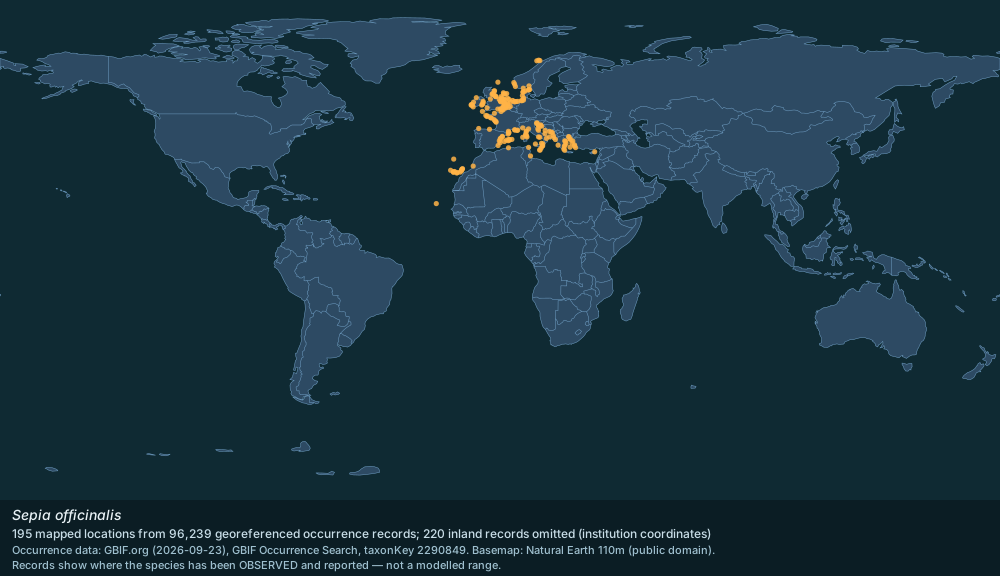
Distribution map plotted from GBIF.org occurrence records; basemap Natural Earth 110m · GBIF records CC0 / CC BY; Natural Earth public domain
The common cuttlefish or European common cuttlefish (Sepia officinalis) is one of the largest and best-known cuttlefish species. They are a migratory species that spend the summer and spring inshore for spawning and then move to depths of 100 - 200 m during autumn and winter. They grow to 49 cm in mantle length and 4 kg in weight. Animals from subtropical seas are smaller and rarely exceed 30 cm in mantle length.
- Scientific name
- Sepia officinalis
- Authority
- Linnaeus, 1758
- Family
- Sepiidae
- Order
- Sepiida
- Maximum length
- 49 cm
- Depth range
- 0–242 m
- Habitat zone
- benthic
- Iucn red list
- Least Concern
- Gbif occurrence records
- 96,239
Classification (WoRMS)
Full classification as recorded by WoRMS: Kingdom: Animalia · Phylum: Mollusca · Class: Cephalopoda · Order: Sepiida · Family: Sepiidae · Genus: Sepia.
Accepted name: Sepia officinalis · Authority: Linnaeus, 1758 · Taxonomic status: accepted · AphiaID: 141444.
Synonyms and superseded combinations recorded for this taxon: Sepia filliouxi Lafont, 1869; Sepia fischeri Lafont, 1871; Sepia mediterranea Ninni, 1884; Sepia officinalis officinalis Linnaeus, 1758; Sepia veranyi Lagatu, 1888; Sepia zebrina Risso, 1854.
Source: World Register of Marine Species (WoRMS) — https://www.marinespecies.org/aphia.php?p=taxdetails&id=141444 (CC BY 4.0). Accessed 2026-09-23.
Biology and life history (SeaLifeBase)
Measured values published by SeaLifeBase for Sepia officinalis. Only fields the database actually holds for this species are shown; these are database values, not aquarium guidance.
Maximum length: 49 cm · Depth range: 0–242 m · Habitat zone: benthic · Vulnerability index: 24.8 of 100 · Fishery importance: commercial.
SeaLifeBase notes: In temperate waters, maximum mantle length is 49 cm and up to 4 kg in weight. In the subtropics, maximum mantle length is 30 cm and up to 2 kg in weight (Ref. 1695). Common size: 15.0 to 25.0 cm (West Saharan fisheries; Ref. 275). One of the most important species for cephalopod fisheries in many countries but have been observed in recent years that it is heavily fished, e.g., Mediterranean (Ref. 1695). Also, a highly valued item especially in Japan, Korea, Italy and Spain (Ref. 1695). Maximum depth range from Ref. 114857. A neritic, demersal species found in the subtidal zone to depths of 200 m, generally over sandy-muddy substrates (Ref. 1695, page 100). Presence in Portuguese waters indicates its tolerance for brackish water. Undergoes seasonal migrations between inshore waters in spring and summer and medium shelf grounds (around 100 m depth) in autumn and winter. Courtship behavior is elaborate and ritualized with visual displays and 'mate guarding'. Spawns in shallow waters, optimally between 13° to 15°C. Eggs, 8 to 10, mm diameter and blackened with ink, are attached on seaweed, shells, debris and other substrates, in grape-like clusters. Depending on water temperature, eggs hatch after 30 to 90 days. Hatchlings measure about 7 to 8 mm TL. From hatchlings to adults, exhibit light-induced burying behavior where most individuals hide in sand during the day and where prey is often ambushed. Life cycle under natural conditions, between 12 to 24 months. Feeds on small mollusks, crabs, shrimps, other cuttlefishes, and juvenile demersal fishes. Cannibalism is common. Considered one of the most commercially important cephalopod species. With potential for aquaculture. Usually marketed fresh or frozen as a highly valued food item, especially in Japan, Korea, Italy and Spain (Ref. 1695).
Source: SeaLifeBase species summary (SpecCode 57474) — https://www.sealifebase.se/summary/Sepia-officinalis.html (CC BY-NC 3.0 — non-commercial use only). Accessed 2026-09-23.
Distribution and occurrence records (GBIF)
96,239 georeferenced occurrence records for Sepia officinalis are published through GBIF from 58 countries or marine areas. The map above plots 195 distinct locations from a sample of 3,000 records, omitting 220 inland records that carry an institution's coordinates rather than a collection site; it shows where the species has been observed and reported, not a modelled range.
Most records by country or area: Netherlands (50,438); France (17,140); United Kingdom of Great Britain and Northern Ireland (10,340); Spain (10,078); Portugal (1,698).
The full country table, WoRMS marine regions and the sampling notes are on this species' Distribution page.
Source: GBIF Occurrence Search (taxonKey 2290849) — https://www.gbif.org/occurrence/search?taxon_key=2290849&has_coordinate=true (records CC0 / CC BY); WoRMS distribution records (MarineRegions) — https://www.marinespecies.org/aphia.php?p=taxdetails&id=141444 (CC BY 4.0); Natural Earth 110m basemap — https://www.naturalearthdata.com/ (public domain). Accessed 2026-09-23.
Conservation status (IUCN Red List)
The IUCN Red List assesses Sepia officinalis Linnaeus, 1758 as Least Concern (code LC). No trend, population estimate or threat analysis is given here, because none is available from this source without the Red List API; follow the source link for the full assessment, including its date.
Source: IUCN Red List of Threatened Species (taxon 162664) — https://www.iucnredlist.org/species/162664/0; GBIF IUCN Red List category endpoint (taxonKey 2290849) — https://api.gbif.org/v1/species/2290849/iucnRedListCategory. Accessed 2026-09-23.
Description and natural history (Wikipedia)
The common cuttlefish is native to at least the Mediterranean Sea, North Sea, and Baltic Sea, although subspecies have been proposed as far south as South Africa. It lives on sand and mud seabeds and it can tolerate brackish water conditions.
It is unknown where the type specimen of S. officinalis was collected, as the location is given simply as "Oceano". It is deposited in the Linnean Society of London.
Sepia officinalis jurujubai Oliveira, 1940, originally described as a subspecies of the common cuttlefish, is a junior synonym of Sepioteuthis sepioidea.
The common cuttlefish is one of the largest species of cuttlefish with a mantle length reaching up to 45 cm and a mass of 4 kg on a presumed male, although this is for an exceptional specimen in temperate waters; specimens in subtropical waters rarely surpass a mantle length of 30 cm and 2 kg in mass. The mantle houses the reproductive and digestive tracts of the cuttlefish and is also home to an internal shell called the cuttlebone, located on the dorsal side of the animal. The common cuttlefish has two highly developed eyes, eight arms which are located around the mouth and are used to hold and manipulate prey, two specialized feeding tentacles which are used to ambush prey, and a beak housing a radula used in breaking down and consuming their (often armored) prey. Cuttlefish move by undulating fins on the periphery of their mantle, but when startled they often jet away using a siphon, inking in the process.
Cuttlefish are well known for their unmatched camouflaging abilities which are possible due a variety of specialized cells; pigmented chromatophore organs, light scattering leucophores, and structurally reflecting iridophores in their skin work in concert to conceal the cuttlefish in its environment. They not only are able to swiftly change their colour and patterns, but can also use peripheral muscles to change the texture of their skin. Their camouflaging abilities are categorized into four main types including mottle, stipple, uniform, and disruptive. Cuttlefish possess these camouflaging abilities from before hatching; a cuttlefish can visibly manipulate its chromatophores from within its clear-membraned egg.
During the day, most cuttlefish can be found buried below the substrate and fairly inactive. At night however, they are actively searching for prey and can ambush them from under the substrate. Cuttlefish are carnivorous and eat a variety of organisms including crustaceans (crabs and shrimp), small demersal fish, molluscs (clams and snails), and sometimes other cuttlefish which is more commonly seen when the abundance of other prey is low.
A 2008 study on S. officinalis revealed that cuttlefish embryos, if visually exposed to a certain species of prey (e.g. crabs), will hunt primarily for that prey in later life. S. officinalis usually prefer shrimp to crabs, but when the embryos were exposed to crabs and the embryos had hatched, the young cuttlefish switched preferences and proceeded to hunt the crabs more often than the shrimp.
Cuttlefish reach sexual maturity between 14 and 18 months of age. During breeding season, which occurs during spring, summer, and sometimes early autumn, large gatherings of male cuttlefish will display a highly contrasting black and white zebra pattern on their mantle to attract females and females will display a uniform grey colour to indicate they are ready to mate. Cuttlefish males carry up to 1400 spermatophores to the female and the female carries between 150 and 4000 eggs depending on her body mass. The female attaches the egg mass to seaweed, shells, or other substrates to prevent it from drifting away; the eggs incubate for 30 or 90 days, depending on temperature, until they hatch into miniature versions of the adults. Cuttlefish live up to 2 years of age; a large number of them die after spawning.
Cuttlefish have many predators including sharks, coastal dolphins, seals, large fish such as sparids, and cephalopods which includes other cuttlefish. They have a number of anti-predator adaptations; their primary means is camouflage, sitting concealed while a predator passes them by. If located, a cuttlefish will jet away using its siphon, and will often ink; a cuttlefish has a variety of ink types that it can use depending on its situation.
The egg masses of the common cuttlefish are also attacked and consumed by predators; an experiment determined that a variety of marine invertebrates, including the murex sea snails, european lobster, rock crabs, sea urchins, Squilla mantis, and sea stars ate common cuttlefish egg masses.
Sepia officinalis is a species that is commonly fished in the Mediterranean, including countries like Greece and Spain. Although it is fished extensively and wild stocks in some regions are close to being over-exploited, population numbers are not declining and the species is of Least Concern on the list of threatened species. Cuttlefish in general have many uses, thus they have a large commercial value. Sepia officinalis is a popular food item in its native range, and mediterranean languages have numerous names for cuttlefish. The mantle is the main cut eaten; it is processed into a multitude of dishes after the cuttlebone and guts are removed. The head including the tentacles are also processed into a variety of dishes; the buccal mass including the beak are often removed beforehand.
Cuttlefish ink is believed to have many beneficial health effects including anti-inflammatory, anti-oxidant, antimicrobial, anti-hypertensive, anti-retroviral, and potential anticancer properties. The ink itself is an ingredient in food, staining the dish to a deep black coloration. Another common use for cuttlefish ink is as a pigment; the color sepia is named after the common cuttlefish, and it is extracted from its ink sac.
Cuttlebones are commonly sold for pet parrots because they provide a good source of calcium, help keep a bird's beak trimmed, improve jaw strength, and provide entertainment for the bird. Some reptile species may also take cuttlebones for calcium and enrichment.
Source: Wikipedia: Common cuttlefish — https://en.wikipedia.org/wiki/Common_cuttlefish (CC BY-SA 4.0). Accessed 2026-09-23.
Gallery
Related in Common cuttlefish
Links follow this subject's own source article.
Elsewhere in Common cuttlefish
Spotted an error? Know more?
Reader corrections go straight into our review queue. Suggest an edit · How this site is sourced