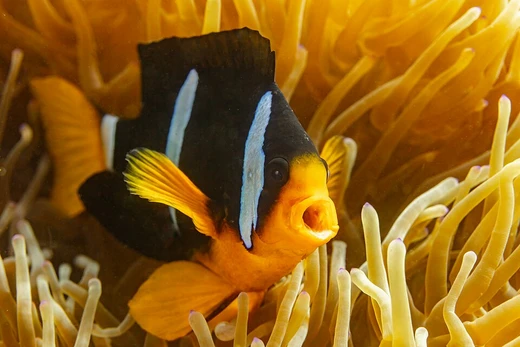
Clark's anemonefish (Amphiprion clarkii)
Source-cited species reference: taxonomy from WoRMS, biology from FishBase, occurrence map from GBIF, conservation from IUCN Red List, description from Wikipedia.

Rickard Zerpe · CC BY 2.0
Clark's anemonefish (Amphiprion clarkii), also known as the yellowtail clownfish, is a marine fish belonging to the family Pomacentridae, the clownfishes and damselfishes. 28 species of anemonefish live within the Pomacentridae family (Steer P. 2012).
- Scientific name
- Amphiprion clarkii
- Authority
- (Bennett, 1830)
- Family
- Pomacentridae
- Order
- Ovalentaria incertae sedis
- Maximum length
- 15 cm
- Depth range
- 1–70 m
- Habitat zone
- reef-associated
- Iucn red list
- Least Concern
- Gbif occurrence records
- 5,181
Classification (WoRMS)
Full classification as recorded by WoRMS: Kingdom: Animalia · Phylum: Chordata · Class: Teleostei · Order: Ovalentaria incertae sedis · Family: Pomacentridae · Genus: Amphiprion.
Accepted name: Amphiprion clarkii · Authority: (Bennett, 1830) · Taxonomic status: accepted · AphiaID: 212783.
Synonyms and superseded combinations recorded for this taxon: Amphiprion boholensis Cartier, 1874; Amphiprion clarki (Bennett, 1830); Amphiprion clarkia (Bennett, 1830); Amphiprion japonicus Temminck & Schlegel, 1843; Amphiprion melanostolus Richardson, 1842; Amphiprion papuensis MacLeay, 1883; Amphiprion snyderi Ishikawa, 1904; Amphiprion xanthurus Cuvier, 1830; Anthias clarkii Bennett, 1830; Sparus milii Bory de Saint-Vincent, 1831.
Source: World Register of Marine Species (WoRMS) — https://www.marinespecies.org/aphia.php?p=taxdetails&id=212783 (CC BY 4.0). Accessed 2026-09-23.
Biology and life history (FishBase)
Measured values published by FishBase for Amphiprion clarkii. Only fields the database actually holds for this species are shown; these are database values, not aquarium guidance.
Maximum length: 15 cm · Depth range: 1–70 m · Habitat zone: reef-associated · Body shape: short and / or deep · Vulnerability index: 28.7 of 100 · Fishery importance: subsistence fisheries · Aquarium trade: commercial.
FishBase notes: Adults inhabit lagoons and outer reef slopes. Omnivorous. Oviparous, with elliptical eggs (Ref. 240). Monogamous (Ref. 52884). Oviparous, distinct pairing during breeding (Ref. 205). Eggs are demersal and adhere to the substrate (Ref. 205). Males guard and aerate the eggs (Ref. 205). Associated with the anemones: Cryptodendrum adhaesivum , Entacmaea quadricolor , Heteractis aurora , Heteractis crispa , Heteractis magnifica , Heteractis malu , Macrodactyla doreensis , Stichodactyla gigantea , Stichodactyla haddoni , and Stichodactyla mertensii (Ref. 5911). Has been observed to share home anemone with individuals of A. sandaracinos (Ref. 90000). Has been reared in captivity (Ref. 35418, 35420). Maximum depth reported taken from Ref. 128797.
Source: FishBase species summary (SpecCode 5448) — https://www.fishbase.se/summary/Amphiprion-clarkii.html (CC BY-NC 3.0 — non-commercial use only). Accessed 2026-09-23.
Distribution and occurrence records (GBIF)
5,181 georeferenced occurrence records for Amphiprion clarkii are published through GBIF from 48 countries or marine areas. The map above plots 302 distinct locations from a sample of 3,000 records, omitting 36 inland records that carry an institution's coordinates rather than a collection site; it shows where the species has been observed and reported, not a modelled range.
Most records by country or area: Indonesia (1,257); Philippines (886); Australia (461); Hong Kong (356); Japan (324).
The full country table, WoRMS marine regions and the sampling notes are on this species' Distribution page.
Source: GBIF Occurrence Search (taxonKey 5212081) — https://www.gbif.org/occurrence/search?taxon_key=5212081&has_coordinate=true (records CC0 / CC BY); WoRMS distribution records (MarineRegions) — https://www.marinespecies.org/aphia.php?p=taxdetails&id=212783 (CC BY 4.0); Natural Earth 110m basemap — https://www.naturalearthdata.com/ (public domain). Accessed 2026-09-23.
Conservation status (IUCN Red List)
The IUCN Red List assesses Amphiprion clarkii (Bennett, 1830) as Least Concern (code LC). No trend, population estimate or threat analysis is given here, because none is available from this source without the Red List API; follow the source link for the full assessment, including its date.
Source: IUCN Red List of Threatened Species (taxon 188338) — https://www.iucnredlist.org/species/188338/0; GBIF IUCN Red List category endpoint (taxonKey 5212081) — https://api.gbif.org/v1/species/5212081/iucnRedListCategory. Accessed 2026-09-23.
Description and natural history (Wikipedia)
Clownfish or anemonefish are fishes that, in the wild, form symbiotic mutualisms with sea anemones and are unaffected by the stinging tentacles of the host anemone, see. The sea anemone protects the clownfish from predators, as well as providing food through the scraps left from the anemone's meals and occasional dead anemone tentacles. In return, the clownfish defends the anemone from its predators, and parasites. Anemonefish tend to have a life span of about 10-11 years when accounting for a predictable environment that does not experience much change in water temperature, increase in predation or habitat degradation (Lakshmi Sawitri). Clownfish are small-sized, 10 - 18 cm, and depending on species, they are overall yellow, orange, or a reddish or blackish color, and many show white bars or patches. Within species there may be color variations, most commonly according to distribution, but also based on sex, age and host anemone. Clownfish are found in warmer waters of the Indian and Pacific oceans and the Red Sea in sheltered reefs or in shallow lagoons.
In a group of clownfish, there is a strict dominance hierarchy. The largest and most aggressive fish is female and is found at the top. Only two clownfish, a male and a female, in a group reproduce through external fertilization. Clownfish are sequential hermaphrodites, meaning that they develop into males first, and when they mature, they become females. They are not aggressive. When the egg production and spawning patterns of eight breeding pairs were observed in a coral reef off the coast of the Philippines, they preferred breeding in the colder months. A trend of a peak breeding season from November through May was seen; egg production increased up to the new moon and decreased after the full moon. This seasonality of spawning is comparable to other species of clownfish that live in temperate regions.
Clark's anemonefish is a small-sized fish which grows up to 10 cm as a male and 15 cm as a female. It is stocky, laterally compressed, and oval to rounded.
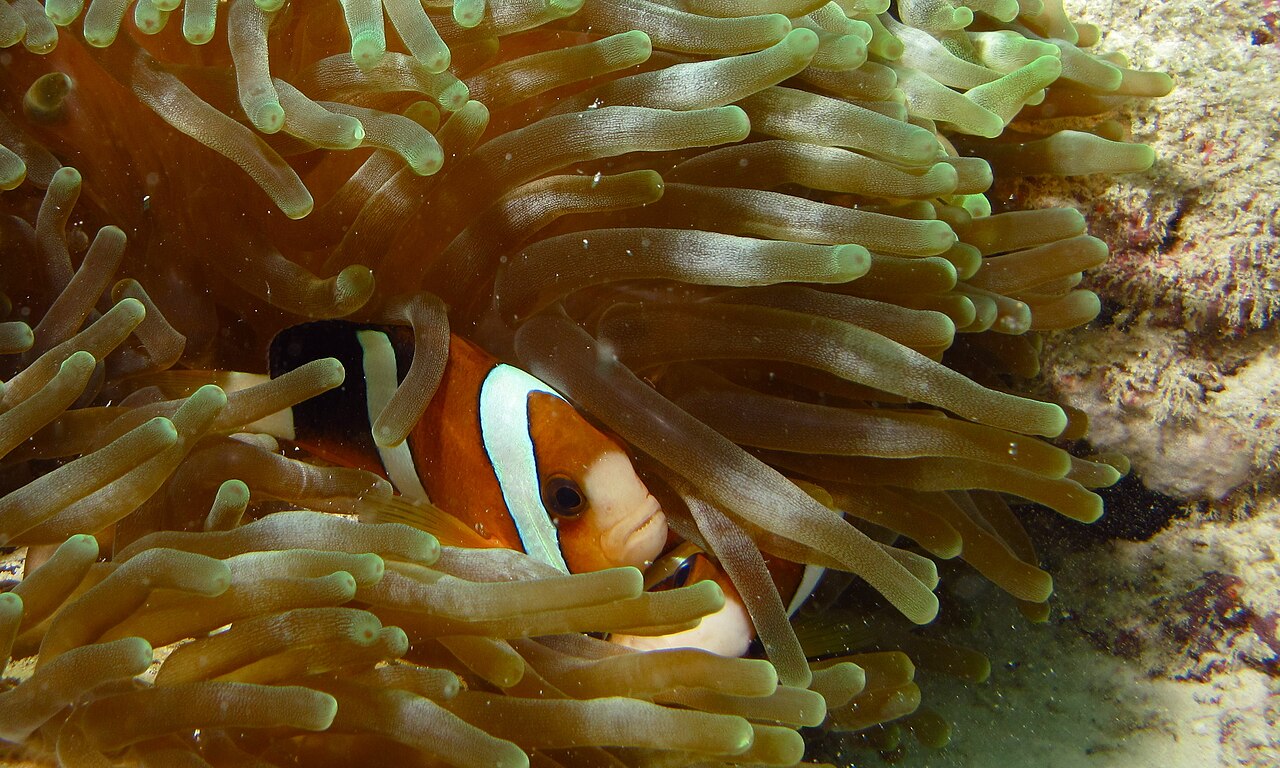
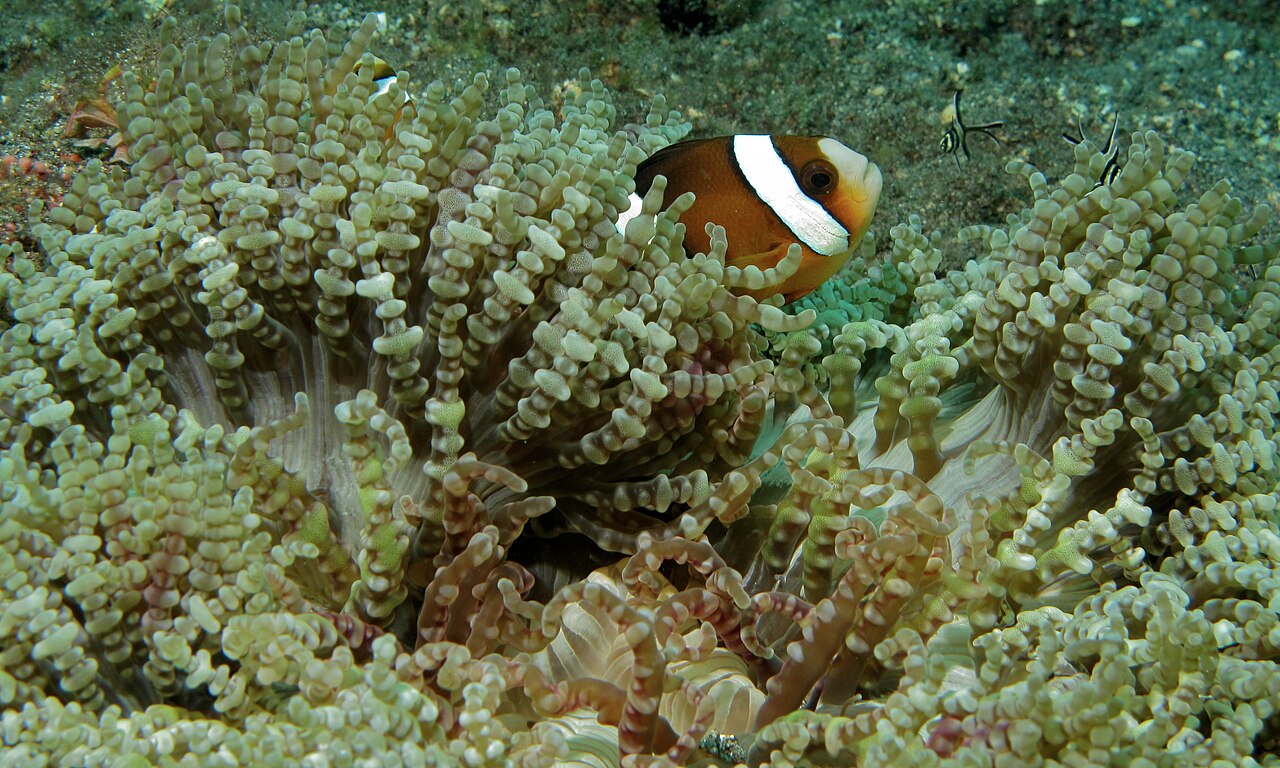
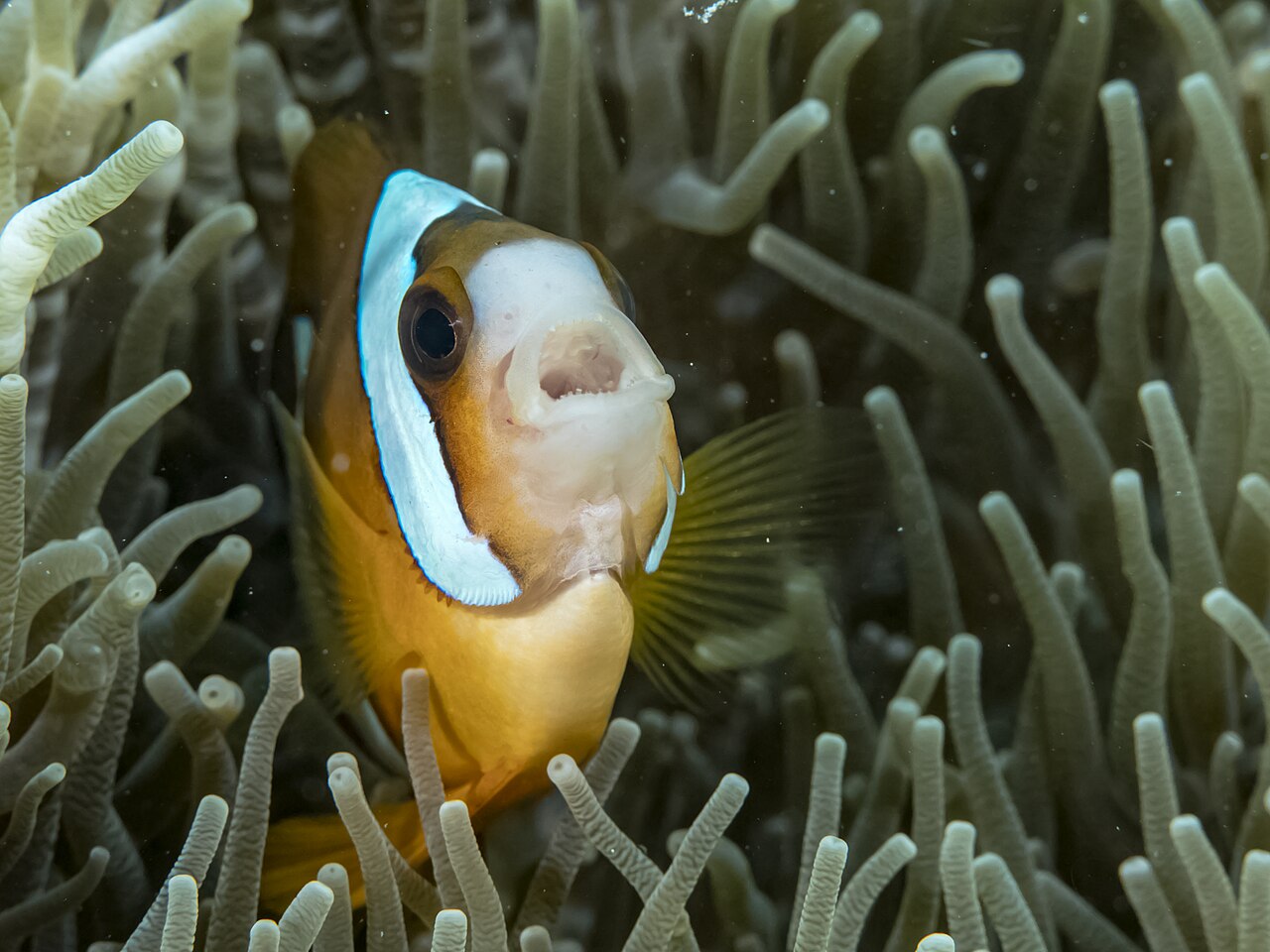
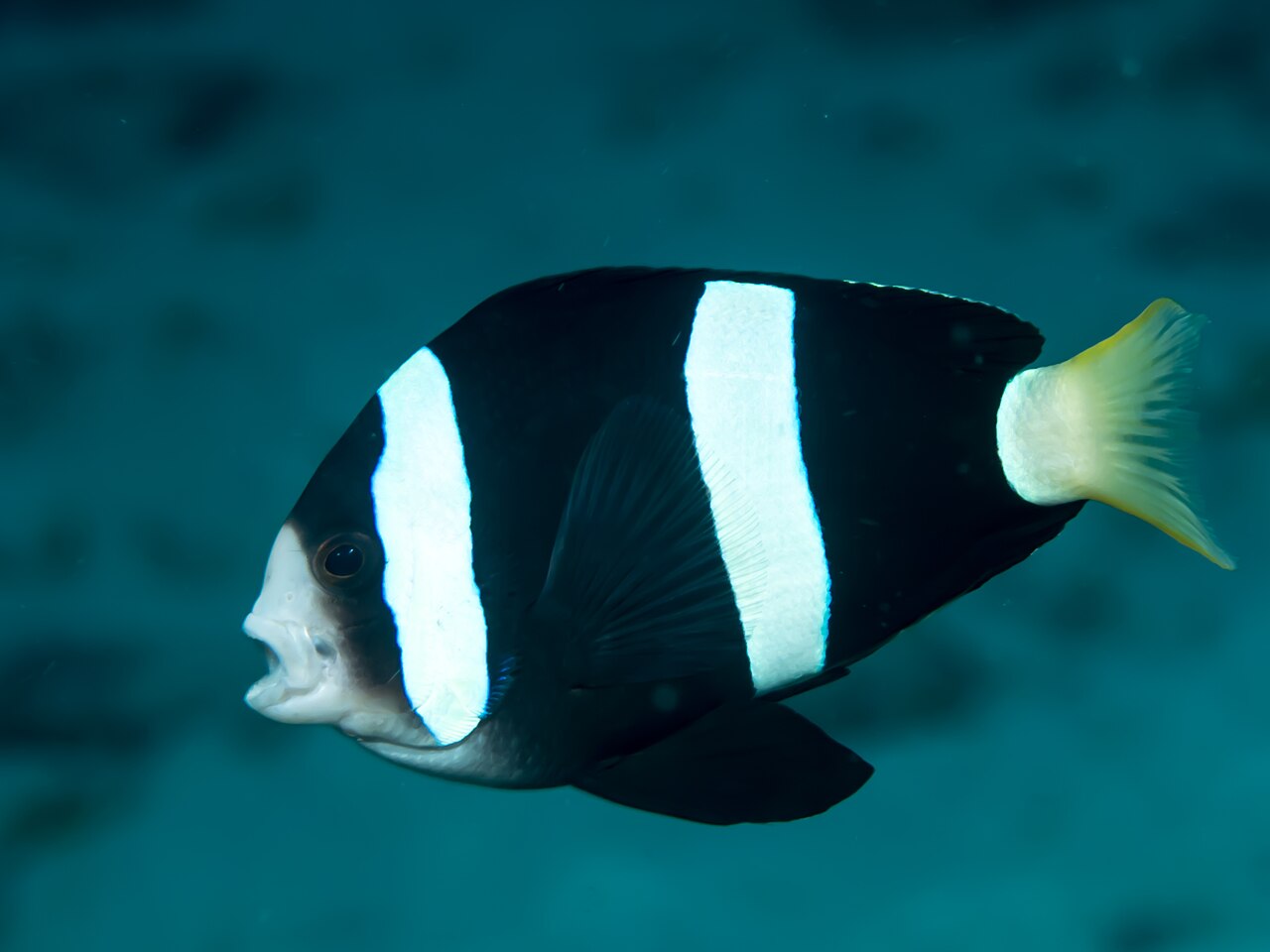
It is colorful, with vivid black, white, and yellow stripes, though the exact pattern shows considerable geographical variation. Usually it is black dorsally and orange-yellow ventrally, the black areas becoming wider with age. There are two vertical white bands, one behind the eye and one above the anus, and the caudal peduncle is white. The snout is orange or pinkish. The dorsal and caudal fins are orange-yellow, and the caudal fin is generally lighter in tone than the rest of the body, sometimes becoming whitish.
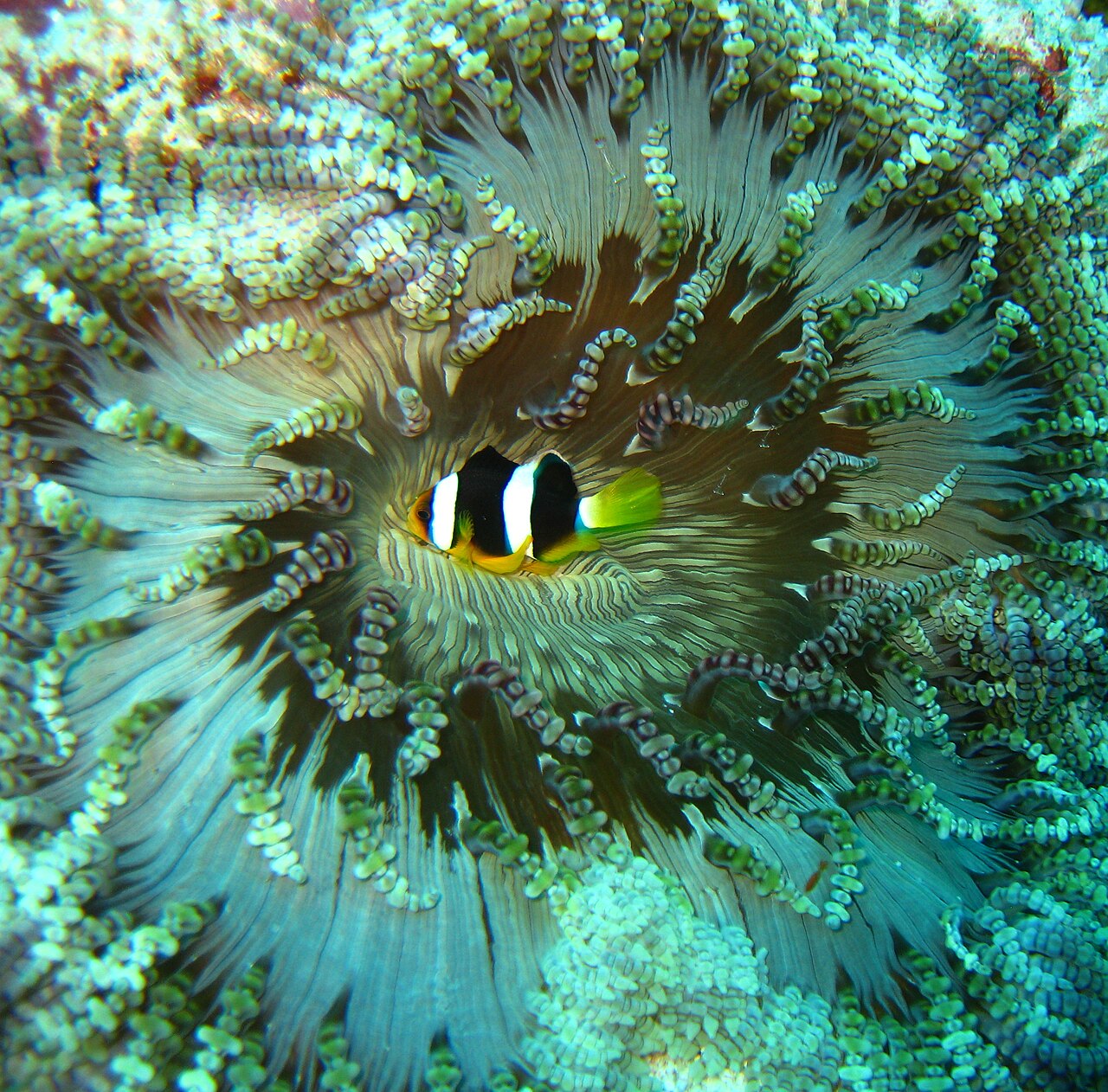
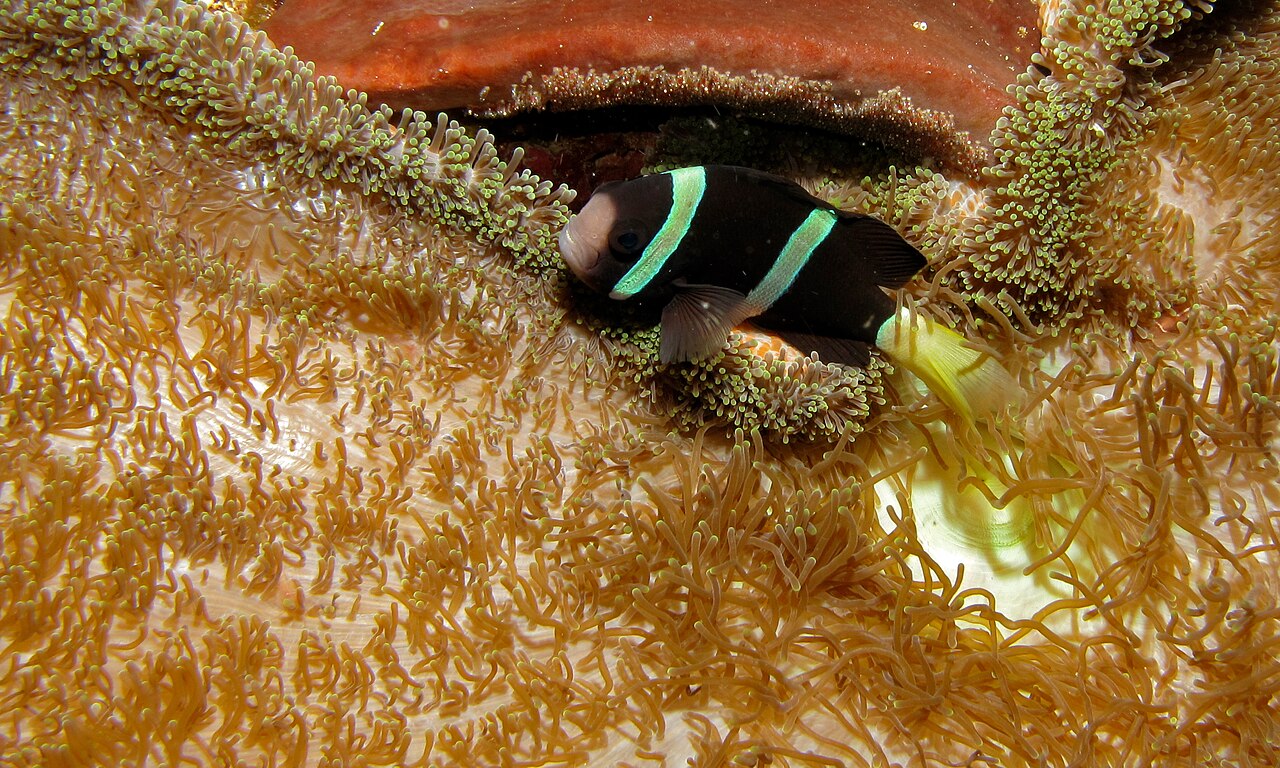
Clark's anemonefish shows the greatest color variations of any anemonefish, with variations based on location, sex, age and host anemone. Adults in Vanuatu and New Caledonia are orange-yellow with two vertical white bands. Sex related color differences may be present, such as the female having a white caudal fin and the male having a yellow caudal fin. Juveniles are orange-yellow with vertical white bands. Fish living with the host anemone Stichodactyla mertensii, Mertens' carpet sea anemone are frequently black except for the snout bars and tail.
The caudal fin is forked and the base lacks a white bar on A. latifasciatus. The caudal fin lacks the sharp demarcation between white and dark and the mid-body bar is narrower on A. allardi and A. akindynos. The caudal fin is dark on A. chrysogaster, A. fuscocaudatus and A. tricinctus.
Clark's anemonefish is the most widely distributed anemonefish, being found in tropical waters from the Indian Ocean to the Western Pacific. These anemonefish most commonly occupy reef biomes at 1 to 60 meters in areas with host anemones (Moore, Billy).
Clark's anemonefish is the least host specific anemonefish, living in association with all ten species of sea anemones that host anemonefish:
Stichodactyla mertensii Mertens' carpet sea anemone
The specific name and the common name both honour the Scottish engraver John Heaviside Clark (1771–1836) who provided illustrations for Bennett's A Selection from the most remarkable and interesting Fishes found on the Coast of Ceylon, from drawings made in the Southern part of that Island.
Source: Wikipedia: Clark's anemonefish — https://en.wikipedia.org/wiki/Clark%27s_anemonefish (CC BY-SA 4.0). Accessed 2026-09-23.
Gallery
Related in Clark's anemonefish
Links follow this subject's own source article.
Elsewhere in Clark's anemonefish
Spotted an error? Know more?
Reader corrections go straight into our review queue. Suggest an edit · How this site is sourced