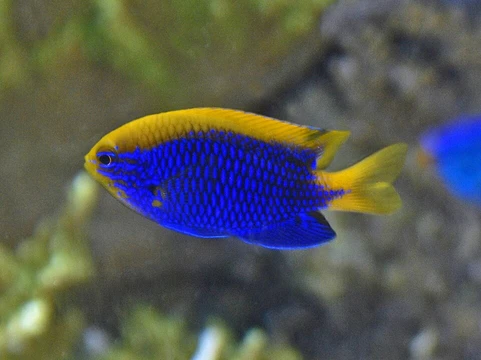
Starck's demoiselle (Chrysiptera starcki)
Source-cited species reference: taxonomy from WoRMS, biology from FishBase, occurrence map from GBIF, conservation from IUCN Red List, description from Wikipedia, aquarium from Wikipedia (cited section).

Chrysiptera starcki, commonly known as Starck's demoiselle or Starck's damselfish, is a species of damselfish in the family Pomacentridae. It is native to the western Pacific Ocean, where it has been reported from the Ryukyu Islands and Taiwan to Australia, New Caledonia, and Tonga. It was originally described in 1973 as Abudefduf starcki.
- Scientific name
- Chrysiptera starcki
- Authority
- (Allen, 1973)
- Family
- Pomacentridae
- Order
- Ovalentaria incertae sedis
- Maximum length
- 7 cm
- Depth range
- 20–60 m
- Habitat zone
- reef-associated
- Iucn red list
- Least Concern
- Gbif occurrence records
- 117
Classification (WoRMS)
Full classification as recorded by WoRMS: Kingdom: Animalia · Phylum: Chordata · Class: Teleostei · Order: Ovalentaria incertae sedis · Family: Pomacentridae · Genus: Chrysiptera.
Accepted name: Chrysiptera starcki · Authority: (Allen, 1973) · Taxonomic status: accepted · AphiaID: 276844.
Synonyms and superseded combinations recorded for this taxon: Abudefduf starcki Allen, 1973; Chrysiptera starki (Allen, 1973); Chryspetera starcki (Allen, 1973); Glyphidodontops starcki (Allen, 1973).
Source: World Register of Marine Species (WoRMS) — https://www.marinespecies.org/aphia.php?p=taxdetails&id=276844 (CC BY 4.0). Accessed 2026-09-23.
Biology and life history (FishBase)
Measured values published by FishBase for Chrysiptera starcki. Only fields the database actually holds for this species are shown; these are database values, not aquarium guidance.
Maximum length: 7 cm · Depth range: 20–60 m · Habitat zone: reef-associated · Body shape: fusiform / normal · Vulnerability index: 10 of 100.
FishBase notes: Adults inhabit rocky outcrops and crevices that are frequently situated in sand channels on outer reef slopes. Common in deeper sections of the outer reef about 20 to 60 m in depth (Ref. 7247). Oviparous, distinct pairing during breeding (Ref. 205). Eggs are demersal and adhere to the substrate (Ref. 205). Males guard and aerate the eggs (Ref. 205). Diurnal species (Ref. 54980; 113699).
Source: FishBase species summary (SpecCode 6601) — https://www.fishbase.se/summary/Chrysiptera-starcki.html (CC BY-NC 3.0 — non-commercial use only). Accessed 2026-09-23.
Distribution and occurrence records (GBIF)
117 georeferenced occurrence records for Chrysiptera starcki are published through GBIF from 10 countries or marine areas. The map above plots 50 distinct locations from a sample of 117 records, omitting 5 inland records that carry an institution's coordinates rather than a collection site; it shows where the species has been observed and reported, not a modelled range.
Most records by country or area: Japan (39); New Caledonia (33); Tonga (16); Australia (15); Chinese Taipei (4); Fiji (3); Wallis and Futuna (3); Philippines (2); Malaysia (1); Vanuatu (1).
Source: GBIF Occurrence Search (taxonKey 2399328) — https://www.gbif.org/occurrence/search?taxon_key=2399328&has_coordinate=true (records CC0 / CC BY); WoRMS distribution records (MarineRegions) — https://www.marinespecies.org/aphia.php?p=taxdetails&id=276844 (CC BY 4.0); Natural Earth 110m basemap — https://www.naturalearthdata.com/ (public domain). Accessed 2026-09-23.
Conservation status (IUCN Red List)
The IUCN Red List assesses Chrysiptera starcki (Allen, 1973) as Least Concern (code LC). No trend, population estimate or threat analysis is given here, because none is available from this source without the Red List API; follow the source link for the full assessment, including its date.
Source: IUCN Red List of Threatened Species (taxon 188583) — https://www.iucnredlist.org/species/188583/0; GBIF IUCN Red List category endpoint (taxonKey 2399328) — https://api.gbif.org/v1/species/2399328/iucnRedListCategory. Accessed 2026-09-23.
Description and natural history (Wikipedia)
The specific name honours the marine biologist Walter A Starck II who pointed out this species out to Gerald R. Allen while diving with him at Osprey Reef in the Coral Sea.
Starck's demoiselle is blue with a yellow stripe down its back. It grows up to 7 cm in length.
The fish lives around reefs, often in deeper, outer areas, up to 60 m deep. It lives in crevices in rocky areas. It pairs up to breed and the male guards and tends the eggs. In the wild, Starck's demoiselle will eat plankton (both zooplankton and phytoplankton).
When breeding, males will swim back and forth swiftly flashing their colors to attract females. Males will prepare a territory full of rubble for the female to lay her eggs. Then the male will fertilize them and aggressively defend them from intruders.
This is a highly desired fish for a saltwater aquarium. Shallow waters are best for the fish. It can be very colorful if fed the correct diet. The minimum aquarium size is 76 L. The tank should be decorated with rocks or gravel and should have many hiding places for the fish. It is not a very aggressive fish, but as it gets bigger it may harass smaller, more passive fish. Two of them together in a tank will fight, however. They are very easy to keep in captivity. They will eat many different types of foods in captivity.
Source: Wikipedia: Chrysiptera starcki — https://en.wikipedia.org/wiki/Chrysiptera_starcki (CC BY-SA 4.0). Accessed 2026-09-23.
Spotted an error? Know more?
Reader corrections go straight into our review queue. Suggest an edit · How this site is sourced